
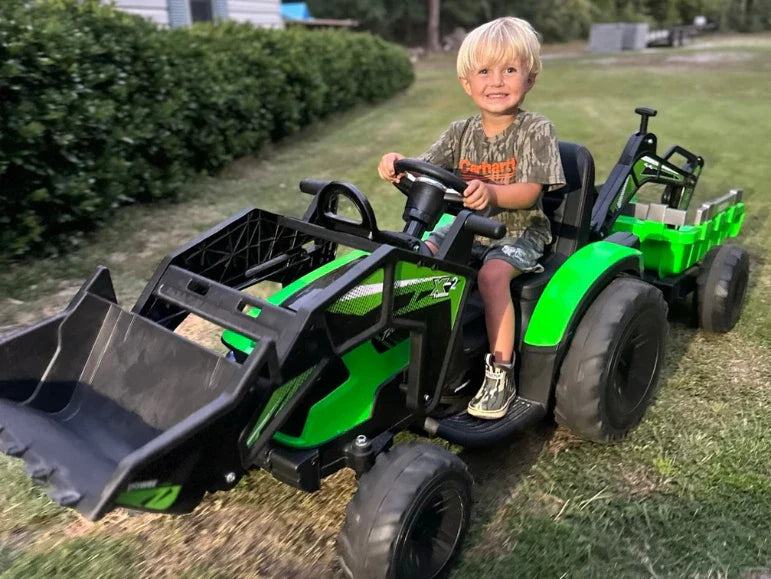
You've just watched your child's eyes light up as they climb into their new ride-on truck for the first time. The engine hums to life, they hit the gas, and you're already wondering: how long is this magic going to last before I need to recharge?
If you're researching ride-on toys in 2026, you've probably noticed that battery specs vary wildly. Some toys promise 30 minutes of runtime, others claim hours. Some run on 6V systems, others on 24V powerhouses. And if you're like most parents, you're wondering what all these numbers actually mean for your Saturday afternoon in the backyard.
Let's break down everything you need to know about ride-on toy battery life, from real-world run times to the maintenance habits that can double your battery's lifespan.
Understanding Ride-On Toy Battery Voltages: 6V vs 12V vs 24V
The voltage of a ride-on toy battery determines two critical things: how much power it delivers and how long it lasts. Think of voltage like the size of your vehicle's gas tank combined with the power of its engine. Higher voltage doesn't just mean more speed, it means longer adventure time before the battery runs out.
6V Battery Systems: Perfect for Toddlers
A 6-volt battery is the entry point for ride-on toys, designed specifically for toddlers ages 1-3. These systems are gentle, safe, and perfectly matched to a young child's attention span and physical abilities.

Our Little Ones First Digger runs on a 6V system and delivers around 45 to 60 minutes of continuous play time on a full charge. That might not sound like much compared to higher-voltage systems, but for a toddler, that's an eternity. Most kids this age are ready for snack time or a diaper change well before the battery dies.
The slower speeds (around 3.5 mph max) also mean the motor isn't working as hard, which extends battery life. You're looking at a toy that matches both the physical capabilities and the attention span of your little one.
12V Battery Systems: The Middle Ground
The 12-volt battery is the workhorse of budget-friendly ride-on toys. You'll find these in many big-box store options and entry-level electric vehicles. Run time typically ranges from 60 to 90 minutes depending on terrain, rider weight, and how aggressively your child drives.
While we don't carry 12V systems at Tough Trucks For Kids, it's worth understanding where they fit in the market. They're a step up from 6V toys in both speed and runtime, but they often struggle on anything other than flat pavement. Hills, grass, and gravel drain these batteries quickly, and the motors simply don't have the torque to power through tougher terrain without significant battery strain.
24V Battery Systems: Built for Real Adventures
This is where things get serious. A 24-volt battery system is what separates a toy from a legitimate outdoor adventure vehicle. These dual-battery setups deliver substantially longer run times, typically between 1.5 to 3 hours depending on conditions, and they maintain that performance even when your child is hauling gravel, climbing inclines, or tearing through the backyard.

All of our premium ride-on vehicles, from the Big Kahuna Dump Truck to the Forklift 9000, run on 24V systems paired with dual high-performance motors. This isn't just about speed, it's about consistent power delivery that doesn't fade as the battery drains.
Parents consistently report 2+ hours of active play time with our 24V vehicles under normal conditions. That's enough for a full afternoon of construction site role-play, backyard expeditions, and legitimate work hauling mulch or helping dad move firewood.
What Actually Affects Battery Life in Real-World Use
The manufacturer's listed run time is calculated under ideal laboratory conditions: flat surface, minimum weight, moderate temperature, constant speed. Your backyard is not a laboratory. Here's what actually impacts how long your ride-on toy will run on a single charge.
Rider Weight and Cargo
The heavier the load, the harder the motor works, and the faster the battery drains. Most ride-on toys list a maximum weight capacity, but that doesn't mean battery life is consistent across that range.
A 40-pound child riding solo will get significantly more runtime than a 70-pound child hauling a wagon full of rocks. This is especially noticeable with working vehicles like our Big Digger Tractor, where kids love to scoop up dirt and gravel. The battery doesn't mind the workout, but expect 20-30% less runtime when your child is actively using the digging and hauling features.
Terrain Makes a Massive Difference
Flat, smooth pavement is the battery's best friend. Grass, gravel, mulch, and hills are its enemies. Not because these surfaces damage the battery, but because they require exponentially more power to traverse.
Climbing a 10-degree incline can cut your runtime in half compared to flat ground. Thick grass or gravel creates constant resistance that drains batteries 30-40% faster than pavement. This is where the power advantage of a 24V system really shines, it has the torque reserves to handle tough terrain without completely depleting the battery in 20 minutes.

Driving Style: Stop-and-Go vs Steady Cruising
Constant acceleration and braking drains batteries faster than steady driving. If your child is the type to floor it, slam the brakes, reverse, and repeat, you're looking at 15-20% less runtime compared to a kid who cruises at a steady pace.
Working vehicles actually get better battery life during "productive" play, loading, hauling, and dumping, than during aggressive racing and donuts. The motors are designed for torque and sustained work, not constant rapid acceleration.
Temperature and Weather
Batteries perform best between 60-80°F. Cold weather (below 40°F) can reduce runtime by 20-30% because the chemical reactions inside the battery slow down. Extreme heat (above 95°F) also decreases performance and can shorten overall battery lifespan.
This doesn't mean you can't use your ride-on toy in winter or summer, just set expectations accordingly and avoid storing the battery in extreme temperatures when not in use.
How to Make Your Ride-On Toy Battery Last Longer
Proper battery care isn't complicated, but it makes the difference between a battery that lasts one season and one that delivers 3-5 years of reliable performance. Here's what actually works.
Charge It Fully Before First Use
This is the most commonly ignored instruction in the manual, and it matters. New batteries need an initial full charge cycle (usually 18-24 hours for the first charge) to reach their full capacity potential. Skipping this step can permanently reduce your battery's maximum charge capacity.
Yes, it's brutal to make your excited child wait a full day before their first ride. But that initial charge sets the foundation for years of battery health.
Don't Let It Fully Drain (Usually)
Lead-acid batteries, which most ride-on toys use, don't like being completely drained. When the vehicle starts slowing down noticeably, it's time to recharge. Repeatedly running the battery until the vehicle won't move can shorten its lifespan by 50% or more.
The exception: once every few months, a complete drain and full recharge cycle can actually recalibrate the battery and maintain capacity. But this should be the exception, not the rule.
Recharge Promptly After Use
Don't leave a drained battery sitting for days or weeks before recharging. Lead-acid batteries self-discharge over time, and if they sit too long in a depleted state, they can sulfate, which permanently reduces capacity.
Make it a habit: when the kids are done playing, put the vehicle on the charger. It doesn't need to charge immediately, but don't let days go by before plugging it in.

Use the Correct Charger
Always use the charger that came with your vehicle or an exact replacement specified by the manufacturer. The wrong charger can overcharge or undercharge your battery, both of which cause permanent damage.
A 6V charger won't fully charge a 12V battery. A 12V charger can overcharge and destroy a 6V battery. This seems obvious, but with multiple ride-on toys in the garage, chargers get mixed up more often than you'd think.
Store It Properly During Off-Season
If you're putting the ride-on toy away for winter or storing it for an extended period, charge the battery to 100%, then disconnect it from the vehicle. Store the battery in a cool, dry place (ideally 50-70°F), and recharge it every 4-6 weeks even if it's not being used.
Batteries that sit unused for months without maintenance charging will sulfate and lose capacity permanently. This is the number one reason batteries "die" over winter, they weren't maintained.
When to Replace Your Ride-On Toy Battery
Even with perfect maintenance, batteries don't last forever. Here's how to know when it's time for a replacement.
Signs Your Battery Is Failing
The most obvious sign is reduced runtime. If your 24V truck used to run for 2+ hours and now dies after 45 minutes, the battery is losing capacity. This is normal after 2-3 years of regular use, but if it happens within the first year, something went wrong.
Other warning signs include the vehicle struggling on terrain it used to handle easily, slower top speeds, or the battery not holding a charge overnight. If you charge it fully and it's dead the next morning without being used, the battery has an internal short or severe sulfation.
Expected Battery Lifespan
With proper care, a quality ride-on toy battery should last 3-5 years. Budget batteries from discount retailers often fail within 1-2 years. The quality of the battery matters as much as how you treat it.
All Tough Trucks For Kids vehicles come with premium batteries matched to high-performance motors. Our customers regularly report 3+ years of reliable performance with normal seasonal use. We also back everything with a 90-day bumper-to-bumper warranty and American-based customer support if you ever run into issues.
Replacement Battery Cost and Options
Replacement batteries for ride-on toys typically cost between $30-$80 depending on voltage and quality. Always replace with the same voltage and similar amp-hour (Ah) rating as the original.
Higher Ah ratings mean longer runtime, so if you're replacing a battery anyway, consider upgrading to a higher capacity option if one is compatible with your vehicle's charging system.
Why 24V Systems Are Worth the Investment
If you're deciding between a budget 6V or 12V ride-on toy and a premium 24V vehicle, the battery life difference alone justifies the cost for most families.

A 6V toy delivers 45-60 minutes of play. A quality 24V system delivers 2-3 hours. That's the difference between one quick loop around the yard and an entire afternoon of screen-free outdoor adventure. For kids ages 3-8 who have the stamina and attention span for extended play, the extra runtime transforms the experience.
Beyond runtime, 24V batteries maintain consistent power as they drain. Cheaper batteries start slowing down at 50% charge. Our 24V systems in vehicles like the Mongoose ATV Quad deliver full speed and torque until the battery is nearly depleted, which means your child's play experience doesn't gradually degrade over the course of the afternoon.
The Bottom Line on Ride-On Toy Battery Life
Battery life isn't just about numbers on a spec sheet. It's about whether your child gets 20 minutes of playtime or 2 hours. It's about whether the truck can actually haul gravel or just crawls on flat pavement. It's about whether the battery lasts one season or five years.
For families serious about outdoor play, screen-free adventure, and toys that grow with their kids, a 24V system isn't a luxury, it's the foundation of everything else. The extra runtime, consistent power delivery, and durability mean your investment pays off in thousands of hours of active play.
If you're ready to explore ride-on vehicles built for real adventure, backed by a veteran-owned business that specializes exclusively in premium construction toys, check out our full lineup. Every vehicle ships 80% pre-assembled from our LA warehouse, arrives in 2-5 days, and comes with a 90-day bumper-to-bumper warranty. Because building tomorrow's builders starts with tools, and toys, that actually work.
Frequently Asked Questions
How long does a 24V ride-on battery last per charge?
A quality 24V ride-on toy battery typically lasts 1.5 to 3 hours on a full charge under normal conditions. Actual runtime depends on rider weight, terrain, driving style, and temperature. Flat pavement and steady cruising maximize runtime, while hills, gravel, and stop-and-go driving reduce it. Our 24V vehicles consistently deliver 2+ hours of active play for most families.
How often should I charge my child's ride-on toy battery?
Charge the battery after each use, or at minimum before it's completely drained. Lead-acid batteries (used in most ride-on toys) last longest when kept charged and shouldn't be stored in a depleted state. If the vehicle is in regular use, charge it overnight after each play session. During off-season storage, recharge every 4-6 weeks even if not being used.
Can I upgrade to a higher voltage battery for more runtime?
No, you cannot safely upgrade voltage beyond what the vehicle is designed for. A 6V vehicle cannot handle a 12V battery, the motors, wiring, and controller aren't rated for the extra voltage and will burn out. However, you can upgrade to a higher amp-hour (Ah) battery of the same voltage, which will increase runtime without damaging the system.
Why does my ride-on toy battery die faster in winter?
Cold temperatures slow down the chemical reactions inside lead-acid batteries, reducing their effective capacity by 20-30% when temperatures drop below 40°F. The battery isn't damaged, it just can't deliver its full power in cold weather. Storing the battery indoors between uses and allowing it to warm to room temperature before charging helps maintain performance during winter months.
How long do ride-on toy batteries last before they need replacement?
With proper care, a quality ride-on toy battery should last 3-5 years. This assumes regular use, proper charging habits, and seasonal maintenance. Batteries that are repeatedly fully drained, left uncharged for extended periods, or exposed to extreme temperatures will fail sooner, often within 1-2 years. Budget batteries from discount retailers typically have shorter lifespans than premium batteries included with higher-quality vehicles.

Leave a comment
This site is protected by hCaptcha and the hCaptcha Privacy Policy and Terms of Service apply.