
You have done the research. You know what kind of ride-on toy your child needs — the right voltage, the right age range, the right features. Now comes the question that trips up more parents than any specification sheet ever could: where do you actually buy it?
The answer matters more than most parents realize. Where you purchase a ride-on toy directly affects the quality of what you receive, the warranty protection you get, the speed of delivery, the level of customer support available when something goes wrong, and even whether the product in the box matches the one in the listing. In 2026, parents searching for ride-on toys for sale are confronted with an overwhelming number of options — big-box retail stores, Amazon marketplace listings, niche online shops, social media ads, and direct-to-consumer brands that sell exclusively through their own websites.
Not all of these channels are created equal. Some are excellent. Some are acceptable. And some are outright risky, exposing you to counterfeit products, nonexistent warranties, and customer service that vanishes the moment your payment clears.
This guide will walk you through every major option for where to buy ride-on toys in 2026. We will cover the genuine advantages and hidden risks of each channel, give you a clear framework for evaluating any seller before you spend a dollar, and explain why an increasing number of informed parents are choosing specialist direct-to-consumer brands over mass-market retailers. By the end, you will know exactly where to buy — and precisely what to avoid.

The Major Channels: Where Parents Buy Ride-On Toys in 2026
Before we get into recommendations, it helps to understand the landscape. Parents looking for ride-on toys for sale typically encounter four main purchasing channels, and each has a distinctly different buying experience.
Big-Box Retailers: Walmart, Target, and Costco
Big-box stores like Walmart, Target, and Costco remain the most visible option for many families. You can walk into a store, see a ride-on toy on the shelf, and take it home that day. There is comfort in that tangibility, and it is the reason big-box retailers still command a significant share of the ride-on toy market.
But the reality of what those stores carry deserves closer scrutiny. Big-box retailers optimize for breadth and price, not depth and quality. They stock dozens of ride-on brands at the lowest possible price points because their business model depends on high volume and thin margins. The ride-on toys you find at Walmart for $149 or $199 are typically 6V or 12V models with plastic frames, plastic wheels, basic motors, and minimal warranty coverage. They look attractive in the packaging, but they are engineered to hit a price point — not to last.
That is not to say every product in a big-box store is bad. You can occasionally find decent 24V ride-on toys at Costco or Target. But the selection is limited, the staff rarely has specialized knowledge about ride-on vehicles, and the return policies — while generally good — are no substitute for a genuine bumper-to-bumper warranty with manufacturer support.
The other issue is discovery. If you are searching for where to buy ride-on construction vehicles for kids or where to buy an excavator ride-on toy, a big-box retailer's toy aisle will offer you licensed character cars and generic ATVs. Finding specialized construction ride-on toys at these stores is the exception, not the rule.
Amazon Marketplace: The Convenience Trap
Amazon is probably the first place most parents look when searching for 24V ride-on toys for sale or toddler ride-on toys for sale. The convenience is undeniable — Prime shipping, customer reviews, easy returns, and a massive selection that covers every price point and category imaginable.
But Amazon's greatest strength is also its most significant risk. The marketplace model means that anyone can list a ride-on toy for sale, and the line between legitimate brands and opportunistic sellers has become increasingly blurred. Search for "24 volt ride on toys for sale" on Amazon and you will find dozens of listings with professional photos, competitive prices, and suspiciously similar product descriptions. Many of these are white-label products manufactured at the lowest possible cost, rebranded with a name you have never heard of, and listed by sellers who may not exist in six months.
This creates real problems for parents. When you buy a ride-on toy from an unknown Amazon seller, you are often getting a product with no meaningful warranty, no US-based customer support, and no recourse if a part fails three months after purchase. The Amazon return window helps for immediate defects, but ride-on toy problems frequently surface after weeks or months of use — well outside the standard return period. If the seller has disappeared by then, you are on your own.
There is also the issue of counterfeit and knockoff products. Established ride-on toy brands have documented cases of their product photos and descriptions being copied by unauthorized sellers offering inferior lookalike products at lower prices. Parents think they are getting a deal. What they are actually getting is a vehicle with cheaper motors, lower-grade batteries, thinner frames, and zero safety testing from the original manufacturer.
Social Media Ads and Drop-Shipping Stores
If you spend any time on Facebook, Instagram, or TikTok, you have seen them: flashy video ads showcasing ride-on toys at what appear to be incredible prices. "50% off — today only!" These ads typically lead to standalone websites with limited product selections, generic branding, and checkout pages that feel hastily assembled.
Many of these stores are drop-shippers. They do not hold inventory. They do not manufacture anything. They take your order, forward it to a factory (often overseas), and that factory ships directly to you — often with shipping times measured in weeks rather than days. The product you receive may or may not match the one in the ad. Customer support, if it exists, is typically an email address that takes days to respond. Warranty coverage is effectively nonexistent.
This is the highest-risk channel for buying ride-on toys, and we strongly recommend avoiding it entirely. The low prices are appealing, but the total cost — including the likely need to replace the product within a year — almost always exceeds what you would have paid for a quality option from a reputable source.
Specialist Direct-to-Consumer (DTC) Brands
The fourth option, and the one that has grown most significantly in recent years, is purchasing directly from a specialist brand's own website. Direct-to-consumer ride-on toy companies design, source, and sell their own products without the intermediary of Amazon or Walmart. They control the entire experience — from product engineering to shipping to customer support to warranty service.
This model has distinct advantages that we will explore in detail throughout this article. For now, the key differentiator is specialization. A DTC brand that focuses exclusively on ride-on construction vehicles is fundamentally different from a big-box retailer that happens to stock a few ride-ons alongside thousands of other toys. That focus translates into deeper product expertise, higher quality standards, more responsive support, and a buying experience designed specifically for the parents who care most about getting this purchase right.

What to Look for When Buying Ride-On Toys Online
Regardless of where you shop, there are specific quality signals that separate trustworthy sellers from ones that will leave you frustrated. If you are in the market for a kids ride on tractor for sale, a dump truck ride-on for sale, or any 24V ride-on for that matter, these are the criteria that should guide your decision. For a deeper dive into the technical specifications and features to evaluate, our complete ride-on toy buying guide for 2026 covers every detail.
Transparent Product Specifications
A trustworthy seller provides clear, specific technical information. You should be able to find the exact battery voltage, motor wattage, weight capacity, tire material, frame construction, and age range without digging through marketing fluff. If a product listing talks extensively about "fun" and "exciting colors" but tells you nothing about what the vehicle is actually built from, that is a red flag.
Look for concrete numbers. Dual 550W motors tells you something specific. "Powerful motor" tells you nothing. A 24V battery system with stated charge time and ride time is informative. "Long-lasting battery" is marketing. The more precise the specifications, the more confident you can be that the seller knows and stands behind their product.
Real Customer Reviews with Photos
Reviews matter, but the type of reviews matters more than the star rating alone. What you want to see is volume, consistency, and photo evidence. A product with 1,000+ reviews maintaining a 4.9-star average is showing you statistical proof of quality. A product with 23 five-star reviews, all posted within the same week, should raise immediate suspicion.
Customer photos are especially valuable for ride-on toys because they show you the real product in real conditions — not a staged studio shot with perfect lighting. You can see actual size proportions with real children, real terrain performance, and real build quality that no marketing photo can replicate. Brands that encourage and display user-generated content are signaling confidence in how their products actually perform in the field.
Warranty Coverage That Actually Covers Things
This is where many parents get burned. A "warranty" means nothing without understanding exactly what it covers. Many ride-on toy sellers offer 30-day warranties that exclude batteries, motors, tires, and electronics — which are conveniently the components most likely to fail. That is not a warranty. That is a return policy dressed up in better language.
A genuine warranty should cover the entire vehicle — bumper to bumper — for a meaningful period. Ninety days is the standard for quality ride-on toy manufacturers. It should include the battery, the motors, the electrical system, the frame, and the working mechanisms. And it should be backed by customer support that is actually reachable, knowledgeable, and empowered to solve problems. As we explain in our guide to the most durable ride-on toys, warranty coverage is one of the strongest signals a manufacturer sends about their confidence in their own product.
US-Based Customer Support
When your child's ride-on toy has an issue — a battery question, an assembly challenge, a part that needs replacing — you want to talk to someone who understands the product, can diagnose the problem, and can ship you a solution quickly. US-based customer support is not just a nice-to-have. It is a practical necessity for a product category that involves assembly, electrical systems, and moving parts.
Many Amazon sellers and drop-shipping operations route customer support through overseas call centers or email-only systems with multi-day response times. When your child is staring at a non-functional ride-on toy on a Saturday morning, waiting 72 hours for an email response from an overseas support team is not an acceptable experience.
Shipping Speed and Delivery Experience
Ride-on toys are large, heavy products. Shipping logistics matter. Where is the product shipping from? How long will it take to arrive? Is it shipping via standard ground freight, or does the seller maintain domestic warehouse inventory that enables fast delivery?
A ride-on truck for sale from a US-based warehouse will typically arrive in two to five business days. A ride-on toy for sale from an overseas manufacturer shipping direct-to-consumer can take three to six weeks — and in some cases, arrives damaged from inadequate packaging during a transpacific journey. The difference in the unboxing experience alone is significant. Domestic-shipped products arrive in packaging designed to survive a US carrier network. Internationally shipped products often do not.
Red Flags When Buying Cheap Ride-On Toys
Now that you know what to look for, let us talk about what to actively avoid. These red flags should stop your purchase in its tracks, regardless of how appealing the price seems.
Prices That Seem Too Good to Be True
A genuine 24V ride-on toy with dual 500W+ motors, EVA tires, metal frame components, and working mechanisms cannot be manufactured, shipped, and sold at a profit for $149. It is physically impossible. The raw materials alone cost more than that. If you are seeing 24 volt ride on toys for sale at dramatically lower prices than established brands, you are not finding a deal — you are finding corners that have been cut.
Those corners show up as thinner plastic, cheaper motor windings, lower-quality battery cells, and reduced safety testing. They may not be visible in a product photo, but they will be painfully obvious after a few months of use. In our analysis of the best ride-on toys under $500, we found that the sweet spot for quality and value requires a certain minimum investment — and anything dramatically below that threshold comes with significant compromises.
No Brand Identity or History
Before buying from any seller, do a quick background check. Does the brand have a real website beyond the Amazon listing? Do they have an "About Us" page with actual people and a real story? Can you find them on social media with genuine customer interactions — not just ads? Have they been in business for more than a few months?
A brand with no discernible history, no social proof, and no identity beyond a product listing is a significant risk. These entities pop up, sell aggressively for a few months, and then disappear — along with any hope of warranty service or replacement parts. Established brands, by contrast, have reputations they need to protect and communities they serve. That accountability matters when something goes wrong.
Vague or Missing Safety Information
Ride-on toys are children's products, and children's products are subject to specific safety regulations in the United States. Reputable manufacturers test their products to ASTM F963 standards and provide clear documentation of compliance. If a product listing includes no mention of safety standards, certifications, or testing, treat that as a warning sign.
Safety is not just about regulatory compliance, either. It includes design decisions like seat belts, parent remote control override, speed limiters, gradual acceleration to prevent jerky starts, and low center-of-gravity engineering to prevent tipping. A product listing that says nothing about safety features is telling you that safety was not a priority in the design process.
Shipping from Unknown or Overseas Origins
Check the shipping origin before you purchase. "Ships from China" or "Delivery in 3-6 weeks" are strong indicators that you are buying from a drop-shipper or direct-from-factory operation. These products often arrive without English instruction manuals, with different components than pictured, and with no domestic support infrastructure if something is wrong or missing from the box.
Additionally, ride-on toys shipped internationally are more prone to transit damage. These are heavy products with complex assemblies, and a journey across an ocean in a shipping container exposes them to vibration, temperature extremes, and handling that domestic shipments simply do not experience.

Why Specialist DTC Brands Deliver Better Value
We have covered the risks of various channels. Now let us talk about why specialist direct-to-consumer brands have become the preferred choice for parents who take ride-on toy purchases seriously. This is not about brand loyalty or marketing — it is about structural advantages that directly benefit the customer.
Specialization Means Expertise
A company that does one thing has no choice but to do it well. When a brand focuses exclusively on ride-on construction vehicles — not stuffed animals, not board games, not general toys — every decision is made through the lens of building the best possible ride-on experience. The engineering team thinks about ride-on performance every day. The customer support team answers ride-on questions every day. The product development roadmap is dedicated entirely to making better ride-on vehicles.
Contrast this with a big-box retailer that stocks 40,000 products across hundreds of categories. The buying team allocating shelf space to ride-on toys is the same team evaluating puzzles, action figures, and art supplies. Their expertise is in retail logistics, not in whether a 24V dual-motor system with EVA tires outperforms a 12V single-motor setup on grass. That depth of knowledge lives with the specialist, not the generalist.
Direct Relationship Means Better Prices
When you buy a ride-on toy from a big-box retailer or Amazon, the retail price includes the manufacturer's margin plus the retailer's margin. The retailer's cut typically adds 30-50% to the end price. A direct-to-consumer brand eliminates that middleman entirely. The savings can be passed to the customer through lower prices, invested in higher-quality components, or both.
This is why a DTC brand can offer a premium 24V ride-on with dual 550W motors, EVA tires, and a working dump bed for a price competitive with the mid-range options at Walmart — while delivering dramatically higher quality. The math works because there is no retailer taking a cut between the manufacturer and the family.
Accountability Without Intermediaries
When you buy from a brand's own website, there is no ambiguity about who is responsible for your experience. The brand designed the product, the brand shipped it, and the brand stands behind it. If there is a problem, you contact the brand directly — not a marketplace customer service team reading from a script, not a retailer's returns department that has never seen the product in person.
This direct accountability creates a powerful incentive for quality. A DTC brand's reputation is built entirely on customer experience. Every review, every social media post, every word-of-mouth recommendation comes from a customer who bought directly and can attribute their experience directly to the brand. There is nowhere to hide and no one else to blame. That pressure produces better products and better service.
The Tough Trucks Buying Experience: What DTC Done Right Looks Like
To illustrate what a specialist DTC buying experience actually looks like in practice, let us walk through the specifics of purchasing from Tough Trucks For Kids — a veteran-owned brand that specializes exclusively in ride-on construction vehicles and has built one of the most respected operations in the category.
Curated Selection, Not Overwhelming Choice
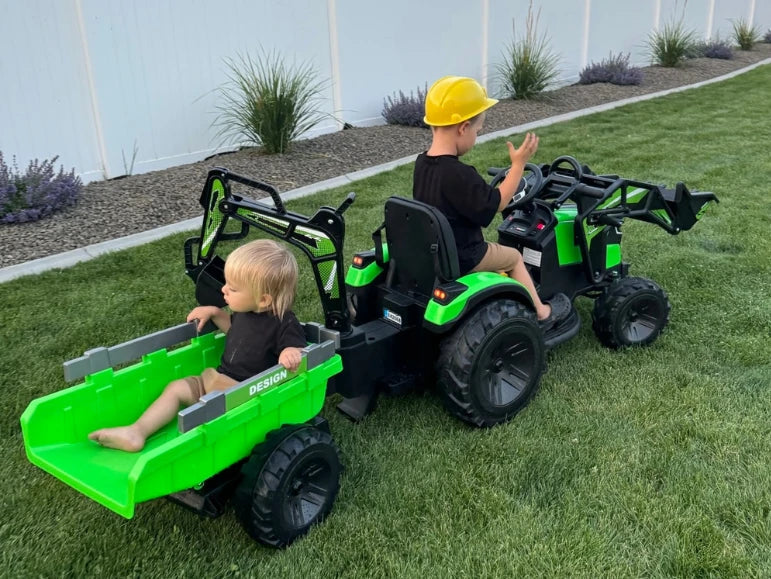
Instead of listing hundreds of generic ride-on toys, Tough Trucks offers a carefully curated lineup of five vehicles, each designed for a specific age range and play style. Whether you are looking for where to buy a ride-on tractor, where to buy a dump truck ride-on, or where to buy an excavator ride-on toy, the selection is focused and intentional. The Big Kahuna Dump Truck with its working electric dump bed and dual 550W motors. The Forklift 9000 with genuine 22-pound lifting capability. The Big Digger Tractor with its working front scooper and rear digger on an all-metal frame. The Little Ones First Digger designed specifically for toddlers ages one to three. And the Mongoose ATV Quad with a touch screen control center and four-wheel shock absorbers.
This curated approach makes the buying decision simpler and more confident. You are not sifting through 200 listings trying to separate quality from junk. You are choosing from a focused collection where every option meets the same high standard for materials, engineering, and play value.
Lightning-Fast Shipping from a US Warehouse
Every Tough Trucks order ships from their warehouse in Los Angeles. Not from a factory overseas. Not from a distribution center that may or may not have inventory. From a real warehouse in LA stocked with real inventory, shipping via major US carriers with standard two-to-five-day delivery. For parents searching for ride-on construction vehicles for kids for sale with fast delivery, this domestic shipping infrastructure makes a meaningful difference — especially when you are buying for a birthday, holiday, or simply cannot wait three weeks for your child's excitement to arrive.
Arrives 80% Pre-Assembled
One of the most common complaints about ride-on toys purchased from any channel is assembly. Parents open the box expecting a straightforward 30-minute project and find themselves surrounded by 200 unlabeled screws, instructions translated from another language, and a growing sense of regret. Tough Trucks vehicles ship 80% pre-assembled, reducing setup time to 30-45 minutes with clear, well-illustrated instructions. The experience is designed so that the vehicle goes from box to backyard as quickly and painlessly as possible.
90-Day Bumper-to-Bumper Warranty
Every Tough Trucks vehicle comes with a 90-day bumper-to-bumper warranty — covering the motors, battery, frame, electrical system, tires, working mechanisms, and every other component on the vehicle. This is not a limited warranty that excludes the parts most likely to need attention. It is a comprehensive commitment that covers the entire product. Behind that warranty is American-based customer support available Monday through Friday, 9am to 4pm, staffed by people who know these vehicles inside and out.
Proven by Thousands of Families
Across the Tough Trucks product lineup, the combined review count exceeds 3,600 verified customer reviews with a consistent 4.9-star average. The Big Kahuna Dump Truck alone has over 1,781 reviews. The Forklift 9000 has more than 1,200. These are not inflated numbers from a paid review service — they are real feedback from real families who bought, built, and put these vehicles to work in their backyards. That kind of sustained quality at volume is impossible to fake and exceedingly difficult to achieve.

Matching the Right Product to Your Search
Parents arrive at the where-to-buy question from many different starting points. Some know exactly what they want. Others are still narrowing it down. Here is a quick guide to matching common search needs with the right product.
Where to Buy 24V Ride-On Toys for Big Kids
If you are searching for where to buy 24V ride-on toys for big kids, you need a vehicle that will not feel like a baby toy to a five, six, or seven-year-old. The Big Kahuna Dump Truck is the top recommendation here — 24V, dual 550W motors, 100-pound weight capacity, 4.50 mph top speed, and a working electric dump bed that gives older kids a sense of real purpose. At $799, it delivers value that no big-box 12V alternative can match. The Mongoose ATV Quad is another strong option for big kids who prefer the ATV form factor, with its 24V dual 555W motors and four-wheel shock absorbers built to handle rougher terrain.
Where to Buy Toddler Ride-On Toys
For parents looking for where to buy toddler ride-on toys, safety and age-appropriate design are the priorities. The Little Ones First Digger is purpose-built for children ages one to three. It runs on a gentle 6V system with a 3.5 mph top speed, features toddler-friendly controls, a low center of gravity for stability, and a working excavator arm that introduces cause-and-effect reasoning at the earliest stages. At $449, it is a thoughtful investment in screen-free outdoor play during the most critical developmental years. Our guide to the best toddler ride-on toys covers what to look for in more detail.
Where to Buy a Ride-On Tractor or Excavator
Construction-themed ride-on toys are a category unto themselves, and finding quality options at big-box stores is surprisingly difficult. If you are specifically searching for where to buy a kids ride-on tractor, the Big Digger Tractor is in a class of its own — working front scooper, rear digger, all-metal frame, realistic engine sounds, and a 24V dual-battery system. It is currently sold out due to demand, but worth joining the waitlist. For parents looking for where to buy an excavator ride-on toy for younger children, the Little Ones First Digger fills that niche perfectly for the toddler age group.
Where to Buy a Dump Truck Ride-On
The dump truck category has exploded in popularity as parents discover how much more engaging a construction vehicle is compared to a generic car or SUV. If you are looking for a dump truck ride-on for sale, the Big Kahuna is the definitive option in 2026 — and its 1,781 reviews at 4.9 stars are the proof. The working electric dump bed is not a gimmick. It is a functional mechanism that turns passive riding into active, purposeful play.
A Note on 2 Seater Ride-Ons
Parents searching for a 2 seater ride-on for sale should be aware that most quality ride-on construction vehicles are designed as single-operator machines — and for good reason. The working mechanisms (dump beds, forks, scooper arms) require the driver to have full control of the vehicle while operating those functions. Adding a second seat compromises the weight distribution, reduces the effectiveness of the working features, and often means the vehicle is simply a wider version with no additional play value. Many 2 seater ride-on models on the market sacrifice functional depth for passenger capacity. If your goal is two children playing together, two dedicated single-rider vehicles will deliver a far better experience than one oversized two-seater — and create opportunities for cooperative play as kids work on "job sites" together.
The True Cost of Buying Cheap
Let us talk honestly about price, because it is the factor that leads most parents astray. A $149 ride-on toy from Walmart or a $199 option from an unknown Amazon seller looks like a bargain next to a $649 or $799 vehicle from a specialist brand. The sticker price difference is real, and it is understandable that it gives parents pause.
But sticker price is not true cost. True cost includes everything that happens after the purchase. How long does the product last? How much does it cost to replace when it breaks? How much is your time worth when you are troubleshooting a motor failure with no customer support? How much frustration does a broken toy cause your child — and you?
The math works like this: a $149 ride-on toy that lasts eight months before the motor burns out, the battery stops charging, or the plastic frame cracks costs you roughly $18.60 per month of useful life. Replace it with another $149 model that also lasts eight months, and you have spent $298 for 16 months of intermittent use. A $799 ride-on toy that lasts three-plus years — which is the consistent feedback from Tough Trucks owners — costs you approximately $22 per month. And it performs better, looks better, teaches more, and gets passed down to younger siblings or sold at a strong resale value because it is still in excellent condition.
Premium is not expensive. Cheap is expensive. The initial sticker shock of a quality ride-on fades quickly when you realize it is the last one you will need to buy.

A Smart Parent's Buying Checklist for 2026
Before you finalize any ride-on toy purchase — regardless of the channel — run through this checklist. Every "yes" adds confidence. Every "no" should give you pause.
Does the seller provide specific, verifiable product specifications including motor wattage, battery voltage, weight capacity, and material details? Does the product have a substantial volume of verified customer reviews with real photos from real families? Does the warranty cover the full vehicle — including battery, motors, and electronics — for at least 90 days? Is customer support US-based, reachable by phone, and staffed by people who know the product? Does the product ship from a domestic warehouse with delivery in five business days or less? Does the brand have a verifiable history, a real website, and genuine customer presence on social media?
If the answer to any of these is "no" or "I'm not sure," keep looking. The ride-on toy market in 2026 is large enough that you do not need to compromise. Quality options exist at every price point, from the best ride-on toys under $500 to premium construction vehicles that deliver years of educational outdoor play.
Making Your Final Decision
Here is the simple truth: where you buy matters as much as what you buy. A great product from a terrible seller is a frustrating experience. A good product from a great seller is a confident one. And a great product from a specialist seller who understands ride-on vehicles inside and out — that is where parents find the combination of quality, value, support, and peace of mind that makes a premium ride-on toy worth every dollar.
If you are ready to explore what that looks like, browse the full Tough Trucks collection. Every vehicle ships from Los Angeles with two-to-five-day delivery, arrives 80% pre-assembled, and is backed by a 90-day bumper-to-bumper warranty and American-based customer support from a veteran-owned business that has earned the trust of thousands of families.
You have done the research. Now buy with confidence.
Frequently Asked Questions
Where is the best place to buy ride-on toys for kids in 2026?
The best place to buy ride-on toys in 2026 depends on your priorities. For the widest selection of budget options, big-box retailers like Walmart and Target offer convenience. For quality, warranty coverage, fast shipping, and specialized expertise, direct-to-consumer brands like Tough Trucks For Kids consistently deliver a superior buying experience. DTC brands eliminate the retail middleman, which means better components at competitive prices, direct manufacturer support, and comprehensive warranty coverage you will not find at mass-market retailers.
Is it safe to buy ride-on toys from Amazon?
Amazon can be safe if you buy from established, verified brands with substantial review histories. The risk comes from unknown third-party sellers offering suspiciously low prices on white-label products with no warranty infrastructure or US-based customer support. Always check the seller's history, review volume, and whether they have a standalone brand website before purchasing. When in doubt, buy directly from the manufacturer's website for maximum protection and accountability.
How can I tell if a ride-on toy listing is a knockoff or counterfeit?
Key warning signs include prices dramatically below market average for comparable specifications, brand names you cannot find outside the marketplace listing, product photos that appear borrowed from other brands, vague or missing technical specifications, minimal or suspiciously uniform reviews, and shipping times exceeding two weeks (suggesting overseas fulfillment). Legitimate ride-on toy brands maintain their own websites, have verifiable business histories, and provide detailed product specifications with real customer photography.
What warranty should I expect when buying a quality ride-on toy?
A quality ride-on toy manufacturer should offer at minimum a 90-day bumper-to-bumper warranty covering the entire vehicle — motors, battery, frame, electrical system, tires, and all working mechanisms. Be cautious of warranties that exclude batteries, motors, or "wear items," as these exclusions effectively void coverage on the components most likely to need service. The warranty should be backed by reachable, knowledgeable customer support — ideally US-based and available by phone during business hours.
Is it worth paying more for a premium ride-on toy from a specialist brand?
In most cases, yes. The cost-per-month of ownership on a premium ride-on toy that lasts three or more years is often comparable to — or lower than — a budget option that needs replacing every eight to twelve months. Premium ride-on toys also deliver better performance, higher safety standards, greater educational value, and stronger resale value. For a detailed comparison of what you get at different price points, our complete ride-on toy buying guide breaks down every factor to consider.


Leave a comment
This site is protected by hCaptcha and the hCaptcha Privacy Policy and Terms of Service apply.