
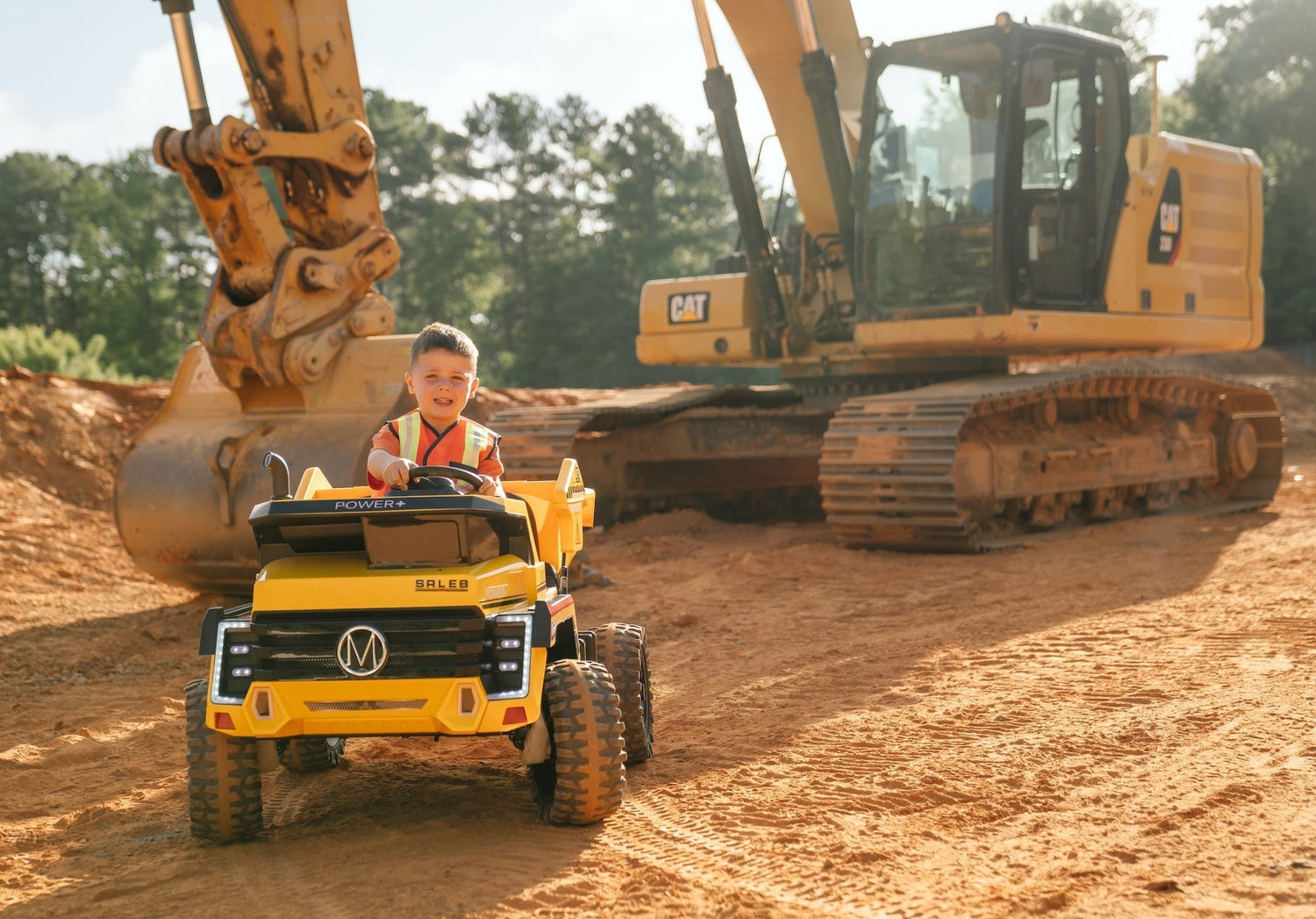
If you've started shopping for a ride-on toy, you've probably noticed that voltage comes up fast. 12V vs 24V ride on debates fill every parenting forum, and for good reason — the battery voltage in your child's ride-on vehicle determines far more than just speed. It affects how long your child can play, what kind of terrain they can handle, how many years they'll actually use the toy, and ultimately whether you're making a smart investment or buying something they'll outgrow in six months.
The short answer? For children ages three and older, 24 volt ride on toys are almost always the better choice. But "almost always" isn't the same as "always," and understanding why requires a closer look at what these numbers actually mean in the real world — not just on a spec sheet.
This guide breaks down everything parents need to know about 12V and 24V ride-on vehicles in 2026. We'll cover speed, battery life, terrain performance, weight capacity, age suitability, and long-term value so you can make a confident decision. No marketing fluff, no jargon without context — just the practical information you need.
What Does Voltage Actually Mean in a Ride-On Toy?
Before we compare 12V and 24V ride-on toys head to head, it helps to understand what voltage does in simple terms. Voltage is essentially the "push" behind the electrical energy flowing from the battery to the motors. Higher voltage means more electrical force is available to power the wheels, which translates into real-world differences your child will feel every time they drive.
Think of it like water pressure in a hose. A 12V system is like a garden hose — perfectly adequate for light tasks on flat, smooth surfaces. A 24V system is more like a pressure washer — it delivers substantially more force, which means the vehicle can handle steeper inclines, rougher terrain, heavier loads, and longer play sessions before the battery needs recharging.
It's worth noting that voltage isn't the only factor that determines performance. Motor wattage, tire type, vehicle weight, and build quality all play critical roles. A well-engineered 24V ride on with quality motors and EVA rubber tires will dramatically outperform a cheaply built 24V vehicle with plastic wheels and low-wattage motors. This is why looking at the full picture — not just the voltage number — matters when choosing the best 24V ride on toys for your family.
Speed: How Fast Do 12V and 24V Ride-On Toys Actually Go?
Speed is usually the first thing parents ask about, and it's where the 12V vs 24V difference becomes immediately obvious.
Most 12V ride-on toys top out between 2.5 and 3.5 miles per hour. That's a comfortable walking pace — fine for toddlers on a flat driveway, but not particularly exciting for a five- or six-year-old who's ready for something more adventurous. Many kids in the three-to-eight age range lose interest in 12V vehicles within a few months because the speed simply doesn't match their growing sense of independence and capability.
24 volt ride on toys typically reach speeds between 3.5 and 5 miles per hour. That might not sound like a dramatic leap on paper, but in practice, the difference is substantial. A child riding at 4.5 mph feels a genuine sense of momentum and control. They're navigating, making decisions, adjusting speed — engaging with the vehicle in a way that builds coordination and spatial awareness. It's the difference between a toy that entertains and a vehicle that teaches.
For example, the Big Digger Tractor reaches 4.75 mph with its 24V dual-battery system, while the Big Kahuna Dump Truck hits 4.50 mph with dual 550-watt motors. These speeds are fast enough to feel genuinely fun for kids up to ages seven and eight, but still well within the range that parents can comfortably supervise — especially with a parent remote control.
Most quality 24V ride on toys also include multiple speed settings, so you can start your child on a lower gear and increase speed as they develop confidence. This graduated approach means you're not buying a new vehicle every time your child's skills advance.
Terrain Capability: Where Can Each Voltage Handle?
Here's where the voltage difference stops being about numbers and starts being about where your child can actually play.
12V Ride-On Terrain Performance
A 12V ride-on is designed for smooth, flat surfaces. Paved driveways, garage floors, sidewalks, and level patios are its natural habitat. The moment you introduce grass — even a well-manicured lawn — most 12V vehicles start to struggle. The motors simply don't have the torque to push through resistance, which means wheels spin, progress slows to a crawl, and your child ends up frustrated.
Hills are essentially off-limits for 12V models. Even a gentle slope can bring the vehicle to a halt or cause it to roll backward. And anything beyond grass — gravel, packed dirt, slightly uneven ground — is typically a non-starter.
24V Ride-On Terrain Performance
A 24V ride on opens up a completely different world of play. The additional voltage gives motors the torque they need to power through grass, handle moderate inclines, and navigate uneven terrain with confidence. For families with yards, this is transformative. Instead of being confined to the driveway, your child can explore the entire property — building trails through the grass, hauling loads across the lawn, and actually using their ride-on vehicle the way real construction equipment operates.
The Mongoose ATV Quad is a perfect example of what 24V terrain capability looks like in practice. With dual 555-watt motors, four-wheel shock absorbers, and EVA tires, it's built to handle the kind of ground that would stop a 12V vehicle cold. Whether your child is riding across a grassy backyard, navigating a gravel path, or exploring a gentle hillside, the power is there.
Similarly, the Forklift 9000 pairs its 24V system with dual 555-watt motors and a stable, low-center-of-gravity design that keeps it planted on uneven surfaces — even while carrying loads with its real lifting mechanism. That combination of power and stability means kids can actually use it for hauling and building projects across the yard, not just driving in circles on concrete.
Battery Life and Run Time: How Long Will They Actually Play?
Battery life is one of those specs where the real-world experience often differs from what's advertised, and it's where the 12V vs 24V comparison gets nuanced.
A typical 12V ride-on toy runs for about 45 minutes to an hour on a full charge under ideal conditions — meaning flat ground, a light rider, and moderate speed. Add grass, hills, or a heavier child, and that drops fast. Many parents report getting 30 minutes or less of actual play time before the vehicle slows to an underwhelming crawl.
24 volt ride on toys generally offer 60 to 90 minutes of play time, though this varies significantly based on terrain, rider weight, driving style, and battery capacity. The higher voltage doesn't just mean more speed — it means the motor doesn't have to work as hard to maintain momentum, which can actually improve efficiency in certain conditions.
Some manufacturers take battery performance further with dual-battery configurations. The Big Digger Tractor, for instance, runs on a 24V dual-battery system that extends run time while distributing power demands across two units. This approach not only gives kids longer play sessions but can also extend overall battery lifespan since neither battery is being drained to absolute zero on every ride.
Charging times are fairly comparable between 12V and 24V systems — most take between 8 and 12 hours for a full charge. A good practice is to plug in after each play session so the vehicle is always ready to go. Investing in a second battery (if the manufacturer offers one) can effectively double your child's outdoor time, which is especially valuable on weekends and school breaks when kids want to play for extended stretches.
Weight Capacity and Age Range: Who Should Ride What?
This is where making the right choice becomes critical, because a mismatch between voltage and your child's size doesn't just affect performance — it affects safety.
12V Ride-On Toys: Best for Ages 1-3
12V ride-on vehicles are genuinely well-suited for toddlers between roughly one and three years old. At this age, children are smaller, lighter, and developing basic motor skills. The slower speed of a 12V vehicle matches their reaction time and coordination level. The lower power output is actually a feature, not a limitation, for this age group.
Weight capacities on 12V models typically range from 40 to 66 pounds, which covers most toddlers comfortably. If your child is under three, a well-built 12V ride-on can be an excellent introduction to the concept of driving and controlling a vehicle.
24V Ride-On Toys: The Right Choice for Ages 3-8
Once your child crosses the three-year-old threshold, a 24V ride on becomes the smarter investment by nearly every measure. Children in the three-to-eight range are heavier, more coordinated, more adventurous, and — crucially — they outgrow things fast. A 12V vehicle bought for a three-year-old will likely feel underpowered and boring by age four. A 24V vehicle bought at the same age can stay exciting and functional through age seven or eight.
Weight capacities on quality 24 volt ride on toys range from 66 to 100 pounds, which comfortably covers the growth curve from preschool through early elementary school. The Big Kahuna Dump Truck supports up to 100 pounds, meaning even larger kids or two smaller siblings can enjoy it together. The Forklift 9000 handles up to 80 pounds, and the Mongoose ATV Quad supports 66 pounds — both solid ranges for the three-to-eight age bracket.
The math is straightforward. If a 12V ride-on lasts your child one to two years before they outgrow it, and a 24V ride-on lasts three to five years, the 24V ride on delivers dramatically more value per dollar — even if the upfront cost is higher.
Build Quality: Why Voltage Is Only Part of the Equation
Here's something that gets overlooked in most 12V vs 24V ride on comparisons: voltage tells you about the electrical system, but it tells you almost nothing about the quality of the vehicle itself. Two 24V ride-on toys can deliver wildly different experiences depending on the materials, engineering, and attention to detail that went into building them.
What to Look for in a Quality 24V Ride-On
Motor wattage matters as much as voltage. A 24V system paired with weak, low-wattage motors will underperform, overheat, and fail prematurely. Look for motors in the 500-watt-and-above range per wheel for genuine terrain-handling capability. The Big Kahuna Dump Truck runs dual 550-watt motors, while the Forklift 9000 and Mongoose ATV Quad both use dual 555-watt systems — these are serious motors that deliver the power the 24V system promises.
Tire material is another critical factor. Plastic wheels — common on budget ride-ons — crack, slip on grass, and provide a jarring ride on anything that isn't perfectly smooth. EVA rubber tires, on the other hand, provide genuine traction, absorb vibration, and last significantly longer. Every vehicle in the Tough Trucks lineup uses EVA tires because the difference in performance and durability is not subtle.
Frame construction separates toys from tools. Plastic frames flex under stress, develop cracks at stress points, and generally don't survive the kind of use an adventurous child will put them through. Metal frames — like the all-metal frame on the Big Digger Tractor — handle impacts, resist twisting, and maintain structural integrity season after season. When you're investing in a 24V ride on that you expect to last through multiple years and potentially multiple children, frame material is not a place to cut corners.
Real-World Functionality: Beyond Just Driving
One of the most significant advantages of the current generation of 24 volt ride on toys is that the best ones don't just drive — they do things. This is where the educational value goes from theoretical to tangible.
The Big Kahuna Dump Truck features a working electric dump bed. Your child isn't just pretending to haul a load — they're actually loading material, driving it to a location, and operating the dump mechanism to unload it. That's a sequence of steps that engages planning, spatial reasoning, and cause-and-effect thinking. At $799 on sale (regularly $1,299), it's an investment in hundreds of hours of screen-free, educational outdoor play.
The Forklift 9000 takes functionality even further with real lifting power — it can raise up to 22 pounds. Children learn about leverage, balance, and load management through direct experience. They stack objects, transport materials across the yard, and solve problems in three dimensions. At $649 on sale (regularly $1,249), it's among the best 24V ride on toys available for children who love hands-on building and problem-solving.
The Big Digger Tractor combines a working front scooper and digger arm with realistic engine sounds and an all-metal frame. It's the kind of vehicle that turns a backyard into a construction site — in the best possible way. At $759 on sale (regularly $1,249), it bridges the gap between toy and tool in a way that keeps kids engaged for years.
And the Mongoose ATV Quad brings a different dimension with its touch-screen control center and Bluetooth connectivity, paired with four-wheel shock absorbers that let kids explore rougher terrain comfortably. Available in Silver, Pink, and Blue at $499 on sale (regularly $749), it's the most accessible entry point to 24V performance in the Tough Trucks lineup.
None of these experiences are possible with a 12V motor. The additional voltage isn't just about going faster — it's about powering mechanisms that transform a simple ride-on into an interactive learning tool.
Parent Remote Control: Safety at Every Voltage
Regardless of whether you choose 12V or 24V, parent remote control is a feature you should insist on for children under five — and it's nice to have even for older kids. A parent remote lets you override speed, steering, and braking if your child gets into a situation they can't handle on their own.
With 24V vehicles, parent remote control is especially important during the first few weeks while your child learns to manage the higher speed and power. All four 24V Tough Trucks models — the Big Kahuna, Forklift 9000, Big Digger Tractor, and Mongoose ATV — come with parent remote control included. Start with the remote in hand, gradually give your child more independence as they demonstrate control, and you'll both enjoy the transition.
This graduated approach is one of the reasons a 24V vehicle is a better long-term investment. Instead of buying a slow vehicle now and a faster one later, you buy one vehicle with higher capability and use the remote to manage the learning curve. Your child grows into the vehicle rather than out of it.
The Cost Comparison: Short-Term Savings vs. Long-Term Value
Let's address the obvious: 24 volt ride on toys cost more upfront than 12V alternatives. A basic 12V ride-on from a big-box retailer might run $150 to $300. A quality 24V ride-on typically starts around $400 and can reach $800 or more for premium models with working features.
But the cost-per-year math tells a different story entirely.
That $200 12V ride-on that your child outgrows in 18 months costs roughly $133 per year of use. A $499 Mongoose ATV Quad that lasts from age three through age eight — five full years — costs about $100 per year. A $799 Big Kahuna Dump Truck over the same five-year span works out to roughly $160 per year, but delivers an incomparably richer experience with its working dump bed, LED lights, and 100-pound weight capacity.
Factor in the replacement cost — because many parents who buy 12V first end up buying a 24V vehicle within a year or two anyway — and the "savings" of starting with 12V often evaporate completely. You end up spending more total while your child gets less total value.
The sweet spot for most families is to start with a quality 24V vehicle at age three and let it carry your child through their prime outdoor play years. If you have a toddler under two and want something for right now, a 12V starter makes sense — but go in knowing it's a short-term purchase, not a long-term solution.
What About 36V and 48V Ride-On Toys?
You may have seen 36V or even 48V ride-on vehicles marketed for children. While these exist, they push into territory that raises legitimate safety considerations for young children. Speeds above 5 mph require faster reaction times and better spatial judgment than most kids under eight consistently demonstrate. The additional weight of larger battery systems also makes these vehicles harder to control and more difficult for parents to manage.
For the overwhelming majority of children ages three to eight, 24V represents the ideal balance of power, safety, and longevity. It's enough voltage to deliver genuinely capable performance without crossing into territory that creates unnecessary risk. This is why the best 24V ride on toys in 2026 focus on optimizing the 24V platform with quality motors, smart engineering, and functional features rather than simply adding more voltage.
How to Choose the Right 24V Ride-On for Your Child
Once you've decided on 24V — and for kids three and older, you should — the next question is which vehicle matches your child's interests and your family's needs. Here are the factors worth considering.
Consider Your Terrain
If your child will primarily ride on grass, dirt, or uneven ground, prioritize vehicles with higher motor wattage, EVA tires, and robust suspension. The Mongoose ATV Quad's four-wheel shock absorbers make it particularly well-suited for rough terrain, while the Big Digger Tractor's all-metal frame and dual-battery power handle demanding conditions with ease.
Consider Your Child's Interests
Does your child love construction sites, dump trucks, and building things? The Big Kahuna Dump Truck and Big Digger Tractor will capture their imagination. Are they fascinated by how things work, by lifting and stacking and organizing? The Forklift 9000's real lifting mechanism will keep them engaged for hours. Do they crave adventure and exploration? The Mongoose ATV Quad is built for exactly that.
Consider Weight Capacity and Growth
Check the weight capacity against your child's current weight and projected growth. If your child is already on the larger side for their age or you want maximum longevity, the Big Kahuna's 100-pound capacity gives you the most room to grow. For average-sized kids, the 66-80 pound capacities on the Forklift 9000 and Mongoose ATV cover the typical three-to-eight age range comfortably.
Consider Your Budget
Every vehicle in the Tough Trucks 24V lineup represents a different price point, from the Mongoose ATV Quad at $499 to the Big Kahuna Dump Truck at $799. All four share the same commitment to quality — 24V power systems, EVA tires, parent remote control, and durable construction — so you're choosing based on features and functionality, not compromising on build quality at the lower price points.
Why Tough Trucks for Kids?
There are plenty of ride-on toys on the market. Here's why families consistently choose Tough Trucks.
We're a veteran-owned business that specializes exclusively in ride-on construction vehicles. This isn't a side category for us — it's our entire focus. That specialization means every vehicle we design is engineered specifically for durability, functionality, and long-term play value. We're not a big-box retailer stocking thousands of products and hoping the ride-ons work out.
Every Tough Trucks vehicle ships 80% pre-assembled from our LA warehouse, with typical setup taking just 30 to 45 minutes. Shipping takes 2 to 5 business days. If anything goes wrong, our American-based customer support team is available Monday through Friday, 9 AM to 4 PM, and every vehicle is backed by a 90-day bumper-to-bumper warranty.
With nearly five-star ratings across every product and thousands of reviews from real families, the quality speaks for itself. But don't take our word for it — explore the full lineup and see what parents are saying.
Frequently Asked Questions
Is a 24V ride-on toy safe for a 3-year-old?
Yes, when the vehicle includes proper safety features. All quality 24 volt ride on toys designed for the three-and-up age range include parent remote control, which lets you override speed and steering while your child learns. Start on the lowest speed setting, supervise closely during the first several sessions, and gradually give your child more independence as they demonstrate control. The Tough Trucks lineup includes parent remote control on every 24V model, making the transition smooth and safe for young drivers.
How long does a 24V ride-on battery last on a single charge?
Most 24V ride on vehicles provide 60 to 90 minutes of play time per full charge, though this varies based on terrain, rider weight, speed settings, and whether the vehicle is operating mechanical features like a dump bed or lift mechanism. Charging typically takes 8 to 12 hours. For maximum play time, plug in the battery after every session so it's always ready. Vehicles with dual-battery systems, like the Big Digger Tractor, can offer extended run times by distributing the power load across two batteries.
Can a 24V ride-on handle grass and hills?
This is one of the biggest advantages of 24V over 12V. A quality 24V ride on with adequate motor wattage (500W+ per motor) and EVA rubber tires can handle grass, packed dirt, gravel paths, and moderate inclines that would stop most 12V vehicles completely. The key factors are motor power, tire material, and vehicle weight — not just voltage alone. Vehicles like the Mongoose ATV Quad with four-wheel shock absorbers and the Big Digger Tractor with its all-metal frame are specifically engineered for off-pavement performance.
What's the difference between a cheap 24V ride-on and a premium one?
The voltage number is the same, but the similarity often ends there. Budget 24V ride-ons frequently use low-wattage motors (under 200W) that can't deliver the performance the 24V battery promises, plastic wheels that crack and lose traction, lightweight plastic frames that flex and break under stress, and minimal safety features. Premium 24 volt ride on toys pair the 24V system with high-wattage motors (500W+), EVA rubber tires, metal frame components, parent remote control, and functional features that add genuine play value. The upfront cost difference typically pays for itself in durability and longevity alone.
Should I buy a 12V ride-on first and upgrade to 24V later?
For toddlers under two, starting with a 12V vehicle makes sense because the lower speed and power match their developmental stage. However, if your child is already three or older, going directly to a 24V ride-on is almost always the smarter financial decision. Many parents who start with 12V end up purchasing a 24V vehicle within a year when their child outgrows the lower-powered option. By starting with 24V and using the parent remote to manage speed during the learning phase, you skip the replacement cycle entirely and your child grows into the vehicle over several years rather than out of it in several months.
Ready to Find the Right Ride-On for Your Child?
Choosing between 12V and 24V comes down to one question: how long do you want this investment to last? For toddlers under two, 12V serves its purpose. For children three and older, 24V ride on toys deliver more speed, more capability, more durability, and more years of genuine outdoor adventure.
Every vehicle in the Tough Trucks lineup is built on a 24V platform (with the exception of our toddler-specific Little Ones First Digger for ages 1-3) because we believe in giving kids the power to actually explore, build, and discover — not just drive in circles on a driveway.
Browse the full Tough Trucks collection to find the 24V ride-on that matches your child's personality, your yard's terrain, and your family's sense of adventure. With 2-5 day shipping from our LA warehouse, 80% pre-assembled builds, and a 90-day bumper-to-bumper warranty, the hardest part is choosing which truck to start with.

Dejar un comentario
Este sitio está protegido por hCaptcha y se aplican la Política de privacidad de hCaptcha y los Términos del servicio.