
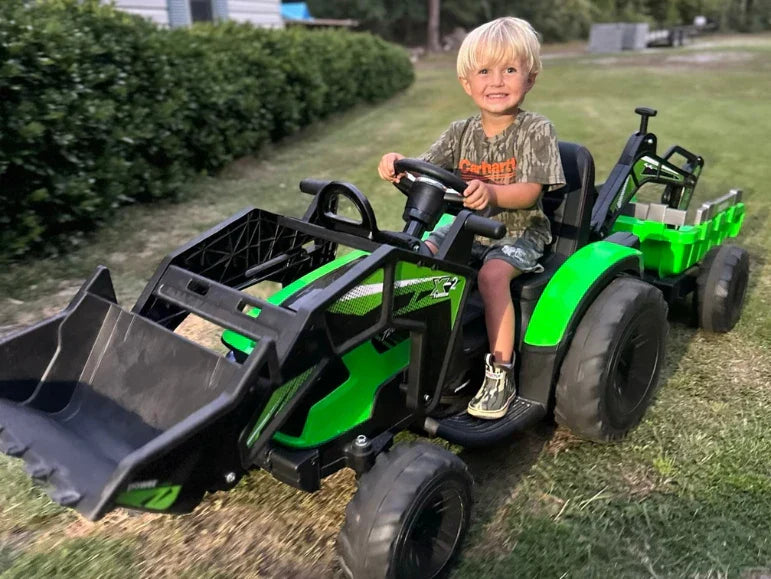
Your child just turned three. They're running faster, climbing higher, asking bigger questions, and ready for something more than the push toys and plastic tricycles that got them through toddlerhood. If you've been searching for the best ride-on toys for 3 year olds in 2026, you already know the options can feel overwhelming. Big-box retailers stock hundreds of generic ride-ons, most of which end up gathering dust in the garage after a few weeks because they're either too flimsy to survive real play or too boring to hold a three-year-old's attention.
This guide is different. We wrote it for parents who want more than a toy — parents who want an outdoor tool that helps their child develop coordination, confidence, problem-solving skills, and a love of hands-on exploration. We'll walk you through exactly what to look for in a ride-on at this age, the safety features that actually matter, and how to pick a vehicle your child won't outgrow in six months. Along the way, we'll show you some of our favorite options from the Tough Trucks for Kids lineup, because as a company that specializes exclusively in ride-on construction vehicles, this is the one thing we know inside and out.
Why Age 3 Is the Perfect Time for a Ride-On Toy
There's a reason so many parents start their ride-on search right around a child's third birthday. Developmentally, three is a turning point. Your child's gross motor skills are maturing rapidly — they can pedal, steer, and coordinate hand-and-foot movements in ways that simply weren't possible a year ago. Their attention span is growing, which means they can engage in extended imaginative play sessions rather than flitting from one activity to the next. And perhaps most importantly, they're developing a fierce sense of independence. They want to do things themselves.
A well-chosen ride-on toy meets every one of those developmental needs. It gives your child autonomy and freedom of movement in a controlled, safe way. It demands coordination — steering with their hands while managing speed with their foot. And for construction-style ride-ons with working parts like dump beds, scoops, or lifts, the play extends far beyond just driving. Your three-year-old starts problem-solving: How do I pick up that pile of dirt? Where should I dump it? How do I back up to get closer? These are real cognitive challenges wrapped in what feels like pure fun.
Research consistently supports the value of active outdoor play for children in this age range. The American Academy of Pediatrics recommends at least 60 minutes of unstructured outdoor play daily for preschoolers, and ride-on toys are one of the most effective ways to keep kids engaged outside and away from screens. In 2026, when the average American child spends over three hours a day on digital devices, that matters more than ever.
What to Look for in a Ride-On Toy for a 3 Year Old
Not all ride-on toys are created equal, and the features that matter most depend heavily on your child's age. Here's what we recommend parents prioritize when shopping for a three-year-old.
Speed Settings and Parent Remote Control
At three, your child is capable of handling a motorized ride-on, but they're still learning the basics of steering and spatial awareness. That's why adjustable speed settings are essential. Look for a ride-on that offers at least two speed levels — a slower beginner setting and a slightly faster option they can graduate to as their confidence grows. Most quality ride-ons for this age group top out somewhere between 3.5 and 4.5 mph, which is roughly a brisk walking pace for an adult. Fast enough to be thrilling for a three-year-old, slow enough that you can keep up.
Even more important than speed settings is a parent remote control. A good remote lets you override your child's steering and speed from a distance, which is invaluable during those first few rides when they're still figuring out the controls. Think of it as training wheels for a motorized vehicle. You can gently guide them away from obstacles, slow them down on hills, or bring them to a complete stop if they get too close to the street. As they gain skill, you'll use the remote less and less — but you'll be glad it's there on day one. Every ride-on in the Tough Trucks for Kids lineup includes a parent remote control as a standard feature, because we believe parental peace of mind shouldn't be an optional upgrade.
Weight Capacity and Build Quality
This is where many budget ride-ons fall short. A three-year-old typically weighs between 25 and 40 pounds, but you want a ride-on with a weight capacity well above that — ideally 66 pounds or more. Why? Because children grow fast, and a ride-on with a 40-pound limit will be maxed out within a year. A higher weight capacity also generally signals a sturdier frame and more robust construction, which means the vehicle can handle rougher terrain, steeper inclines, and the kind of enthusiastic play that three-year-olds are famous for.
Pay attention to the materials, too. Plastic body panels are standard and fine for aesthetics, but the frame beneath should be metal — ideally steel. Check whether the wheels are hard plastic (cheap but noisy and slippery) or EVA rubber (quieter, better traction, longer-lasting). And look at the overall design: does it have a wide wheelbase for stability? A low center of gravity to prevent tipping? These details separate a ride-on that lasts three years from one that lasts three months.
Battery Voltage and Power
Ride-on toys for young children typically come in three voltage tiers: 6V, 12V, and 24V. For a three-year-old, both 6V and 24V can work well — it depends on what kind of experience you're looking for.
A 6V ride-on is the gentlest option. It offers slower speeds (usually around 2-3.5 mph) and is ideal for younger threes who are new to motorized toys or who will primarily ride on flat surfaces like driveways and patios. These models tend to be lighter, more compact, and easier for smaller children to handle. The Little Ones First Digger from Tough Trucks is a perfect example — it's a 6V ride-on excavator designed specifically for ages 1-3, with a working excavator arm, toddler-friendly controls, and a low center of gravity that keeps it remarkably stable.
A 24V ride-on is the step up. It delivers more power, faster speeds (typically 3.75-4.75 mph), and longer run times. If your child is on the older side of three, physically confident, and you want a vehicle they'll enjoy for the next three to five years, a 24V model is the better long-term investment. The higher voltage also means these trucks can handle grass, gravel, gentle hills, and uneven terrain that would stall a 6V model. All of the full-size Tough Trucks — including the Big Kahuna Dump Truck, the Forklift 9000, and the Mongoose ATV Quad — run on 24V systems with dual motors for serious durability and performance.
Safety Features That Actually Matter
Every ride-on toy marketed to parents mentions "safety," but the features worth caring about are specific. Here's our shortlist for three-year-olds:
Seat belts are a must. Your child should be securely strapped in, especially if the ride-on reaches speeds above 3 mph. Soft-start acceleration prevents the vehicle from lurching forward when your child presses the pedal, which can startle younger riders and cause them to lose control. A wide, stable wheelbase reduces the risk of tipping during turns. And as we mentioned above, a parent remote control gives you an immediate override if anything goes sideways — no chasing required.
One feature that's often overlooked is slow-speed reverse. Three-year-olds haven't developed the spatial reasoning to back up safely at full speed. A ride-on that automatically limits reverse speed helps prevent collisions with walls, fences, pets, and siblings. LED headlights and taillights are a nice bonus, too — not just because kids love them, but because they make the vehicle more visible during late-afternoon play sessions when light starts to fade.
The Developmental Benefits of Ride-On Play at Age 3
We talk a lot about ride-ons as toys, but the reality is that a quality ride-on is one of the most effective developmental tools you can put in your child's hands. Here's what happens when a three-year-old climbs into the seat of a ride-on construction vehicle.
Gross Motor Development and Coordination
Operating a ride-on demands the simultaneous use of multiple muscle groups and motor skills. Your child has to press the foot pedal with controlled pressure (not just stomp on it), steer the wheel with both hands, and look where they're going — all at the same time. This kind of bilateral coordination is a critical milestone in early childhood development, and ride-on play is one of the most natural, enjoyable ways to build it. Over time, you'll notice your child's movements becoming smoother, their turns more precise, their stops more controlled. That's their brain building stronger neural pathways between intention and action.
Spatial Awareness and Problem-Solving
When your three-year-old drives a ride-on around the yard, they're constantly making spatial calculations: Can I fit between those two trees? How close can I get to the fence before I need to turn? What happens if I try to drive over that bump? These are the same foundational spatial-reasoning skills that later support everything from reading maps to understanding geometry.
Construction-style ride-ons add another layer of cognitive challenge. A child operating the Big Kahuna Dump Truck's working electric dump bed has to think about cause and effect: If I tilt the bed, the dirt will slide out. If I drive forward while the bed is up, the dirt falls behind me. This is introductory physics, experienced through play. Similarly, the Forklift 9000's real lifting mechanism (capable of hoisting 22 pounds) teaches concepts of weight, balance, and leverage that your child won't encounter in a classroom for years.
Confidence, Independence, and Emotional Growth
There's a moment every parent recognizes — the moment your child figures out how to drive the ride-on completely on their own. Their face lights up. They sit taller. They look back at you with this unmistakable expression of pride. That moment matters. It's your child discovering that they can learn something difficult, practice it, and master it. That experience of earned competence becomes a template for how they approach challenges for the rest of their life.
Ride-on play also provides healthy outlets for the big emotions that three-year-olds are famous for. Frustrated? Go drive it out. Full of energy? Race around the backyard. Need some alone time? Climb in the truck and dig. For many children, a ride-on becomes their first personal space — a place where they feel capable and in control during a stage of life where so much is decided for them.
Social Skills and Cooperative Play
If you have multiple children — or if your three-year-old plays with neighbors and friends — ride-ons naturally foster cooperative play. Kids invent construction projects together, take turns being the "driver" and the "worker," and negotiate roles and rules in ways that build early social skills. We've heard from hundreds of Tough Trucks families who tell us their kids set up entire construction sites in the backyard, complete with designated dump zones, loading areas, and parking lots. That kind of collaborative, imaginative play is exactly what early childhood experts recommend, and it happens organically when the toys are designed to inspire it.
Best Ride-On Toys for 3 Year Olds: Our Top Picks for 2026
Now that you know what to look for, let's talk about specific options. Every ride-on we recommend is from our own Tough Trucks for Kids lineup — not because we're biased (okay, maybe a little), but because we designed each one specifically for the kind of durable, educational, adventure-driven play that parents in our community are looking for. We're a veteran-owned company that specializes exclusively in ride-on construction vehicles, and every product comes with a 90-day bumper-to-bumper warranty and American-based customer support.
Best Entry-Level Option: Little Ones First Digger ($449)

If your three-year-old is on the younger or smaller side, or if this is their very first ride-on experience, the Little Ones First Digger is where we'd start. This 6V ride-on excavator was designed from the ground up for the youngest riders (ages 1-3), with a top speed of 3.5 mph, a 66-pound weight capacity, and controls that are intuitive enough for a toddler to figure out within minutes.
What sets it apart from generic toddler ride-ons is the working excavator arm. Your child can actually scoop, lift, and dump — not just drive in circles. The low center of gravity keeps the vehicle incredibly stable, even on gentle slopes, and the overall design prioritizes safety without sacrificing the feeling of driving a real machine. At $449 (on sale from $649), it's also the most accessible price point in our lineup, making it an excellent first ride-on that introduces your child to the world of construction play before they graduate to a full 24V truck. The Little Ones First Digger is currently available for pre-order and ships February 9, 2026.
Best All-Around Ride-On: Big Kahuna Dump Truck ($799)

The Big Kahuna Dump Truck is our bestseller for a reason. With 4.9 stars across more than 1,781 reviews, it's the ride-on that families come back to rave about months after purchase. It's a 24V powerhouse rated for ages 3-7, which means a three-year-old who gets one today will still be driving it in kindergarten and beyond.
The dual 550W motors deliver a top speed of 4.50 mph with a 100-pound weight capacity — the highest in our lineup. The working electric dump bed is the feature kids obsess over. They'll spend hours loading it with dirt, sand, rocks, sticks, and whatever else they can find, then driving to a "dump site" and unloading it with the push of a button. LED headlights and taillights add realism, the EVA rubber tires provide excellent traction on grass and gravel, and the included parent remote control gives you full override capability while your child learns the ropes. At $799 (down from $1,299), it's a serious investment in years of outdoor play.
Best for Hands-On Learning: Forklift 9000 ($649)

If your child is fascinated by how things work — if they love stacking blocks, carrying things around, and figuring out mechanical puzzles — the Forklift 9000 is going to blow their mind. This 24V ride-on forklift features a working lift mechanism with real lifting power — it can hoist up to 22 pounds, which is enough to pick up toy bins, small boxes, and all kinds of backyard cargo.
Rated for ages 3-8 with an 80-pound weight capacity and dual 555W motors, the Forklift 9000 hits a top speed of 4.25 mph. The stable base design and cabin protection frame give parents peace of mind, while the parent remote control lets you manage speed and direction from a distance. Kids don't just drive this one — they operate it. They plan, lift, carry, place, and repeat. It's ride-on play that doubles as an introduction to real-world problem-solving, and at $649 (sale from $1,249), it's the most unique ride-on toy you'll find anywhere in 2026. With 4.9 stars across 1,200 reviews, the parents who've tried it agree.
Best for Adventure Seekers: Mongoose ATV Quad ($499)

Not every three-year-old is drawn to construction vehicles. Some want pure outdoor adventure — and for those kids, the Mongoose ATV Quad is the answer. This 24V four-wheeler is built for ages 3-8 and comes loaded with features that make it feel like a real ATV: 4-wheel shock absorbers for a smooth ride on bumpy terrain, EVA rubber tires for grip, dual 555W motors, and a touch screen control center with Bluetooth connectivity so your child can play their favorite music while they ride.
With a top speed of 3.75 mph and a 66-pound weight capacity, the Mongoose is slightly more conservative on speed than the Big Kahuna, which actually makes it a great choice for younger threes who are still building confidence. It's available in three colors — Silver, Pink, and Blue — so your child can pick the one that feels like theirs. At $499 (on sale from $749), it's an accessible entry point into the 24V world and a ride-on that will grow with your child for years. It carries a 4.9-star rating from 89 reviews.
6V vs. 24V: Which Is Right for Your 3 Year Old?
This is the question we get more than any other from parents of three-year-olds, and the honest answer is: it depends on your child.
A 6V ride-on like the Little Ones First Digger is the right call if your child is small for their age, cautious by nature, new to motorized toys, or if you primarily have flat, smooth surfaces for them to ride on. The gentler speed and lighter weight make it easier to control, and your child won't feel overwhelmed on their first few rides. The tradeoff is that they'll likely outgrow a 6V model within a year or two.
A 24V ride-on is the right call if your child is physically confident, eager for speed, or if you want to buy once and get several years of use. The extra power handles grass, gravel, and gentle hills with ease, and the higher weight capacities mean the truck grows with your child rather than being left behind. With the parent remote control, you can keep the experience safe and controlled even while your child is still learning.
Many of our families take a both-and approach: they start with the Little Ones First Digger and then add a 24V truck — the Big Kahuna, Forklift 9000, or Mongoose — once their child is comfortable and ready for more. It's a strategy that maximizes play value at every stage and often means the younger sibling inherits the 6V model when the older one graduates up.
Setting Up for Success: Tips for Your Child's First Rides
Buying the right ride-on is step one. Here's how to make sure those first rides go smoothly.
Choose the Right Surface
For a three-year-old's first few sessions, stick to flat, open surfaces like a driveway, patio, or short-cut lawn. Avoid steep hills, loose gravel, and areas near roads or water until your child has developed consistent steering and braking habits. As their skills improve over the first few weeks, you can gradually introduce more challenging terrain.
Use the Parent Remote (Especially at First)
We can't emphasize this enough. The parent remote isn't a sign that your child isn't ready — it's a safety tool that lets them explore at their own pace while you maintain a safety net. Start by letting your child steer while you manage the speed from the remote. Once they're comfortable, hand over the speed control too. Most kids are riding independently within a week or two, but those first few guided sessions make a big difference in building their confidence.
Start Slow, Then Level Up
Every Tough Trucks ride-on has adjustable speed settings. Start on the lowest setting and let your child master turning, stopping, and reversing before you unlock the next speed level. Rushing to the highest speed is a recipe for frustration (and dented fences). Let them earn it — and watch how proud they are when they do.
Make It a Routine
Three-year-olds thrive on routine. If ride-on play becomes a regular part of their day — 20 to 30 minutes after lunch, for example — they'll progress faster because their skills build on each session rather than being forgotten between sporadic rides. It also gives them something to look forward to, which helps with transitions and behavior management throughout the day.
What About Durability and Longevity?
Parents invest real money in ride-on toys, and nothing is more frustrating than a product that falls apart after a few months. This is an area where the difference between premium ride-ons and bargain models becomes painfully obvious.
Cheap ride-ons from big-box retailers and Amazon marketplaces often use thin plastic frames, hard plastic wheels that crack on rough surfaces, and underpowered motors that can't handle anything beyond a smooth, flat driveway. They work fine for the first few weeks, then start showing wear: cracked body panels, stripped gears, batteries that won't hold a charge.
At Tough Trucks for Kids, we take a quality-over-quantity approach. Our trucks feature metal frames for structural integrity, EVA rubber tires that grip and last, and industrial-grade motors that can handle the kind of daily, all-terrain play that three-year-olds dish out. Every vehicle ships 80% pre-assembled from our Los Angeles warehouse, so you're looking at 30 to 45 minutes of setup — not an entire afternoon wrestling with confusing instructions. And if anything does go wrong, our 90-day bumper-to-bumper warranty and American-based customer support team (available 9am to 4pm, Monday through Friday) have you covered. We typically ship within 2-5 business days, which means your child could be riding by the end of the week.
How to Choose Between Multiple Ride-On Toys
If you've narrowed it down to two or three options and can't decide, ask yourself these three questions:
What does my child gravitate toward? If they love dirt, sand, and hauling things around, the Big Kahuna Dump Truck is the natural fit. If they're fascinated by machines and how things work, the Forklift 9000 offers the most interactive, hands-on experience. If they want wide-open adventure and speed, the Mongoose ATV Quad delivers. And if they're on the younger side of three or this is their first ride-on, the Little Ones First Digger is the smartest starting point.
What terrain will they ride on? If you have a smooth driveway and patio, any option works. If you have a big grassy yard, uneven ground, or gravel paths, a 24V model will handle the terrain far better than a 6V.
How long do I want this to last? A 6V ride-on will serve a three-year-old well for one to two years. A 24V ride-on rated for ages 3-7 or 3-8 can last four to five years with proper care. If you want to buy once and be done, go 24V.
Frequently Asked Questions
What is the best ride-on toy for a 3 year old in 2026?
The best ride-on toy for a 3 year old depends on your child's size, confidence level, and the terrain available. For younger or smaller threes, a 6V ride-on like the Little Ones First Digger ($449) offers gentle speeds and toddler-friendly controls. For confident, active three-year-olds ready for a long-term investment, a 24V ride-on like the Big Kahuna Dump Truck ($799) provides more power, faster speeds, and a higher weight capacity that your child won't outgrow for years. Look for features like a parent remote control, adjustable speed settings, EVA rubber tires, and a sturdy metal frame regardless of which voltage you choose.
Are ride-on toys safe for 3 year olds?
Yes, quality ride-on toys with appropriate safety features are safe for three-year-olds. The key features to look for are a parent remote control that gives you full override capability, adjustable speed settings so you can start slow, seat belts to keep your child secure, a wide wheelbase for stability, and soft-start acceleration to prevent lurching. Always supervise your child during ride-on play, start on flat and open surfaces, and use the parent remote during initial rides until your child demonstrates consistent control over steering and braking.
How fast do ride-on toys go for toddlers?
Ride-on toys designed for toddlers and young children typically range from 2 mph to about 4.75 mph, depending on the voltage. A 6V ride-on like the Little Ones First Digger tops out at 3.5 mph, which is about a brisk walking pace for an adult. A 24V ride-on can reach up to 4.75 mph. All quality ride-on toys for this age group include adjustable speed settings, so you can start your child at the lowest speed and increase it as their confidence and skills develop. A parent remote control also allows you to manage speed in real time.
What is the difference between 6V, 12V, and 24V ride-on toys?
The voltage rating tells you how much power the ride-on's battery and motor system delivers. A 6V ride-on offers the gentlest experience with slower speeds and is best for younger or smaller children (ages 1-3). A 12V ride-on is a mid-range option often found in generic models. A 24V ride-on provides the most power, handling speeds of 3.75-4.75 mph and offering enough torque to handle grass, gravel, and gentle hills. For a three-year-old, both 6V and 24V can be excellent choices — a 6V if they're newer to ride-ons, and a 24V if you want a vehicle that grows with them through age 7 or 8. The parent remote control on 24V models allows you to keep the experience safe even at higher power levels.
How long do ride-on toy batteries last on a single charge?
Most quality ride-on toy batteries last between 45 minutes and 2 hours on a single charge, depending on the voltage, the terrain, the weight of the rider, and whether the child is using additional features like working dump beds or lift mechanisms. A 24V battery generally offers longer run times than a 6V battery. To maximize battery life, charge the battery fully before each use, avoid running it completely dead before recharging, and store the ride-on in a temperature-controlled space when not in use. Many Tough Trucks families find that a single charge provides plenty of ride time for their daily play sessions.
Ready to Find the Perfect Ride-On for Your 3 Year Old?
Choosing the right ride-on toy for your three-year-old is one of those parenting decisions that pays dividends for years. The right truck doesn't just entertain — it builds coordination, confidence, problem-solving skills, and a genuine love of outdoor play. Whether you start with the gentler pace of the Little Ones First Digger or go straight to the power and longevity of the Big Kahuna Dump Truck, you're giving your child something that matters: a tool for building tomorrow's builder.
Browse the full Tough Trucks for Kids collection to find the perfect ride-on for your family. Every truck ships from our LA warehouse in 2-5 business days, arrives 80% pre-assembled, and is backed by our 90-day bumper-to-bumper warranty. Questions? Our American-based support team is here to help Monday through Friday, 9am to 4pm.


Dejar un comentario
Este sitio está protegido por hCaptcha y se aplican la Política de privacidad de hCaptcha y los Términos del servicio.