
Here is a stat that should stop every parent mid-scroll: the average American child between ages 2 and 8 now spends over three hours a day on screens, according to recent studies from the American Academy of Pediatrics. That number has climbed steadily since 2020, and in 2026, it shows no sign of slowing down. Tablets, phones, streaming services, and gaming consoles have become the default babysitter in millions of households. And while no parent sets out to raise a child tethered to a glowing rectangle, the gravitational pull of digital entertainment is relentless.
But something interesting is happening on the other side of the equation. A growing number of families are pushing back, not by banning screens outright, but by discovering outdoor toys for kids that are genuinely more compelling than what is on the screen. The key word is genuinely. A plastic bat and ball set gathering dust in the garage is not the answer. What works, what actually pulls a child away from a tablet and keeps them outside for hours, are toys that offer functional, immersive, hands-on play. Toys with purpose. Toys that let children do real things in the real world.
This guide breaks down the outdoor toy categories that are winning the screen-time battle in 2026, explains the science behind why they work, and helps you invest in the ones that will deliver the biggest return in active play, skill-building, and pure childhood joy.
Why Most Outdoor Toys Fail the Screen Test
Before we talk about what works, it is worth understanding why so many outdoor toys for kids end up collecting cobwebs. The problem is not that children dislike being outside. Watch any toddler discover a mud puddle or a pile of sand, and you will see unbridled fascination. The problem is that most outdoor toys offer what child development researchers call passive play, a brief moment of novelty followed by a quick plateau. A generic scooter might thrill a child for a weekend. A basic sandbox kit might hold attention for an afternoon. But screens are engineered to be infinitely stimulating, and passive outdoor toys simply cannot compete with that dopamine loop.
The outdoor toys that actually work, the ones families rave about years later, share a common thread: they offer functional play. Functional play means the toy does something meaningful. It has moving parts. It responds to the child's input. It creates scenarios where the child has to think, problem-solve, and engage physically. The child is not just sitting on a toy; they are operating it, building with it, exploring with it. That distinction is everything.
Think about it from a child's perspective. A tablet offers infinite choices, instant feedback, and constant stimulation. A generic outdoor toy offers one thing, and once the novelty wears off, the choice is obvious. But a toy that lets a child lift real objects, haul dirt across the yard, dig trenches, or navigate terrain? That is a different proposition entirely. That is an experience the screen cannot replicate, because it engages the body, the senses, and the imagination simultaneously.
The Categories of Outdoor Toys That Actually Stick
After reviewing thousands of parent testimonials, child development studies, and hands-on testing data, certain categories of screen free toys consistently rise to the top. These are the outdoor toys that do not just get kids outside, they keep them outside. Let us walk through the major categories, ranked by their ability to sustain long-term, repeated engagement.
1. Ride-On Construction Vehicles: The Undisputed Champion
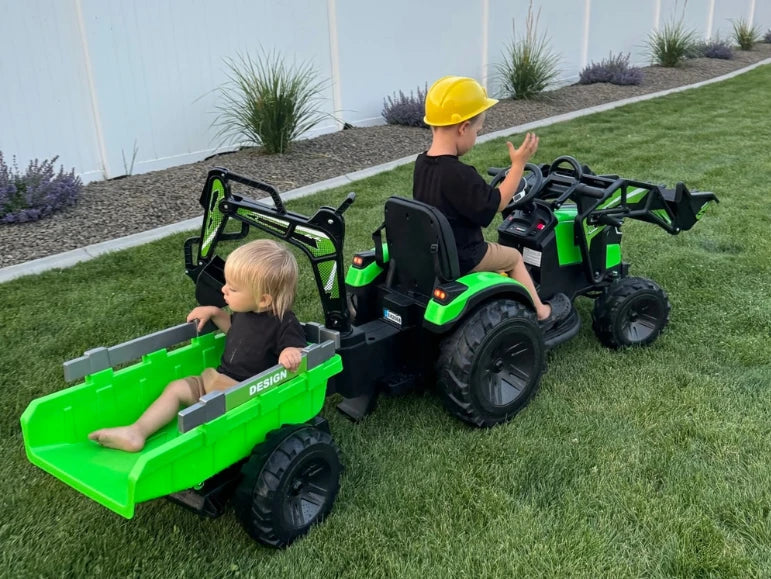
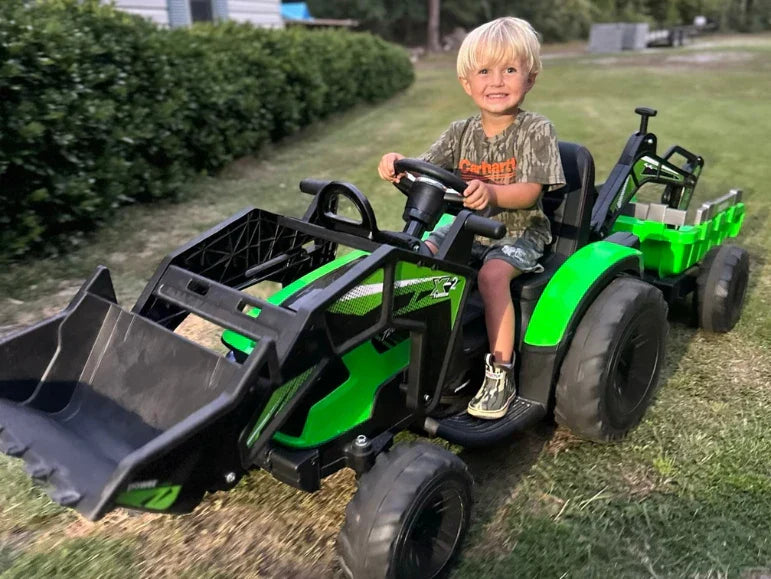
No category of active play toys comes close to ride-on construction vehicles when it comes to sustained outdoor engagement. And the reason is straightforward: these are not toys that children ride on and then abandon. They are machines that children operate. A ride-on dump truck with a working electric bed teaches cause and effect, load management, and spatial awareness. A ride-on excavator with a functional digging arm turns the backyard into a construction site where imagination meets real-world physics. A ride-on forklift that can actually lift objects introduces concepts of weight, balance, and mechanical advantage.
The magic of construction vehicles is that they create open-ended play scenarios. There is no "beating the game" or "finishing the level." Every session is different because every project is different. Today, the child is hauling mulch for a garden project alongside a parent. Tomorrow, they are building an imaginary highway system with friends. Next week, they are running a construction company with elaborate job assignments and timelines. The play evolves as the child grows, which means these toys remain relevant for years instead of weeks.
This is where quality matters enormously. The cheap plastic ride-ons sold at big-box retailers often fail within months, with underpowered motors that cannot handle real terrain, flimsy beds that do not actually dump anything, and batteries that die after twenty minutes. When the toy breaks or underperforms, the child loses trust in outdoor play and gravitates back to the screen. Investing in a well-built ride-on construction vehicle with real functionality is not just about durability; it is about maintaining the child's belief that outside is more interesting than inside.
Tough Trucks For Kids has built its entire business around this principle. As a veteran-owned company that specializes exclusively in ride-on construction vehicles, they have engineered their lineup to deliver genuine functionality, not toy-store theater. Their vehicles feature 24V battery systems with dual motors, working mechanical components, and build quality that holds up to daily outdoor use across multiple children and multiple years. Every vehicle ships 80% pre-assembled from their LA warehouse and arrives in two to five days, which means your child is outside operating heavy machinery (the fun kind) by the weekend.
2. Water Play Systems and Nature Exploration Kits
Water is one of nature's most compelling play materials, and smart water play setups can hold a child's attention for remarkable stretches. We are not talking about a basic sprinkler, though those have their place. The toys that get kids outside in 2026 include water tables with pump systems, creek-diverting kits, and backyard water engineering sets that let children build channels, dams, and waterfalls.
Nature exploration kits occupy a similar space. Bug-catching sets with magnifying viewers, rock and mineral identification kits, and outdoor science stations give children a mission every time they step outside. The key ingredient is purpose. A child with a clipboard and a bug identification card is not just "playing outside." They are on an expedition. And expeditions, unlike passive play, have built-in motivation structures that sustain engagement over time.
The limitation of water play and nature kits is seasonality and weather dependence. They are phenomenal spring and summer toys, but in cooler months or dry climates, their utility drops. They also tend to skew younger, with most children aging out of water tables by five or six. That said, as a complementary category alongside something more substantial, they are excellent screen free toys for younger children.
3. Building and Construction Sets for Outdoors
Large-scale outdoor building sets, think fort-building kits, large wooden block systems, and construction-grade building planks, tap into the same drive that makes Minecraft so addictive: the desire to create something from nothing. The difference is that outdoor building is physical. It requires lifting, balancing, planning, and collaborating. A group of children building a fort together is practicing engineering, negotiation, teamwork, and project management, all while getting exercise and fresh air.
These sets pair exceptionally well with ride-on construction vehicles. Imagine a child using a Forklift 9000 to transport building planks across the yard to a construction site where other kids are assembling a structure. That is not just outdoor play; that is a fully immersive project-based experience that no screen can match. The Forklift 9000's real lifting capability, it can hoist up to 22 pounds, makes it a functional part of the building process rather than a pretend accessory.
4. Wheeled Adventure Toys: Beyond the Basic Bike
Bicycles remain a cornerstone of outdoor childhood, and they should. But the category has expanded significantly, and the most engaging wheeled toys in 2026 go well beyond a standard two-wheeler. Balance bikes for toddlers, all-terrain vehicles for older kids, and purpose-built adventure vehicles that can handle grass, dirt, gravel, and mild hills are dominating the active play toys market.
What separates the best wheeled toys from forgettable ones is terrain capability and a sense of mission. A child on a sidewalk bike is getting exercise, which is great, but a child navigating a backyard trail on a vehicle built for rough terrain is having an adventure. The Mongoose ATV Quad from Tough Trucks is a perfect example. With 24V power, four-wheel shock absorbers, and EVA tires designed for real terrain, it transforms a typical yard into an off-road course. Available in silver, pink, and blue, it appeals to every child who craves exploration and independence. The built-in touch screen control center and Bluetooth capability add a tech-savvy element that bridges the gap between the digital world kids are comfortable with and the outdoor world you want them to embrace.
5. Gardening and Farming Play Sets
Do not underestimate the power of dirt. Gardening toys, real child-sized tools with actual functionality, are quietly becoming one of the most effective categories of toys that get kids outside. When a child plants a seed, waters it daily, and watches it grow into a tomato they can eat, they experience a feedback loop that is more profound than anything a screen can deliver. The timeline is longer, which teaches patience. The outcome is tangible, which builds confidence. And the process is inherently outdoor, which solves the screen-time equation elegantly.
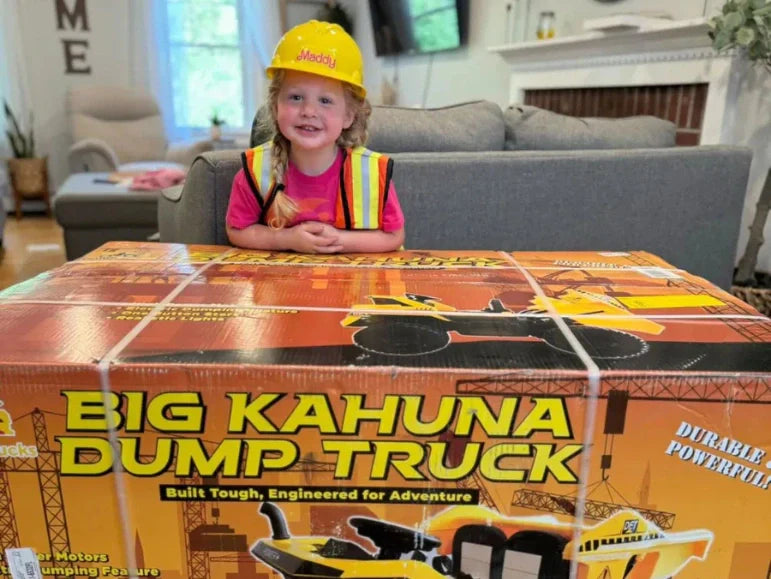
The best gardening setups for children include raised beds at child height, real tools scaled down for small hands, and a few key ride-on accessories for transporting soil, mulch, and harvest. The Big Kahuna Dump Truck has become a surprise hit in this category. With its working electric dump bed and 100-pound weight capacity, kids use it to haul soil to garden beds, transport rocks for landscaping projects, and move harvested vegetables back to the house. Parents report that the dump truck turns gardening from a chore into a collaborative adventure. At 24V with dual 550W motors, it handles loaded hauling across grass and dirt with ease, and the parent remote control means adults can supervise younger operators from a distance.
What to Look for in Screen Free Outdoor Toys That Last
Not all outdoor toys are created equal, and the difference between a toy that changes your family's screen-time equation and one that ends up at a garage sale often comes down to a few critical factors. Here is what to prioritize when investing in toys that get kids outside and keep them there.
Functionality Over Flash
The single most important predictor of long-term play value is whether the toy does something. Lights and sounds are fine as secondary features, but they should not be the main attraction. A ride-on vehicle with a working dump bed, a functional lifting fork, or a real digging arm will outlast a flashier toy with a better paint job but no real capability every single time. Children are remarkably perceptive about authenticity. They know the difference between a toy that pretends to work and a toy that actually works, and they gravitate toward the real thing.
Durability That Matches Childhood
Outdoor toys take a beating. Sun, rain, dirt, crashes, drops, and the general enthusiasm of a five-year-old all conspire against cheap materials. When evaluating outdoor toys for kids, look for metal frames over plastic, EVA rubber tires over hollow plastic wheels, and battery systems rated for sustained use rather than brief demonstrations. A toy that breaks after three months does not just waste money; it teaches the child that outdoor play is fragile and unreliable, which pushes them right back to the indestructible tablet.
This is an area where Tough Trucks For Kids has invested heavily. Their vehicles use all-metal frames, commercial-grade EVA tires, and 24V battery systems that deliver sustained power across long play sessions. They back everything with a 90-day bumper-to-bumper warranty and American-based customer support, which is increasingly rare in the ride-on toy category. When something does need attention, you are talking to a real person in the US, not navigating a chatbot maze.
Age-Appropriate Challenge
A toy that is too simple bores a child quickly. A toy that is too complex frustrates them. The sweet spot is a toy that a child can operate independently but that still offers room to grow into. The best outdoor toys scale with the child, offering basic functionality for beginners and more advanced capabilities as skills develop.
For younger children just starting their outdoor play journey, the Little Ones First Digger is purpose-built for ages one to three. Its low center of gravity, toddler-friendly controls, and working excavator arm give the youngest adventurers a genuine construction experience without overwhelming them. It runs on a 6V system appropriate for its size and speed range, and it introduces the concept of functional play at an age when screen habits are just beginning to form. Currently available for pre-order with shipping beginning February 9, 2026, it is an ideal entry point for families committed to screen-free early childhood.
For the three-to-eight age range, the full lineup of 24V Tough Trucks vehicles offers progressive complexity. A child might start with basic driving and gradually learn to operate the dump bed, the forklift mechanism, or the excavator arm with increasing skill and independence. The parent remote control on every vehicle provides a safety net during the learning phase, allowing adults to override or assist as needed.
Multi-Child and Social Play Potential
One of the most overlooked factors in outdoor toy selection is social play potential. Screens are inherently isolating, even when children are playing "together" on connected devices. The outdoor toys that most effectively combat screen time are the ones that create reasons for children to interact face-to-face, collaborate on projects, and engage in shared imaginative scenarios.
Construction vehicles excel here because they naturally create job sites. One child operates the Big Digger Tractor to scoop and move earth. Another hauls materials in the Big Kahuna Dump Truck. A third manages logistics with the Forklift 9000. Suddenly, the backyard is a functioning construction company with roles, responsibilities, and a shared objective. This kind of cooperative play builds social skills that are increasingly rare in a screen-dominated childhood, skills like communication, compromise, leadership, and teamwork.
The Real Cost of Screen Time (and the Real Value of Getting Outside)
The conversation about outdoor toys for kids is ultimately a conversation about childhood itself. The research on excessive screen time is sobering: increased rates of anxiety and depression, reduced attention spans, delayed social development, declining physical fitness, and disrupted sleep patterns. These are not theoretical risks. They are documented outcomes that pediatricians across the country are seeing in their offices every day in 2026.
But framing outdoor play purely as a screen-time antidote misses the bigger picture. Outdoor play is not just the absence of screens; it is the presence of something irreplaceable. When a child spends an afternoon operating a ride-on vehicle, hauling materials, building structures, and navigating terrain, they are developing gross motor skills, spatial reasoning, problem-solving ability, physical confidence, and environmental awareness. They are learning how the physical world works through direct experience, not through a simulation.
The financial investment in quality outdoor toys often gives parents pause, especially when compared to the apparent "free" entertainment of screens. But consider the math differently. A premium ride-on construction vehicle that costs $500 to $800 and delivers three to five years of daily outdoor play works out to pennies per hour of active, educational, screen-free engagement. Compare that to the cumulative cost of streaming subscriptions, app purchases, device replacements, and, increasingly, the healthcare costs associated with sedentary childhood. The outdoor toy is not the expensive option. It is the investment that pays compounding returns in your child's physical and cognitive development.
Building a Screen-Free Outdoor Routine That Sticks
Having the right toys is essential, but toys alone do not solve the screen-time equation. The families who successfully shift their children's default from screen to outdoors share a few common practices that are worth adopting.
First, they make outdoor play the path of least resistance. The ride-on vehicle is charged and parked by the back door, not buried in the garage. The gardening tools are accessible at child height. The outdoor play space is set up and inviting. When going outside is easier than finding the tablet, children naturally choose outside more often.
Second, they participate, at least initially. The most effective outdoor toys invite parent involvement. Driving alongside your child in the yard, helping them operate the dump bed for a real project, or collaborating on a garden together is not just supervision. It is modeling. Children who see their parents engaged in outdoor activity internalize the value of being outside. As they build confidence and skill with their toys, independence follows naturally.
Third, they create projects, not just playtime. "Go play outside" is vague and uninspiring. "We need to move that pile of mulch to the garden bed, and the dump truck is charged up" is a mission. Children respond to purpose. The best active play toys enable purpose-driven outdoor time, which is why functional construction vehicles consistently outperform passive ride-on toys in long-term engagement metrics.
Why Tough Trucks For Kids Leads the Ride-On Category in 2026
The ride-on vehicle market is crowded, and big-box retailers offer dozens of options at lower price points. So why do thousands of families, over 3,600 verified five-star reviews across the lineup, choose Tough Trucks? The answer comes down to the difference between a toy and a tool.
Tough Trucks For Kids is a veteran-owned business that does one thing: build ride-on construction vehicles that actually work. They are not a toy conglomerate with a construction line. They are specialists. Every vehicle in their lineup is engineered with 24V power systems and dual motors (the Little Ones First Digger uses a 6V system appropriate for toddlers), working mechanical components, all-metal frames, and EVA rubber tires that handle real outdoor terrain. The dump bed on the Big Kahuna actually dumps. The fork on the Forklift 9000 actually lifts 22 pounds. The scooper and digger on the Big Digger Tractor actually move earth.
The practical details matter too. Every vehicle ships from a Los Angeles warehouse and arrives in two to five days. They come 80% pre-assembled, so you are looking at 30 to 45 minutes of setup, not a full weekend with an Allen wrench. The 90-day bumper-to-bumper warranty is backed by American-based customer support available Monday through Friday, 9 AM to 4 PM. And with a parent remote control included on every model, adults maintain oversight while children enjoy the independence of operating their own vehicle.
If you are ready to make 2026 the year your family reclaims outdoor play, explore the full Tough Trucks lineup here. From the toddler-ready Little Ones First Digger to the heavy-hauling Big Kahuna Dump Truck, there is a vehicle for every age, every yard, and every family ready to trade screen time for adventure.
Frequently Asked Questions
What are the best outdoor toys to get kids off screens in 2026?
The most effective outdoor toys for kids in 2026 are those that offer functional, hands-on play rather than passive entertainment. Ride-on construction vehicles with working mechanical components consistently rank highest for sustained engagement because they create open-ended play scenarios that evolve over time. Other strong categories include water engineering sets, large-scale outdoor building kits, all-terrain wheeled vehicles, and gardening setups with real tools. The common thread among all top-performing screen free toys is that they give children a sense of purpose and real-world capability every time they step outside.
At what age should I introduce outdoor ride-on toys?
Children as young as one year old can begin with age-appropriate ride-on vehicles. The Little Ones First Digger from Tough Trucks For Kids is designed specifically for ages one to three, with a low center of gravity, toddler-friendly controls, and a gentle 6V power system. For children ages three and up, 24V ride-on construction vehicles offer more power, speed, and functional capability. Starting early with outdoor play toys helps establish screen-free habits before digital dependence takes hold.
Are ride-on construction vehicles safe for young children?
Quality ride-on construction vehicles designed for children include multiple safety features. Tough Trucks vehicles, for example, come with a parent remote control that allows adults to steer, accelerate, and brake from a distance. Speed settings can be adjusted for younger or less experienced drivers. EVA rubber tires provide stable traction on grass, dirt, and pavement, and the vehicles are designed with appropriate weight capacities and speed limits for their target age ranges. As with any outdoor toy, adult supervision is recommended, especially during the initial learning period.
How do outdoor toys help with child development compared to screens?
Outdoor toys that get kids outside promote development across multiple domains simultaneously. Physical development comes from steering, lifting, digging, and navigating terrain. Cognitive development occurs through problem-solving, spatial reasoning, and cause-and-effect learning. Social development happens when children collaborate on projects, assign roles, and negotiate shared play scenarios. Emotional development grows through building competence and independence. Screens, even educational ones, primarily engage visual and auditory processing in a passive mode. Active play toys engage the whole child, body, mind, and social skills, in ways that screens fundamentally cannot replicate.
What makes a ride-on toy worth the investment over cheaper alternatives?
The difference between a premium ride-on construction vehicle and a budget alternative typically comes down to three factors: functional capability, durability, and sustained play value. Budget ride-ons from big-box stores often feature underpowered motors, non-functional "decorative" components, plastic wheels that crack on real terrain, and batteries that lose capacity within months. A quality vehicle with working mechanical components, metal frames, EVA tires, and a robust 24V power system will deliver years of daily outdoor use across multiple children. When calculated on a per-hour-of-play basis, the premium option almost always costs less in the long run and does a far better job of keeping children engaged and away from screens. Tough Trucks For Kids backs their vehicles with a 90-day bumper-to-bumper warranty and American-based customer support, ensuring your investment is protected.

Dejar un comentario
Este sitio está protegido por hCaptcha y se aplican la Política de privacidad de hCaptcha y los Términos del servicio.