
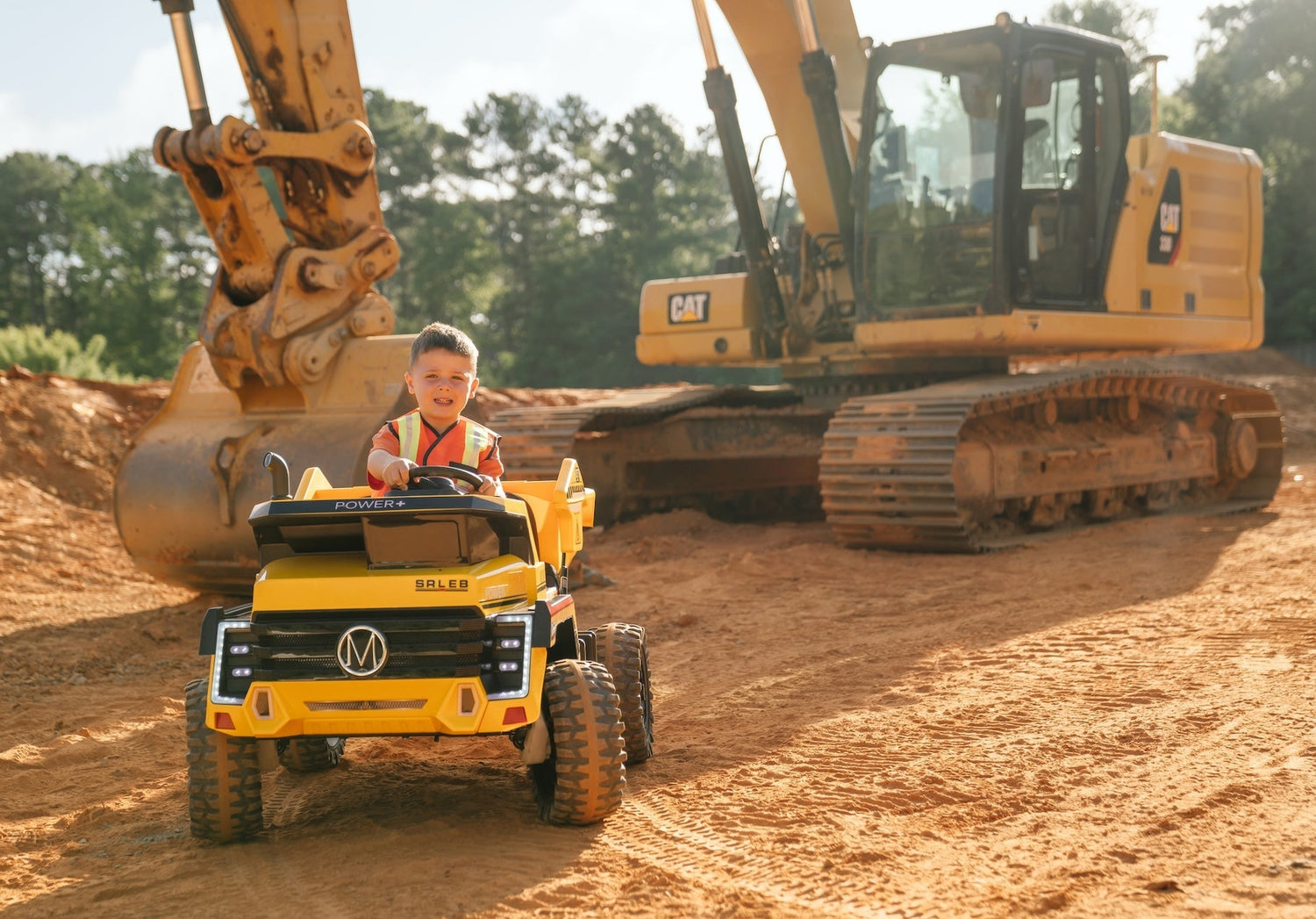
You've seen the look on your child's face. That pure, electrified joy when they spot a construction vehicle rumbling down the highway or watch an excavator scoop dirt at a building site. You know exactly what they want for their birthday. But before you pull the trigger on a ride-on toy, one question stops you cold: is this actually safe for my child?
It's the right question to ask. As ride-on toys have evolved from plastic foot-powered cars into powerful 24V electric vehicles with working dump beds, lifting forklifts, and real traction tires, the safety conversation has evolved too. These aren't the flimsy toys your parents bought at a department store clearance rack. Modern ride-on construction vehicles for kids are engineered machines with real motors, real batteries, and real capabilities.
Here's the answer you came for: yes, ride-on toys are safe — when you choose the right vehicle for your child's age and developmental stage, understand the safety features that matter, and create an appropriate environment for play. This guide covers every angle of that equation. We'll walk through age-appropriate selection, essential safety features, terrain considerations, battery safety, and vehicle-specific considerations so you can make a confident, informed decision.

Age-Appropriate Selection: The Foundation of Ride-On Safety
The single most important safety decision you'll make isn't about features, brands, or price. It's about matching the vehicle to your child's developmental stage. A ride-on toy that's perfectly safe for a six-year-old can be genuinely dangerous for a two-year-old — not because the toy is inherently unsafe, but because the child's coordination, judgment, and reaction time aren't ready for what that vehicle can do. Conversely, a ride-on designed for toddlers won't engage an older child properly, which leads to risky behavior as they push boundaries the vehicle wasn't designed to handle.
Understanding what age is appropriate for ride-on toys starts with understanding your child, not just their birthday. Every child develops differently, and you know yours better than any age chart. That said, here's a research-backed framework that accounts for the physical and cognitive milestones that matter most.
Ages 1-3: Toddler Ride-Ons — Starting Safe and Simple
Are toddler ride-on toys safe? Absolutely — when the vehicle is purpose-built for developing bodies and minds. At this age, your child is still mastering the basics: walking confidently, understanding cause and effect, developing hand-eye coordination, and learning directional concepts like "stop" and "go." A toddler ride-on needs to respect every one of those limitations.
What age is appropriate for toddler ride-on toys comes down to three measurable milestones. First, your child should be walking independently and confidently — not perfectly, but without frequent falls. Second, they should demonstrate basic understanding of simple commands. Third, they should be able to sit upright unsupported for extended periods. Most children hit these markers between 12 and 18 months, though some are ready earlier and others need more time.
For this age group, look for 6V battery systems that keep speeds conservative — typically maxing out around 3 to 3.5 mph. That's barely faster than a toddler's walking pace, which means you can always keep up on foot. Low center of gravity is critical because toddlers shift their weight unpredictably. They'll lean, twist around to look at something, or suddenly reach for an object while moving. A vehicle designed with a wide wheelbase and low seating position compensates for this unpredictability and dramatically reduces tip-over risk.
The Little Ones First Digger was engineered from the ground up for exactly this developmental window. Its 6V system delivers a controlled 3.5 mph maximum speed. The seat sits low to the ground with a wide stance that keeps the vehicle stable even when your toddler is doing their best impression of a seasoned excavator operator. The working excavator arm is scaled for small hands and teaches cause-and-effect reasoning — push the lever, the arm moves — without adding speed or complexity that could create a hazard. At $449 with a 66-pound capacity, it's designed to grow with your child through the full toddler stage. Are excavator ride-on toys safe for this age? With the right design specifications, they're one of the best options because the working arm keeps kids engaged and focused rather than trying to push speed limits.

Ages 3-5: The 24V Transition — More Power, More Features, More Safety Systems
Around age three, something shifts. Your child's balance improves substantially. Their reaction time quickens. They start anticipating outcomes rather than just reacting to them. They can follow multi-step instructions and demonstrate genuine problem-solving skills. This is when the world of 24V ride-on toys opens up — and when parents understandably have the most questions about safety.
Are 24V ride-on toys for big kids safe? The short answer is yes, and the longer answer is that modern 24V systems are engineered with more safety layers than the simpler 6V vehicles your toddler outgrew. The key is that 24V doesn't just mean "faster." It means more powerful motors that deliver smoother, more controlled acceleration. It means the vehicle can handle terrain that would stall a 6V motor, reducing the risk of getting stuck in an awkward position. And it means the vehicle can support more sophisticated safety systems like parent remote override, adjustable speed settings, and gradual acceleration curves.
What age is appropriate for 24V ride-on toys for big kids depends less on the calendar and more on demonstrated readiness. Can your child steer with intention? Do they understand the concept of slowing down before a turn? Can they process information while operating controls — seeing an obstacle and knowing to stop or steer around it? Most three-year-olds can handle these basics, especially when the vehicle includes parental override via remote control.
Every 24V vehicle in the Tough Trucks lineup includes a parent remote control for this exact reason. During the transition period, you're not just handing over the keys and hoping for the best. You're co-piloting. You can override steering, braking, and speed from up to 100 feet away. When your child heads toward the garden wall, you redirect. When they freeze up in confusion, you bring them to a safe stop. As they demonstrate competence, you use the remote less. It's a graduated learning system built into the vehicle itself.
The Big Kahuna Dump Truck is an excellent entry point to the 24V world. At 4.50 mph with dual 550W motors, it delivers enough power to feel genuinely exciting while remaining controllable. The working electric dump bed gives children a purpose beyond just driving — they load, haul, and dump, which keeps their attention focused on the task rather than on testing speed limits. The 100-pound weight capacity means this truck isn't going to be outgrown in six months. At $799 on sale with 1,781 five-star reviews and a 4.9 rating, thousands of parents have already validated its safety record.
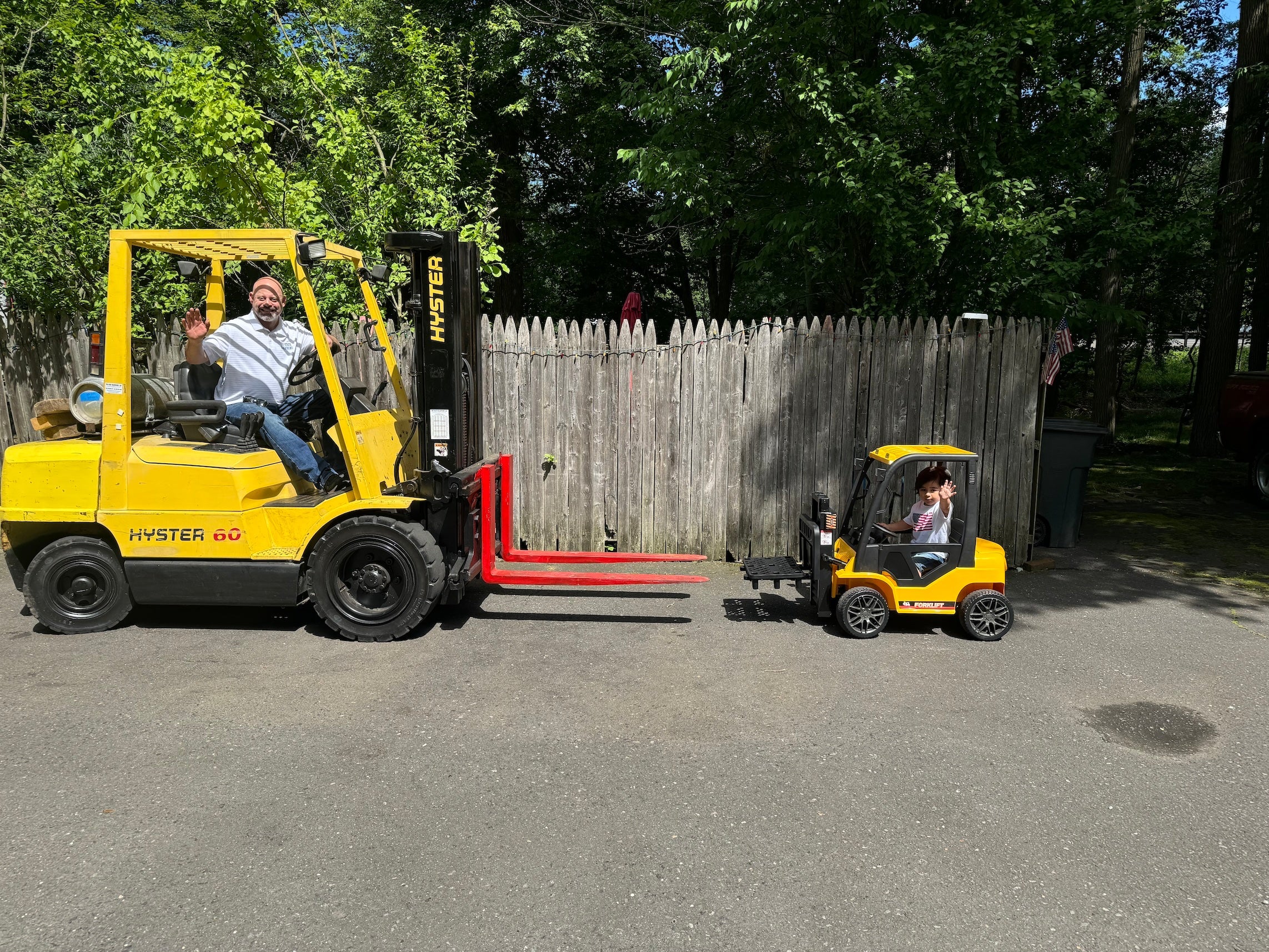
The Forklift 9000 offers a different kind of engagement for this age range. Its real lifting power — 22 pounds of capacity — teaches weight, balance, and precision. The stable base and cabin protection create a safe zone around the driver. Children in this age group can start by simply driving and lifting the forks, then progress to stacking challenges and carrying missions as their skills develop. The dual 555W motors and 4.25 mph speed are perfectly matched to the 3-8 age range.
Ages 5-8: Full Capability and Growing Independence
By five to eight years old, most children have developed the coordination, judgment, and spatial awareness to handle the full capabilities of a 24V ride-on. They can coordinate steering, speed control, and functional features simultaneously. They anticipate the physics of their vehicle — understanding that a loaded dump bed handles differently than an empty one, or that turning radius changes with speed. This is where ride-on toys transition from supervised play to genuine independent adventure.
What age is appropriate for ride-on trucks at their full potential varies by child, but the general markers are solid: can they ride a bicycle? Do they show good judgment about boundaries and hazards? Can they operate multiple controls at once without becoming overwhelmed? If yes, they're likely ready for the full range of features these vehicles offer.
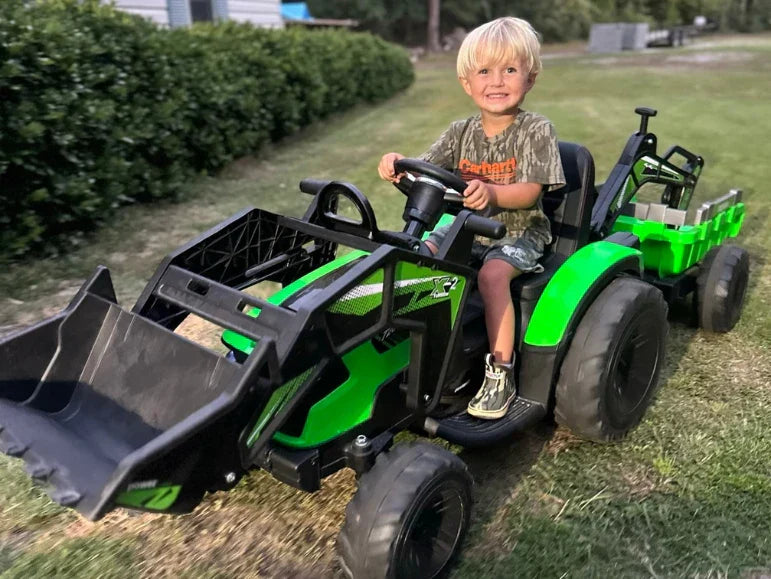
The Big Digger Tractor exemplifies what this age group can handle. With a working front scooper and rear digger, all-metal frame construction, and 4.75 mph speed, it's the most complex vehicle in the lineup. Children at this stage don't just drive it — they plan excavation projects, move materials from one location to another, and create elaborate construction scenarios that can occupy entire afternoons of screen-free play. The dual battery system ensures they won't run out of power mid-project. The realistic engine sounds add to the immersion without distracting from the task at hand.
The Mongoose ATV Quad appeals to the adventure-oriented child in this age range. Its 4-wheel shock absorbers and EVA tires handle varied terrain that would challenge other vehicles, and the touch-screen control center with Bluetooth gives older kids a technology interface they find genuinely engaging. Available in Silver, Pink, and Blue, it also lets them express their personality — a small detail that actually matters for sustained engagement and careful treatment of the vehicle.
Essential Safety Features Every Ride-On Should Have
Not all ride-on toys are created equal when it comes to safety engineering. Here's what separates a genuinely safe vehicle from one that just looks the part. For a more detailed breakdown of every safety feature and how it works, check out our detailed safety features breakdown.
Parent Remote Control: Your Safety Net
A parent remote control is not a luxury feature. It's a safety mechanism that gives you ultimate override authority over your child's vehicle. The best systems — the kind included with every Tough Trucks ride-on — provide complete control over steering, acceleration, and braking from a distance. This means that when your three-year-old decides to drive toward the neighbor's prized rose garden, you intervene with a quick joystick adjustment. When they panic and freeze on a gentle slope, you bring them to a controlled stop.
The parent remote is particularly essential during the learning phase, but it remains valuable even as children become experienced drivers. Unexpected situations arise: a dog runs into the play area, another child wanders into the path, or the terrain changes in a way your child didn't anticipate. Having instantaneous override capability transforms a potentially scary moment into a seamless correction.
Speed Settings and Gradual Acceleration
Adjustable speed settings serve a dual safety purpose. They let you match the vehicle's performance to your child's current skill level, and they allow you to restrict speeds based on terrain or conditions. A vehicle that's perfectly safe at top speed on flat grass may need to be dialed back on a paved driveway where traction characteristics change, or when your child has a friend riding nearby and distractions increase.
Gradual acceleration — sometimes called "soft start" technology — prevents the jarring lurch that happens when small feet stomp a pedal. Instead of rocketing forward, the vehicle builds speed smoothly. This gives your child time to adjust their grip, their posture, and their attention. It's the difference between a controlled departure and a white-knuckle surprise that ends with tears.
Seatbelts and Weight Capacity
Are ride-on trucks safe without seatbelts? They're safer with them. While these vehicles travel at walking speed rather than highway speed, sudden stops on uneven terrain or unexpected bumps can shift an unrestrained child forward. Seatbelts keep small bodies in the optimal driving position where they have full access to controls and maximum stability.
Weight capacity limits aren't suggestions — they're engineering boundaries. When a ride-on is rated for 80 pounds, that number reflects the point at which stability, braking performance, steering response, and motor efficiency all remain within safe parameters. Exceed that limit and every safety system on the vehicle is compromised. Always check the weight rating against your child's current weight and leave reasonable headroom for growth, winter clothing, and any cargo they'll be hauling.
Low Center of Gravity and Stability Design
Tip-over resistance is one of the most critical safety factors, and it's determined primarily by two design elements: center of gravity and track width. A vehicle with its weight concentrated low and spread wide across a broad wheelbase resists tipping during turns, on slopes, and when children shift their weight unexpectedly. This is especially important for younger children who haven't yet developed the instinct to lean into turns or counterbalance their body weight.
Every Tough Trucks vehicle is engineered with stability as a primary design constraint. The seats are positioned low in the chassis. The batteries — the heaviest components — are mounted at the vehicle's lowest point. The wheel spacing is wide relative to the vehicle's height. These aren't accidental design choices. They're deliberate engineering decisions that prioritize tip-over prevention.
EVA Rubber Tires vs. Hard Plastic Wheels
This is a safety detail that many parents overlook, but it makes a significant difference. Hard plastic wheels — the kind found on many budget ride-ons from big-box retailers — have minimal traction. They skid on grass, slide on smooth surfaces, and transmit every bump directly to the vehicle and its occupant. They also create more noise, which can startle a young child into reactive steering.
EVA rubber tires grip across multiple surfaces — grass, packed dirt, pavement, gravel — providing consistent, predictable traction. They absorb vibration for a smoother ride that keeps your child more comfortable and more in control. They won't puncture or go flat like air-filled tires. Every vehicle in the Tough Trucks lineup uses EVA tires because traction isn't an area where you cut corners. When your child turns the wheel, they need the vehicle to go where they pointed it.

Terrain and Environment: Where Should Kids Ride?
The safest vehicle in the world becomes unsafe in the wrong environment. Terrain selection and environmental setup are critical components of ride-on toy safety that deserve as much attention as the vehicle itself.
Ideal Riding Surfaces
Flat, open grass is the gold standard for learning and everyday riding. It provides enough traction for controlled driving while offering a forgiving surface if your child tips or falls. The slight resistance of grass also naturally limits speed compared to hard surfaces, which acts as a built-in speed governor during the early learning phase.
Packed dirt and gravel paths work well for more experienced riders. They teach different traction characteristics and navigational skills. Paved surfaces like driveways and sidewalks are suitable for confident riders but require additional awareness of the reduced stopping friction. Concrete and asphalt are harder on tires and transmit more vibration, so keep sessions on these surfaces shorter for younger children.
Surfaces and Areas to Avoid
Steep slopes present the most obvious terrain hazard. While quality ride-ons can handle gentle inclines, slopes steeper than about 15 degrees create rollover risk and can exceed the braking capacity of the motors. If your child's play area includes slopes, restrict access until they demonstrate the skill and judgment to navigate them safely.
Keep ride-on toys away from streets, driveways with active vehicle traffic, swimming pools, ponds, and any body of water. Establish clear, visible boundaries before your child starts riding — physical markers like cones or landscape features work better than verbal instructions alone, especially for younger children who forget rules when excitement takes over.
Wet surfaces deserve special caution. Rain-soaked grass becomes slippery, reducing the traction advantage that makes grass ideal in dry conditions. Puddles can hide holes or uneven ground. And while ride-on vehicles are built to handle occasional light moisture, standing water can damage electrical components and compromise performance.
Supervision Guidelines by Age
For ages 1-3, direct, hands-on supervision is non-negotiable. Stay within arm's reach. Keep the parent remote in hand at all times. Limit sessions to controlled areas you've inspected for hazards. This isn't about being overprotective — it's about recognizing that toddlers lack the judgment to identify and avoid hazards on their own.
For ages 3-5, transition to active visual supervision. You should be outdoors, watching, with the parent remote accessible. You don't need to be at arm's reach, but you need a clear line of sight and the ability to intervene within seconds. This is the age where you're gradually building their independence while remaining ready to step in.
For ages 5-8, visual supervision with periodic check-ins is generally appropriate for experienced riders in familiar environments. You should know where they're riding, what boundaries are in place, and check on them regularly. New environments or challenging terrain still warrant closer supervision regardless of age.
Battery Safety: What Every Parent Needs to Know
Battery safety is a topic that generates more anxiety than it should — but it does deserve informed attention. Modern ride-on toy batteries are engineered with multiple safety protections, and following basic guidelines keeps them safe and reliable for years.
Charging Best Practices
Always use the charger that came with your vehicle. Third-party chargers may not match the voltage and amperage specifications, which can lead to overcharging, undercharging, or overheating. Charge the battery on a flat, non-flammable surface in a well-ventilated area. Don't leave batteries charging unattended overnight — modern chargers have auto-shutoff features, but treating the charge cycle with attention is good practice.
Most 24V ride-on batteries require 8-12 hours for a full charge from empty and deliver 1-2 hours of ride time depending on terrain and payload. Charge after every use rather than waiting for the battery to fully deplete — this extends battery life and ensures the vehicle is always ready to go. For detailed information on battery types, charging schedules, and maximizing battery lifespan, check out our ride-on toy battery guide.
Storage and Weather Considerations
Store ride-on toys and their batteries in a dry, temperature-controlled space. Extreme cold (below freezing) can damage battery cells and reduce capacity. Extreme heat can create safety risks. A garage, shed, or covered patio works well for most climates. If you live somewhere with harsh winters, bring the battery inside even if the vehicle stays in the garage.
Ride-on vehicles are built for outdoor use, but they're not waterproof. Don't ride in heavy rain and never submerge any part of the vehicle. After riding on wet ground, wipe down the undercarriage and check that battery compartments are dry. Battery compartments on quality vehicles like those from Tough Trucks are enclosed and require tools to access, keeping children away from terminals and reducing the risk of moisture intrusion.
Quality Indicators: How to Tell a Safe Ride-On from a Risky One
The difference between a safe ride-on toy and a dangerous one often comes down to build quality and materials. Here's how to evaluate what you're buying before your child climbs in.
Certification and Standards
Look for ASTM F963 certification, the American standard for toy safety. This certification means the vehicle has been tested for mechanical hazards, electrical safety, flammability, and material toxicity. It's not a guarantee of perfection, but it's a baseline that eliminates the most egregious safety risks. CPSIA compliance (Consumer Product Safety Improvement Act) is another important marker, particularly for lead and phthalate content in materials children touch.
Metal Frames vs. All-Plastic Construction
This is where price differences between premium ride-ons and budget alternatives become safety-relevant. All-metal frames withstand impacts that would crack plastic bodies, maintaining structural integrity through years of enthusiastic driving. When a child runs into a tree stump or another vehicle, a metal frame absorbs and distributes the impact rather than shattering into sharp fragments.
The Big Digger Tractor's all-metal frame isn't a marketing bullet point — it's a structural safety decision. Metal frames also maintain tighter tolerances over time. Plastic frames develop flex and looseness that can cause unpredictable handling, loose connections, and the kind of rattling play that makes components fail without warning.
Warranty as a Quality Signal
A manufacturer's warranty tells you how much they trust their own product. A 30-day warranty on an $800 vehicle should raise red flags — why won't the manufacturer stand behind it for longer? Tough Trucks offers a 90-day bumper-to-bumper warranty specifically because the engineering and materials are built to last well beyond that window. It signals confidence in the product, and it protects your investment if something does go wrong.
American-based customer support is another quality indicator that directly impacts safety. When you have a question about assembly, a concern about a noise your child's vehicle is making, or need guidance on a safety feature, you want to talk to a real person who knows the product — not navigate a chatbot at 2 AM. Tough Trucks' US-based support team is available 9 AM to 4 PM Monday through Friday, staffed by people who can actually help resolve your concern.
Higher quality materials, metal frames, EVA tires, enclosed battery compartments, and robust warranty coverage are what separate specialist ride-on brands from the mass-produced alternatives you'll find at Walmart or on Amazon. When safety is the priority, the build quality difference matters more than the price difference.
Vehicle-Specific Safety Considerations
Different types of ride-on vehicles have different working features, and each comes with its own safety considerations. Here's what to know about each category.
Dump Truck Ride-Ons: Dump Bed Safety
Are dump truck ride-ons safe? The primary consideration unique to dump trucks is the electric dump bed — a working mechanism that tilts to release cargo. On the Big Kahuna Dump Truck, the dump bed is operated by a button within the cab, so children control when and where they dump their payload. The mechanism is designed with a controlled tilt speed that prevents sudden drops, and the bed's weight capacity is matched to the vehicle's stability so a full load doesn't compromise handling.
What age is appropriate for dump truck ride-ons? The Big Kahuna is rated for ages 3-7, and that range reflects the cognitive ability needed to manage both driving and dump bed operation. Younger children in that range will treat the dump bed as a simple novelty — press the button, watch things slide out. Older children develop genuine strategy around loading, transporting, and depositing materials. Both approaches are safe because the mechanism is self-contained and doesn't create pinch points or external hazards.
Teach your child to come to a complete stop before operating the dump bed. While the vehicle can handle simultaneous driving and dumping, the shift in weight as cargo exits can change handling characteristics. Building the habit of stopping first instills good operational awareness that mirrors how real dump trucks work.
Forklift Ride-Ons: Lifting Mechanism and Cabin Safety
The Forklift 9000 introduces a unique safety dimension: a working lifting mechanism with 22 pounds of real lifting power. This is the feature that generates the most parental questions, and rightfully so. The lifting mechanism is designed with controlled speed — the forks don't snap up or crash down. They move at a pace that gives children time to position their cargo and adjust their plan.
Cabin protection is another standout safety feature on the Forklift 9000. The overhead structure creates a protective zone above the driver, similar to a ROPS (Roll-Over Protective Structure) on real forklifts. This isn't just cosmetic — it provides genuine protection if the vehicle contacts overhanging branches, play structures, or other overhead obstacles.
The stable base with a wide footprint prevents tip-over even when the forks are raised and loaded. This is critical because a raised load shifts the center of gravity upward. The engineering accounts for this: the vehicle remains stable at maximum fork height with a full 22-pound payload. That said, teach children not to drive at full speed with the forks fully raised. It's not dangerous, but driving with a lowered load is a better habit that builds understanding of how weight and height interact.

Tractor Ride-Ons: Scooper and Digger Safety
What age is appropriate for a ride-on tractor with working attachments? The Big Digger Tractor is rated for ages 3-8 and features both a front scooper and a rear digger — the most complex working feature set in the Tough Trucks lineup. The scooper operates via lever controls within the cab, requiring deliberate input rather than accidental activation. The rear digger operates independently, teaching children to switch between functions and manage multiple systems.
The safety consideration with moving attachments is proximity awareness. The scooper extends in front of the vehicle, meaning children need to understand that their vehicle is "longer" than it appears from the driver's seat. The wide EVA wheels and all-metal frame maintain stability even when the scooper is loaded, and the vehicle's weight distribution is calibrated to prevent front-heavy tipping when the scoop is full and raised.
Teach children to be aware of other kids and pets near the scooper and digger during operation. The mechanisms don't generate dangerous force — they're scaled for children — but developing the awareness of working around others builds genuine operational skills and safety consciousness.
ATV Ride-Ons: Four-Wheel Stability and Shock Absorption
Are 2-seater ride-ons safe? What age is appropriate for 2-seater ride-ons? While the Mongoose ATV Quad is a single-rider vehicle, it addresses many of the stability concerns parents have about ATV-style ride-ons. The four-wheel design with individual shock absorbers on each wheel provides superior stability compared to two-wheel alternatives, maintaining contact with uneven ground rather than bouncing over it.
The shock absorbers serve a dual purpose: they smooth the ride for comfort and they keep all four tires planted on the ground for traction and stability. On uneven terrain — which is where adventurous kids inevitably end up — this suspension system prevents the sudden jolts and tire-lifts that can cause loss of control on rigid-axle designs.
The Mongoose's 66-pound weight capacity and 3.75 mph speed are appropriately conservative for the 3-8 age range. The EVA tires provide consistent grip across the varied terrain that ATV-style vehicles naturally invite children to explore. The touch-screen control center, while primarily an engagement feature, also gives parents a visible indicator of speed and battery status — useful safety information during outdoor play.
The Bottom Line: Making Your Decision
Are ride-on construction vehicles for kids safe? When you choose quality over price, match the vehicle to your child's developmental stage, use the parent remote during the learning phase, establish clear riding boundaries, and supervise appropriately for your child's age — these vehicles aren't just safe. They're among the most developmentally valuable toys your child can own. They teach physics through a loaded dump bed. They teach spatial reasoning through forklift stacking. They teach responsibility through vehicle care. And they teach independence through graduated skill building.
The safety question shouldn't stop you from giving your child these experiences. It should guide you toward the right experiences. Start with the right vehicle for their age. Use the safety features as they're designed. Create a safe environment. And then let them discover, build, explore, and grow.
For a complete breakdown of which ride-on matches your child's specific age and developmental stage, explore our complete ride-on toy age guide. Ready to find the perfect ride-on for your child? Browse the full Tough Trucks collection and choose a vehicle built with safety as the foundation — backed by a 90-day bumper-to-bumper warranty, American-based customer support, and thousands of five-star reviews from parents who asked the same questions you're asking right now.
Frequently Asked Questions
Are 24V ride-on toys safe for a 3-year-old?
Yes, 24V ride-on toys are safe for most 3-year-olds when the vehicle includes a parent remote control, adjustable speed settings, and a low center of gravity. The key is choosing a vehicle designed for the 3+ age range — like the Big Kahuna Dump Truck or Forklift 9000 — rather than a vehicle intended for older children. Start at the lowest speed setting, use the parent remote actively during the learning phase, and increase speed and independence as your child demonstrates control and judgment. Always supervise directly during the first several weeks.
What is the safest type of ride-on toy for toddlers?
The safest ride-on toys for toddlers (ages 1-3) are 6V vehicles with low center of gravity, wide wheelbase, conservative maximum speed (3.5 mph or less), and toddler-specific controls designed for small, developing hands. A working feature like an excavator arm or simple scoop keeps toddlers engaged in purposeful play rather than pushing speed limits. Parent remote control is essential at this age for immediate override capability. The Little Ones First Digger is purpose-built for this age range with all of these specifications.
Do kids need helmets for ride-on toys?
While ride-on toy manufacturers typically don't require helmets because these vehicles operate at walking speeds (3-5 mph), a helmet is never a bad idea — especially for children under four or on hard surfaces like driveways and sidewalks. If your child is riding on grass in a controlled area with the parent remote active, the risk of head injury is very low. If they're riding on pavement or more challenging terrain, a bicycle helmet adds a sensible layer of protection. More importantly, wearing a helmet builds a habit that will serve them well when they graduate to bicycles, scooters, and other faster vehicles.
How do I know if a ride-on toy is good quality vs. a safety risk?
Look for ASTM F963 certification, metal frame construction (not all-plastic), EVA rubber tires (not hard plastic wheels), enclosed battery compartments, and a meaningful warranty — 90 days or more. Check the review count and rating: a product with thousands of verified reviews above 4.5 stars has been field-tested by real families. Be wary of ride-ons that lack parent remote controls, use hard plastic wheels, have ambiguous weight ratings, or come from manufacturers with no identifiable customer support. A company that specializes exclusively in ride-on vehicles — rather than selling them as one category among hundreds — is more likely to have the engineering focus that safety requires.
Can two kids ride on a single-rider ride-on toy at the same time?
No. Single-rider ride-on toys are engineered for one child's weight and center of gravity. Adding a second child exceeds the weight capacity, shifts the balance point unpredictably, and compromises braking and steering performance. Even if two small children technically fit within the weight limit, the altered seating position and weight distribution create hazards the vehicle wasn't designed to handle. If you want a shared riding experience, look for vehicles specifically designed as 2-seater ride-ons with appropriate weight ratings, dual seatbelts, and stability engineering that accounts for two occupants.

Dejar un comentario
Este sitio está protegido por hCaptcha y se aplican la Política de privacidad de hCaptcha y los Términos del servicio.