
If you've ever watched your child's ride-on toy sputter to a halt the moment it hits the lawn, you know the frustration. You're not alone. One of the most common questions parents ask before investing in a ride-on vehicle is simple: will this actually work on grass, dirt, or gravel?
The short answer is that it depends entirely on three critical factors: the tire type, motor power, and overall weight distribution of the vehicle. Most budget ride-on toys sold at big-box retailers are designed for smooth surfaces only, which means your child's outdoor adventures are limited to driveways and patios. But if you're looking for a ride-on that can handle real terrain—the kind of rough-and-tumble exploration that builds confidence and problem-solving skills—you need to understand what separates a backyard toy from a true adventure vehicle.
In this guide, we'll break down exactly what makes a ride-on toy terrain-capable, compare different tire types and motor configurations, and help you choose a vehicle that won't disappoint when your little one takes it off the pavement.
Why Most Ride-On Toys Struggle on Grass
Walk into any major retailer, and you'll find shelves stocked with colorful ride-on toys at attractive price points. Most of these vehicles share a common weakness: they're built for smooth, flat surfaces. The culprit is usually a combination of underpowered motors, hard plastic wheels, and lightweight construction that can't generate enough traction to push through grass or gravel.
When a ride-on toy encounters grass, it faces resistance that simply doesn't exist on concrete. Blades of grass create friction against the wheels, and uneven ground requires more torque to maintain momentum. A single motor producing 100-200 watts might be sufficient for a patio, but it will bog down immediately when faced with even a well-manicured lawn. Add a child's weight to the equation, and you have a recipe for disappointment.

The second issue is wheel composition. Hard plastic wheels are cost-effective to manufacture, but they offer minimal grip on anything other than smooth pavement. They slip on grass, spin uselessly in dirt, and can crack when encountering sharp rocks or gravel. Parents often discover this limitation only after the toy has been unboxed and assembled, when it's too late to easily return.
The 24V Difference: Why Voltage Matters
Battery voltage is one of the most overlooked specifications when shopping for ride-on toys, yet it's arguably the most important for terrain performance. Most entry-level ride-ons run on 6V or 12V systems, which simply don't provide enough power for anything beyond flat surfaces. A 24V battery system, on the other hand, delivers the sustained power needed to climb inclines, push through grass, and maintain speed on uneven ground.
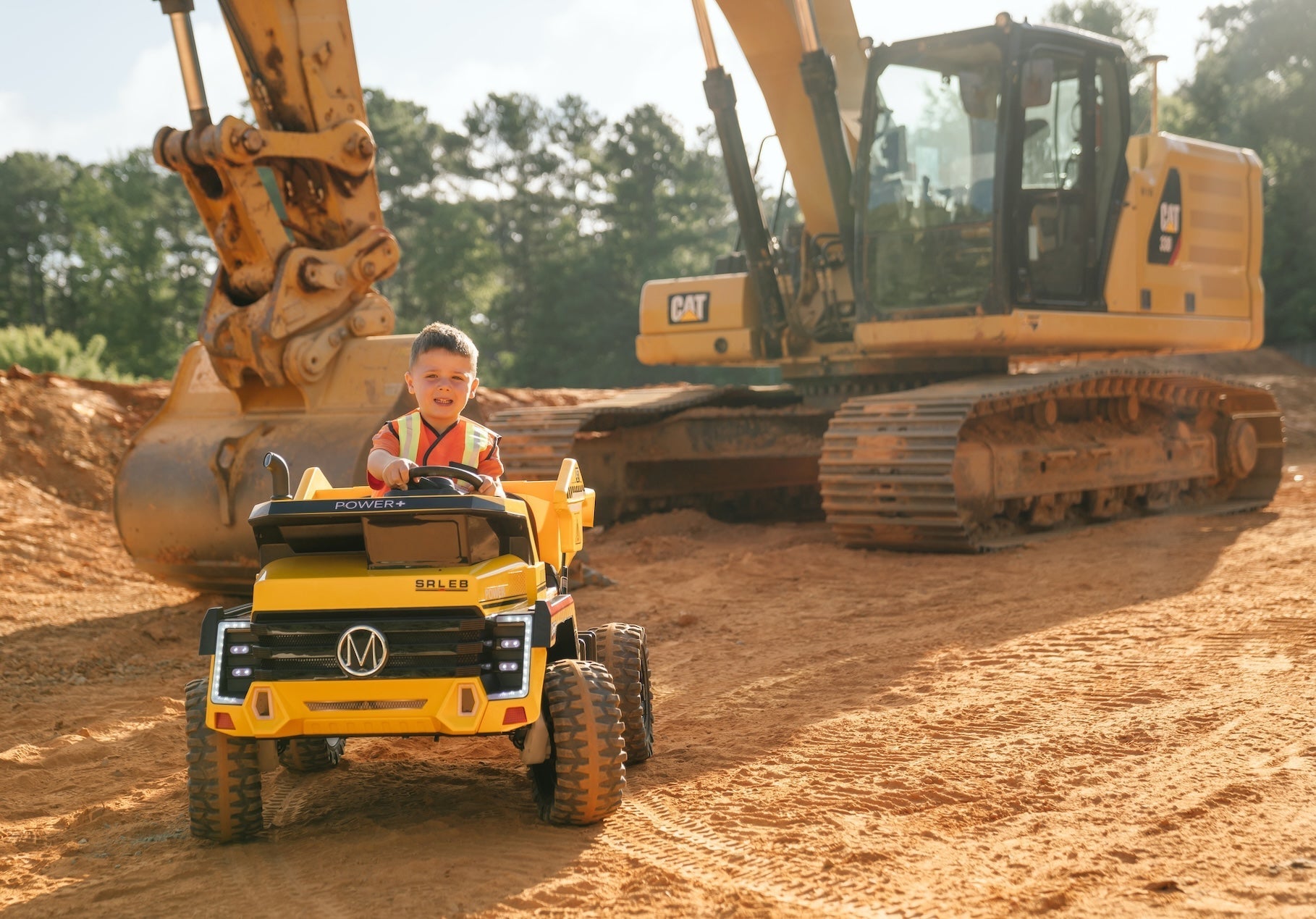
Think of it like the difference between a small car engine and a truck engine. Both will get you down a smooth highway, but only one has the torque to haul a load up a steep grade. The same principle applies to ride-on toys. A 24V dual-motor configuration, like those found in the Big Kahuna Dump Truck with its dual 550W motors, provides the muscle needed to handle real outdoor terrain without losing momentum.
Tire Types Compared: Plastic vs. Rubber vs. EVA
If voltage is the engine that powers terrain capability, tires are the shoes that deliver traction. The three most common tire types in ride-on vehicles each have distinct advantages and limitations when it comes to grass, dirt, and gravel.
Hard Plastic Wheels
These are the default option on most budget ride-on toys. They're inexpensive, durable against wear on pavement, and maintenance-free. Unfortunately, that's where the advantages end. Hard plastic offers almost no shock absorption, which means every bump and divot gets transmitted directly to the rider. On grass, they tend to slide rather than grip, and on gravel, they can slip unpredictably. If your child plans to ride exclusively on smooth concrete or tile floors, plastic wheels will suffice. For any other terrain, look elsewhere.
Air-Filled Rubber Tires
Traditional rubber tires with air chambers provide excellent shock absorption and grip on varied terrain. They're what you'll find on bicycles and full-size vehicles for good reason. However, they come with a significant drawback for ride-on toys: they can go flat. A puncture from a thorn, nail, or sharp rock means your child's adventure ends until you can repair or replace the tire. For parents who want low-maintenance outdoor play, this can be a dealbreaker.

EVA Foam Tires: The Best of Both Worlds
EVA (ethylene-vinyl acetate) foam tires have become the gold standard for premium ride-on vehicles, and for good reason. These tires combine the grip and shock absorption of rubber with the puncture-proof durability of plastic. EVA is a dense foam material that compresses slightly under weight, providing cushioning over rough terrain while maintaining excellent traction on grass, dirt, and gravel.
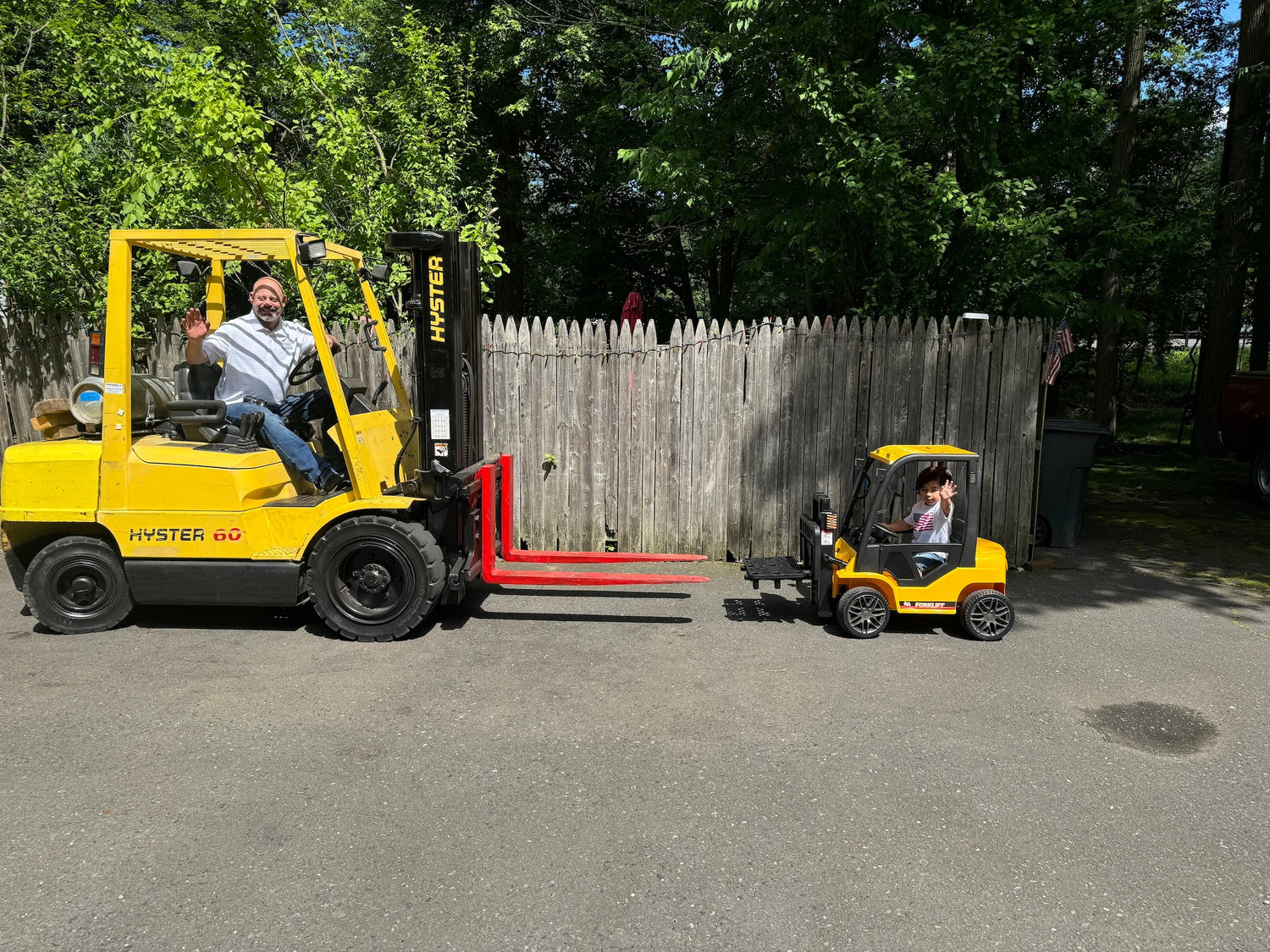
Unlike air-filled tires, EVA tires can't go flat. They're impervious to thorns, nails, and sharp rocks. This makes them ideal for outdoor exploration where you can't predict every hazard your child might encounter. Vehicles like the Forklift 9000 and Mongoose ATV come equipped with EVA tires as standard, reflecting the material's superiority for all-terrain performance.
The trade-off is cost. EVA tires are more expensive to manufacture than hard plastic, which is why they're typically found only on higher-quality ride-ons. But for parents who want a vehicle that can handle the full range of backyard terrain without constant maintenance, the investment pays dividends in durability and performance.
Motor Power and Weight: The Physics of Terrain Performance
Even the best tires in the world won't help a ride-on toy if the motor lacks sufficient power to drive them. This is where dual-motor configurations become critical for terrain capability.
A single motor, regardless of voltage, must power both rear wheels through a differential or direct connection. This setup can work on flat ground, but it struggles when one wheel encounters more resistance than the other—a common scenario on uneven terrain. Dual motors solve this problem by powering each rear wheel independently, providing better traction distribution and preventing the vehicle from getting stuck when one side hits a patch of thick grass or loose gravel.

The Big Kahuna Dump Truck, for example, features dual 550W motors paired with a 24V battery system. That's a combined 1,100 watts of power dedicated to terrain performance. Compare this to a typical 6V single-motor ride-on producing perhaps 80-100 watts total, and you can see why one vehicle powers through grass while the other stalls out.
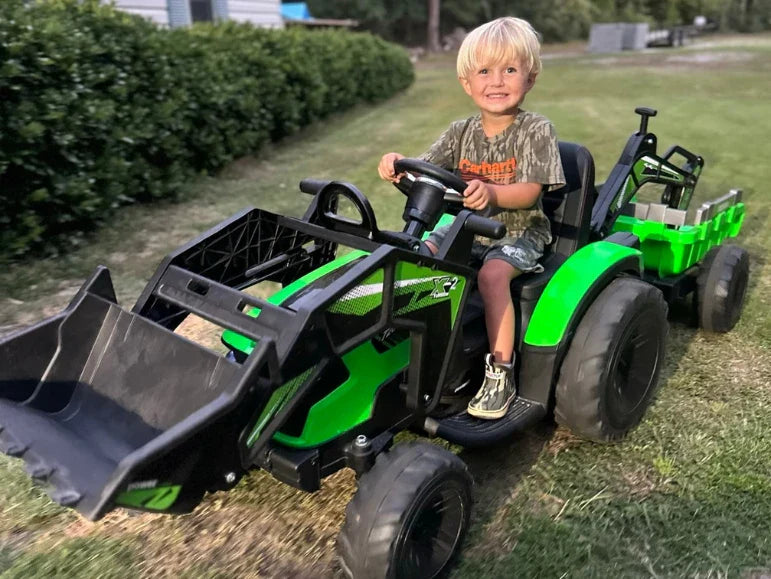
Weight is the other half of the equation. A heavier vehicle provides better traction because it increases the contact force between tires and ground. This is counterintuitive—many parents assume lighter is better for easier maneuverability. But on grass and gravel, weight becomes an advantage. The all-metal frame construction on the Big Digger Tractor isn't just about durability; it provides the mass needed to keep those EVA tires firmly planted when traversing rough terrain.
Best Ride-On Toys for Rough Terrain in 2026
If you're shopping specifically for a ride-on that can handle grass, dirt, gravel, and everything in between, focus on vehicles that combine all three critical elements: 24V power systems, dual motors, and EVA tires. These aren't just marketing features—they're engineering solutions to real-world terrain challenges.
Tough Trucks specializes in exactly this category of ride-on vehicles. As a veteran-owned business that focuses exclusively on premium construction-themed ride-ons, they've engineered their entire product line around outdoor adventure rather than smooth-surface cruising. Every vehicle in their collection (except the 6V Little Ones First Digger designed for toddlers) runs on 24V dual-motor systems with EVA tires as standard equipment.
The Big Kahuna Dump Truck is particularly well-suited for rough terrain thanks to its 100-pound weight capacity and dual 550W motors. The working electric dump bed adds an educational component—your child can actually haul dirt, sand, or gravel from one part of the yard to another, turning terrain navigation into purposeful play. With 4.9 stars from over 1,700 reviews, real parents consistently praise its ability to handle varied outdoor surfaces.

For families with multiple terrain types—perhaps grass in the backyard and a gravel driveway out front—the Mongoose ATV offers an additional advantage: four-wheel shock absorbers. This suspension system smooths out the ride over bumpy surfaces while maintaining tire contact with the ground for consistent traction. The touch screen control center and Bluetooth connectivity are bonuses, but the real star is the suspension that makes rough-terrain riding comfortable for kids ages 3-8.
What separates these vehicles from big-box alternatives isn't just the specifications—it's the philosophy behind them. Tough Trucks ships 80% pre-assembled from their LA warehouse, meaning you'll spend 30-45 minutes on setup rather than hours deciphering confusing instructions. The 90-day bumper-to-bumper warranty and American-based customer support (9am-4pm Monday-Friday) provide peace of mind that you won't be left stranded if issues arise. And because these vehicles are built with higher-quality materials than typical Walmart or Amazon alternatives, they hold up to the punishment that outdoor terrain delivers.
Can Electric Ride-On Toys Go on Dirt and Gravel?
Yes, but with important caveats. Not all electric ride-ons are created equal when it comes to loose surfaces like dirt and gravel. These materials present unique challenges because they shift under the tires, requiring both adequate traction and sufficient motor torque to maintain forward momentum.
Gravel is particularly demanding. The small rocks can jam in mechanical components, and they provide an unstable surface that requires continuous power adjustments to navigate. A vehicle with too little torque will spin its wheels uselessly. One with inadequate ground clearance might drag its undercarriage. And plastic wheels simply don't have the grip needed to find purchase in loose stone.

This is where the combination of EVA tires and dual motors becomes essential. EVA's slight compression creates a larger contact patch with gravel, distributing weight and improving stability. Dual motors ensure that when one wheel hits a patch of loose stone, the other can compensate, keeping the vehicle moving forward rather than getting bogged down.
Dirt presents a different challenge depending on moisture level. Dry, packed dirt behaves similarly to hard-packed grass—it requires decent traction and moderate power to traverse. Muddy dirt, however, is exponentially more difficult. Few ride-on toys are truly capable in mud, and it's generally not recommended even for high-quality vehicles due to the risk of motor and electronic damage from water and debris intrusion.
For families with dirt or gravel driveways, or those who want to create a backyard "construction site" with dirt piles and gravel paths, investing in a 24V dual-motor ride-on with EVA tires isn't optional—it's essential. The alternative is a toy that sits unused because it can't access half the play space.
Practical Tips for Maximizing Terrain Performance
Even the most capable ride-on will perform better with a few practical considerations. First, battery charge matters more than you might think. As a battery depletes, available torque decreases. What might have been a manageable incline at full charge becomes impossible at 50%. Make it a habit to charge the battery after each play session, ensuring your child always has maximum power available for terrain challenges.
Second, weight distribution affects traction. If your ride-on has a working dump bed or front loader, experiment with adding a bit of weight (sand, small rocks) to improve rear traction on slippery surfaces. Just stay within the vehicle's weight capacity—overloading can strain motors and reduce battery life.
Third, teach your child to approach terrain changes at an angle rather than head-on. Transitioning from grass to gravel, or from flat ground to an incline, works better when done gradually. This is actually a valuable physics lesson disguised as play—they're learning about momentum, traction, and mechanical advantage without realizing it.
Finally, inspect the vehicle regularly for grass clippings, dirt, or gravel caught in wheel wells or mechanical components. A quick post-play cleanup extends the life of motors and prevents small issues from becoming big problems. Tough Trucks vehicles are designed for outdoor use, but a little preventive maintenance goes a long way toward ensuring years of terrain-capable performance.
Frequently Asked Questions
Do 6V ride-on toys work on grass?
Most 6V ride-on toys struggle significantly on grass due to limited motor power. They may be able to traverse very short, well-manicured grass on flat terrain, but they typically lack the torque needed to handle anything beyond smooth surfaces. The exception is vehicles specifically designed for toddlers with very low weight, like the Little Ones First Digger, which can handle light grass thanks to its low center of gravity and minimal weight. For reliable grass performance with older children, a 24V system is recommended.
What's the difference between 12V and 24V ride-on toys for terrain?
A 24V system provides approximately double the power of a 12V system, which translates directly to better terrain capability. While a 12V ride-on might handle flat grass with some effort, a 24V vehicle can tackle inclines, thick grass, and uneven ground without bogging down. The difference becomes especially noticeable with heavier children or when navigating from one terrain type to another, such as grass to gravel. For families serious about outdoor play, 24V is the minimum recommended voltage.
Can ride-on toys damage grass or lawns?
High-quality ride-on toys with EVA or rubber tires typically cause minimal lawn damage when used reasonably. The risk comes from extended use in the same area, which can compact soil, or from doing repeated tight turns in one spot that tears up grass. Hard plastic wheels are more likely to cause damage due to their narrow contact patch and tendency to dig into soft ground. To minimize impact, encourage varied play patterns across different areas of the yard and avoid using ride-ons on wet grass where tires are more likely to leave ruts.
How do EVA tires compare to air-filled tires for outdoor use?
EVA foam tires offer nearly identical traction and shock absorption to air-filled rubber tires, with the significant advantage of being puncture-proof. Air-filled tires can provide slightly better cushioning on very rough terrain, but they require maintenance and can go flat from thorns, nails, or sharp rocks—a common occurrence during outdoor play. For ride-on toys where convenience and reliability matter, EVA is generally the superior choice. The performance difference in normal backyard conditions is negligible, while the maintenance advantage is substantial.
What terrain should I avoid with ride-on toys?
Even high-quality 24V ride-ons should avoid certain conditions. Deep mud or standing water can damage electrical components and motors. Steep inclines beyond the manufacturer's specifications risk tipping or motor strain. Very thick, tall grass (more than 3-4 inches) can wrap around axles and jam mechanisms. Sharp rocks or debris fields that could damage tires or undercarriage components should be cleared before play. Stick to grass, dirt, gravel, gentle inclines, and hard-packed surfaces for the best combination of safety and performance.
Ready to Explore Real Terrain?
Choosing a ride-on toy that can handle grass, dirt, and gravel isn't about finding the cheapest option—it's about investing in a vehicle that won't disappoint when your child takes it beyond the driveway. The combination of 24V power, dual motors, and EVA tires separates toys that sit unused after the first outdoor attempt from vehicles that become central to years of outdoor exploration and learning.
Tough Trucks builds every vehicle around the principle that outdoor play should be limitless. With lightning-fast shipping (2-5 days from their LA warehouse), 90-day bumper-to-bumper warranty, and American-based customer support, you're not just buying a ride-on toy—you're investing in the kind of screen-free, hands-on adventure that builds problem-solving skills and confidence.
Browse the full collection of terrain-capable ride-on vehicles and find the perfect match for your child's next outdoor adventure at Tough Trucks For Kids.

Dejar un comentario
Este sitio está protegido por hCaptcha y se aplican la Política de privacidad de hCaptcha y los Términos del servicio.