

When you watch your child climb into their first ride-on toy, pride and excitement mix with that familiar parental instinct to protect. You're not just buying a toy—you're investing in outdoor adventure, physical development, and hours of screen-free play. But as these vehicles have evolved from simple push toys to sophisticated electric ride-ons with real horsepower, understanding ride on toy safety has become more important than ever.
The good news? Modern electric ride-ons are engineered with safety at their core. When you know what to look for and how to supervise properly, these vehicles provide children with invaluable lessons in spatial awareness, cause-and-effect reasoning, and motor skill development—all while keeping them safe. This guide walks you through everything you need to know about ride-on toy age requirements, essential safety features, and how to create the safest possible play environment for your young driver.
The Foundation: Age-Appropriate Selection
The single most important safety decision you'll make is choosing a ride-on toy that matches your child's developmental stage. A vehicle that's too advanced can overwhelm young reflexes and coordination, while one that's too basic won't properly engage an older child—leading to risky behavior as they push the limits.
Understanding Toddler Ride-Ons (Ages 1-3)
For the youngest adventurers, ride-on toy safety begins with vehicles specifically engineered for developing motor skills. Toddler ride-ons should feature lower voltage systems—typically 6V—that keep speeds conservative, usually maxing out around 2.5 to 3.5 mph. This gives little ones time to process what they're seeing and react appropriately.
The Little Ones First Digger exemplifies this approach with its 6V battery system and toddler-friendly controls designed for small hands still developing fine motor coordination. The low center of gravity prevents tipping, while the controlled 3.5 mph maximum speed gives parents peace of mind. At this age, the working excavator arm teaches cause-and-effect reasoning without overwhelming speed or complexity.
Look for wide wheelbases, seats positioned low to the ground, and simple one-button operation. These features aren't just convenient—they're fundamental safety elements that prevent rollovers and allow toddlers to focus on the basics of steering and stopping.
Elementary Age Ride-Ons (Ages 3-8)
Once children develop better balance, reaction time, and spatial reasoning—typically around age three—they're ready for 24V ride-ons with more sophisticated features. These vehicles can reach speeds of 4 to 5 mph, similar to a brisk adult walk, providing genuine adventure while remaining controllable.
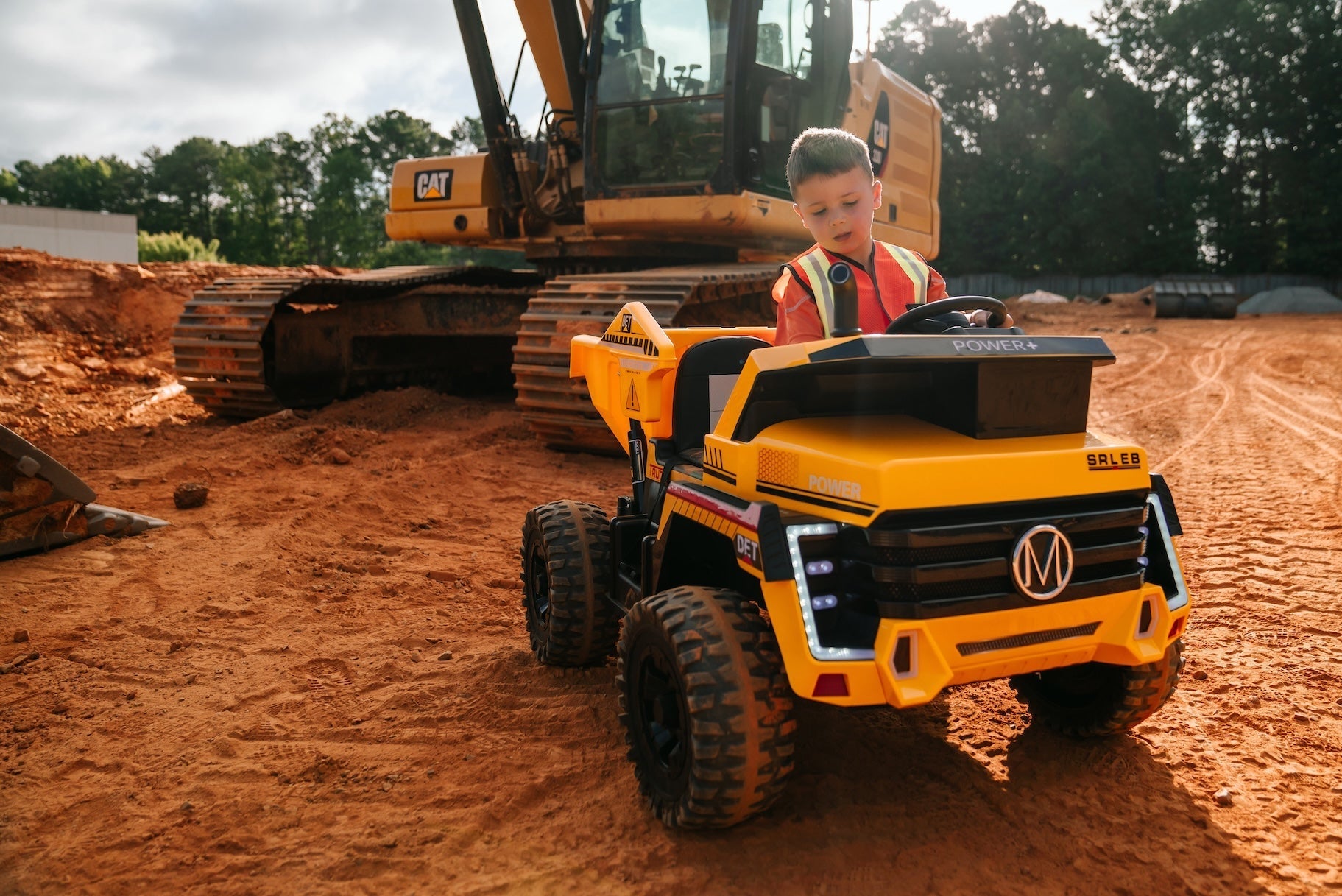
The critical factor at this stage is matching the vehicle's capabilities to your specific child's skill level. A cautious four-year-old might do better starting with a vehicle that has adjustable speed settings, allowing you to begin at lower speeds and increase as their confidence grows. Meanwhile, an experienced six-year-old with good judgment might be ready for the full capabilities of a vehicle like the Big Kahuna Dump Truck, which reaches 4.50 mph and includes working features like an electric dump bed that teaches practical physics concepts.
Pay close attention to weight capacity ratings. These aren't arbitrary numbers—they represent the engineering limits where stability, braking performance, and motor efficiency remain optimal. Exceeding weight limits compromises every safety system on the vehicle.
Essential Electric Ride On Safety Features
Modern electric ride-ons incorporate multiple layers of safety technology. Understanding these features helps you evaluate which vehicles offer genuine protection versus marketing fluff.
Parent Remote Control: Your Safety Override
A parent remote control isn't just a convenience feature—it's a critical safety mechanism that gives you ultimate override authority. The best systems allow you to take complete control of steering, acceleration, and braking from up to 100 feet away.
This becomes invaluable in those split-second moments when a child heads toward a hazard they haven't noticed, or when they panic and forget how to brake. Every vehicle in the Tough Trucks lineup includes a parent remote precisely because it transforms these vehicles from autonomous toys into supervised adventures where you maintain final authority.
Look for remotes with intuitive controls that don't require you to fumble through buttons in an emergency. The best designs use simple joystick operation that mirrors video game controllers—something you can operate instinctively when it matters most.
Speed Settings and Power Management
Adjustable speed settings serve two crucial purposes: they allow you to match the vehicle's performance to your child's skill level, and they let you restrict speeds based on terrain and conditions. A vehicle that's safe at full speed on flat grass might need speed limiting when your child is learning on pavement or navigating slopes.
Progressive speed unlocking—where you start at lower settings and gradually increase as skills develop—teaches children that increased capability requires demonstrated responsibility. This isn't just about physical safety; it's about building judgment and decision-making skills that extend far beyond the driveway.
Quality 24V systems like those in the Forklift 9000 deliver consistent power management that prevents unexpected acceleration or power surges. The dual 555W motors provide smooth, predictable performance that children can anticipate and control.
Seatbelts and Restraint Systems
Are ride on toys safe without seatbelts? The honest answer is that seatbelts significantly reduce injury risk, particularly for younger children still developing balance. While these vehicles travel at walking speed rather than automotive speed, sudden stops or uneven terrain can still throw an unrestrained child forward.
Look for adjustable seatbelts that can grow with your child and that they can buckle independently once they develop the motor skills. This independence is important—you want them learning the habit of always buckling up, not just when an adult does it for them.
Some vehicles integrate the seatbelt into a larger safety seat design with side bolsters that provide lateral support during turns. This is particularly valuable for younger children who might lean too far into turns before they develop a feel for the vehicle's balance point.
Tire Design and Traction
Tires are where the vehicle meets the world, making them a critical safety component that doesn't get enough attention. Hard plastic wheels—common on budget ride-ons—offer minimal traction on grass and can slip dangerously on smooth surfaces like garage floors or decks.
EVA foam tires provide superior grip across multiple surfaces without the maintenance concerns of air-filled tires. They won't go flat, they dampen vibration for a smoother ride, and they deliver consistent traction whether your child is driving on grass, packed dirt, or pavement. Every Tough Trucks vehicle uses EVA tires specifically because they enhance safety across the varied terrain where children actually play.
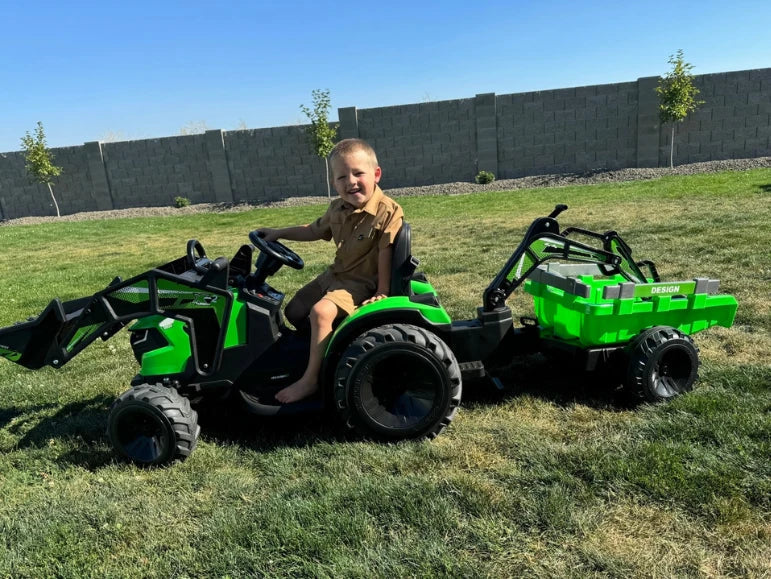
Wide tire spacing and appropriate ground clearance also factor into stability. Vehicles with narrow track widths tip more easily on side slopes or during sharp turns. The Big Digger Tractor uses a wide stance and substantial EVA wheels specifically to maintain stability even when the front scooper is loaded—teaching children about weight distribution and balance through hands-on experience.
Structural Protection and Build Quality
The materials and construction quality directly impact safety. All-metal frames withstand impacts that would crack plastic bodies, maintaining structural integrity through years of adventurous play. This durability isn't just about longevity—a frame that stays intact protects the child inside.
Look for designs with cabin protection or roll bars that create a protective zone around the child. Smooth edges, recessed hardware, and rounded corners prevent cuts and scrapes. Battery compartments should be fully enclosed and require tools to access—children should never have direct contact with battery terminals.
Quality construction also ensures consistent performance of safety systems. Cheap assemblies develop loose connections that can cause erratic behavior or unexpected shutoffs. When you're evaluating ride-on toy safety, remember that reliability is a safety feature—you need to trust that the vehicle will respond predictably every single time your child uses it.
Creating a Safe Operating Environment
Even the safest vehicle needs an appropriate environment. The terrain, weather conditions, and physical space all factor into ride on toy safety.
Terrain Assessment and Boundaries
Start by establishing clear boundaries for where the vehicle can operate. Flat, open areas free from obstacles provide the safest learning environment. Grass offers some cushioning for falls while providing enough traction for control. Avoid areas near streets, driveways where cars might back up, bodies of water, or steep slopes until children demonstrate advanced skill.
As children gain experience, you can gradually expand boundaries and introduce more challenging terrain. Gentle slopes teach hill climbing and controlled descent. Packed dirt paths develop navigation skills. Hard surfaces like sidewalks demonstrate different traction characteristics. This progressive approach builds competence systematically rather than overwhelming children with complexity all at once.
Watch for hidden hazards: sprinkler heads, tree roots, garden hoses, pet toys, and yard equipment all become obstacles when you're two feet off the ground. Before each play session, do a quick visual sweep of the area. This also models good safety habits—eventually, older children will start doing their own pre-drive checks.
Weather and Time of Day Considerations
Electric ride-ons should never operate in rain or on wet surfaces. Water and electricity don't mix, and wet surfaces dramatically reduce traction. Even morning dew can make grass slippery enough to compromise control.
Extreme temperatures affect battery performance. Cold weather reduces battery capacity and power output, which might actually be beneficial for very young drivers but should be factored into range expectations. Hot weather can accelerate battery drain and cause motors to run warmer—give vehicles cool-down breaks during extended summer play sessions.
Time of day matters for visibility. Early morning or dusk lighting makes it harder for children to see obstacles and for you to supervise effectively. The LED lights on vehicles like the Big Kahuna Dump Truck aren't just fun features—they genuinely improve visibility during those times when natural light is marginal.
Appropriate Supervision Strategies
Supervision doesn't mean hovering—it means maintaining appropriate oversight based on the child's age, skill level, and the operating environment. For toddlers on their first ride-ons, that means staying within arm's reach, ready to steady them or redirect the vehicle. For experienced elementary-age children in familiar, safe terrain, supervision might mean watching from the porch while you fold laundry—present and attentive but allowing independence.
The parent remote control bridges these supervision levels. You can give children the autonomy to drive independently while maintaining override capability when needed. This balance teaches responsibility while keeping the safety net in place.
Establish clear rules before each session: where they can drive, how to signal when they're done, what to do if something seems wrong with the vehicle. Consistency in these rules builds habits that become automatic safety responses.
Battery Safety and Maintenance
Batteries deserve special attention in any discussion of electric ride on safety features. These power systems are safe when properly maintained but require respect and understanding.
Charging Safety Protocols
Always charge batteries in well-ventilated areas away from flammable materials. Never charge overnight unattended—while modern chargers include overcharge protection, no electronic system is infallible. The charging cycle for quality 24V systems typically takes 8-12 hours, so plan charging times when you're home and awake.
Use only the charger provided with the vehicle. Aftermarket chargers might have different voltage or amperage specifications that can damage batteries or create fire hazards. If you need a replacement charger, source it directly from the manufacturer to ensure proper specifications.
Never let children handle battery charging. This is adult-only territory. The same goes for battery replacement or any maintenance involving the battery compartment.
Storage and Seasonal Maintenance
When vehicles will sit unused for extended periods, charge batteries to approximately 50-75% capacity and disconnect them. Fully charged batteries left connected can self-discharge and drop to levels that cause permanent capacity loss. Store vehicles in climate-controlled spaces when possible—extreme temperatures accelerate battery degradation.
Before each season's first use, inspect batteries for any swelling, leaking, or corrosion around terminals. These signs indicate battery failure and require immediate replacement. Never attempt to use a damaged battery.
Teaching Children Safe Operation
The most sophisticated safety features mean nothing if children don't understand how to operate the vehicle responsibly. Teaching ride on toy safety is as important as the features themselves.
Pre-Drive Instruction
Before the first drive, walk children through every control. Explain what each pedal, button, or lever does. Let them practice in place before moving. Demonstrate proper seating position and why the seatbelt matters. Show them how to stop—and practice stopping repeatedly until it becomes reflex.
For vehicles with working features like the dump bed on the Big Kahuna or the lifting forks on the Forklift 9000, explain not just how these features work but when it's safe to use them. A child who dumps the bed while moving might get startled by the shift in balance. Teaching them to stop first, operate the feature, then resume driving creates safe habits.
Progressive Skill Building
Start simple: straight lines forward and back. Then add turning. Then backing up. Then obstacles to navigate around. Then gentle slopes. This progression builds competence layer by layer, with each skill mastered before adding complexity.
The working features on Tough Trucks vehicles provide natural opportunities for skill progression. Learning to scoop with the Big Digger Tractor's front loader teaches precision and control. Operating the Forklift 9000's lifting mechanism while stationary develops fine motor skills before adding the complexity of doing it while moving.
Modeling Good Judgment
Children learn more from what you do than what you say. When you consistently enforce safety rules—no exceptions for "just this once"—you teach that safety isn't negotiable. When you inspect the vehicle before each use, they learn that maintenance matters. When you expand boundaries only after demonstrated skill, they learn that increased freedom requires proven responsibility.
Talk through your decision-making: "The grass is still wet this morning, so let's wait until after lunch when it's dried out." "That slope looks too steep—let's find a gentler hill to practice on first." This narration teaches risk assessment, a skill that transfers far beyond ride-on toys.
Special Safety Considerations for Different Vehicle Types
Dump Trucks and Load-Bearing Vehicles
Vehicles with working dump beds or cargo areas introduce weight distribution dynamics. Teach children that heavy loads affect handling—the vehicle might not turn as sharply or stop as quickly. Establish rules about maximum load weights (dirt, rocks, toys) and always distributing weight evenly.
The electric dump bed on the Big Kahuna creates a teachable moment about pinch points. Children need to understand that moving parts require clear zones—no hands or toys under the bed when it's operating. This lesson applies to garage doors, car trunks, and countless other real-world situations.
Forklifts and Lifting Vehicles
The real lifting power of the Forklift 9000—capable of hoisting 22 pounds—means it can actually affect the vehicle's stability. Teach children to approach lifting systematically: position the forks, raise slowly, reverse away from the pickup zone, lower the forks to travel height.
The stable base design of quality forklift ride-ons prevents tipping, but children still need to understand that lifting changes the center of gravity. This is practical physics education—they're learning about leverage, balance, and load dynamics through direct experience.
ATVs and Open-Frame Vehicles
Vehicles like the Mongoose ATV Quad offer different design characteristics than enclosed ride-ons. The open frame provides better visibility and a sportier feel but requires children to maintain seated position actively rather than being guided by a cabin structure.
The four-wheel shock absorbers on the Mongoose handle terrain variations smoothly, but children need to learn that rough terrain requires reduced speed and firmer grip. The touch screen control center adds sophistication that older children appreciate, but it also requires teaching appropriate interaction with technology while driving—lessons that apply directly to future automotive safety.
When Safety Features Fail: Troubleshooting and Repairs
Even well-maintained vehicles occasionally develop issues. Knowing what's normal versus what requires immediate attention is part of ride on toy safety.
Identifying Safety-Critical Problems
Stop using the vehicle immediately if you notice: unresponsive steering, brakes that don't engage fully, erratic speed changes, unusual sounds from motors, smoke or burning smells, or parent remote that stops responding. These aren't "keep using until convenient to fix" issues—they're "stop now" safety concerns.
Also watch for structural problems: cracks in frames or seats, loose wheels, damaged tires, or any hardware coming loose. Vehicles experience significant forces during normal use, and components do wear. Catching wear early prevents failures during operation.
When to Contact Support
For safety-critical issues or anything involving electrical systems or batteries, contact manufacturer support rather than attempting DIY repairs. Tough Trucks provides American-based customer support specifically because safety concerns require expert guidance, not guesswork.
The 90-day bumper-to-bumper warranty on Tough Trucks vehicles covers manufacturing defects and component failures. This isn't just about protecting your investment—it ensures that safety-critical components get proper professional attention.
The Bigger Picture: What Ride-On Toys Teach About Safety
Here's what often gets overlooked in discussions about ride on toy safety: these vehicles are teaching moments for risk assessment, responsibility, and consequence understanding that children will carry for life.
When a child learns to check their path before accelerating, they're developing situational awareness. When they practice stopping before operating the dump bed, they're learning sequential thinking and procedure following. When they discover that turning too sharply on a slope affects balance, they're getting hands-on physics and engineering education.
The question "are ride on toys safe?" misses the deeper value. With appropriate selection, proper supervision, and quality equipment, ride-on toys aren't just safe—they're developmental tools disguised as adventure. They teach children to assess their environment, understand their own capabilities, and make decisions with consequences more immediate and tangible than most childhood experiences provide.
This is why Tough Trucks focuses exclusively on ride-on vehicles rather than being a general toy retailer. Specialization allows deep expertise in safety engineering, age-appropriate design, and the educational value these vehicles provide. It's not just about building better dump trucks—it's about building tomorrow's builders through experiences that teach real-world skills.
Making Your Decision: Choosing the Safest Ride-On for Your Family
Armed with understanding of essential safety features and age-appropriate selection, you're ready to choose the right vehicle. Start by honestly assessing your child's current skill level, not where you hope they'll be or what their peers are doing. A vehicle that matches their present abilities will be used more, enjoyed more, and operated more safely.
Consider your actual operating environment. A large, flat backyard accommodates any vehicle type. A smaller, sloped yard might be better suited to more maneuverable vehicles. Urban families with limited private space might need to plan around park visits or shared play areas.
Don't compromise on safety features to save money. The price difference between a budget ride-on and a quality vehicle like those from Tough Trucks often comes down to exactly the safety features we've discussed: parent remotes, quality tires, stable construction, reliable electrical systems. These aren't luxuries—they're the fundamentals of ride on toy safety.
Look for manufacturers who specialize in ride-ons rather than mass-market toy retailers. Specialists invest in engineering, customer support, and warranty programs because their reputation depends entirely on these products. That focus translates to better safety outcomes.
Frequently Asked Questions About Ride-On Toy Safety
What age is safe for electric ride-on toys?
Children as young as 12-18 months can safely use 6V ride-ons specifically designed for toddlers, like the Little Ones First Digger, which features appropriate speed limits, low center of gravity, and simplified controls. For 24V ride-ons with more power and features, age three is generally the starting point, though individual children develop at different rates. The key is matching the vehicle's capabilities to your specific child's coordination, judgment, and impulse control rather than relying solely on age recommendations. Parent remote controls allow you to maintain override authority while children develop skills, making these vehicles adaptable as abilities grow.
Do kids really need to wear helmets on ride-on toys?
While not legally required for ride-on toys operating on private property, helmets provide meaningful protection and establish lifelong safety habits. Ride-on toys travel at 3-5 mph—fast enough that falls can cause head impacts, particularly when children are learning steering and balance. A properly fitted bicycle helmet absorbs impact forces that could otherwise cause concussion or skull fractures. Beyond physical protection, wearing helmets normalizes safety equipment for future bicycle, scooter, and eventually automotive use. If your child resists, let them choose a helmet design they're excited about—making it part of the fun rather than a restriction.
How do I know if a ride-on toy is too powerful for my child?
Watch for these warning signs: your child seems overwhelmed or anxious rather than confident, they frequently lose control or can't stop smoothly, they're not looking ahead and planning their path, or they're relying heavily on the parent remote for basic operation. If you see these signs, the vehicle might be too advanced, or your child might need more practice in a simplified environment before tackling open areas. Conversely, a properly matched vehicle produces focused engagement—children are challenged but not overwhelmed, building skills progressively. Adjustable speed settings let you dial in the right challenge level and increase it as skills develop.
What's the most important safety feature on electric ride-on toys?
While all safety features work together, the parent remote control provides the most comprehensive protection because it gives you ultimate override authority in any situation. No matter what happens—whether your child panics and forgets how to brake, heads toward an unseen hazard, or drives beyond boundaries—you can take complete control instantly. This transforms the vehicle from an autonomous toy into a supervised learning experience where children gain independence while you maintain final authority. Combined with other essential features like seatbelts, appropriate speed limits, and quality construction, the parent remote creates multiple protective layers that work together for comprehensive safety.
How should I maintain a ride-on toy for optimal safety?
Conduct a quick pre-use inspection before each play session: check tire condition and inflation (or foam integrity), test brakes and steering, verify the parent remote connects properly, and confirm the seatbelt functions. Weekly, inspect for loose hardware, damaged components, or developing wear patterns. Monthly, clean battery terminals (with batteries disconnected), check all electrical connections, and test safety features systematically. Charge batteries promptly after use rather than letting them sit depleted, and store vehicles in climate-controlled spaces when possible. Address any unusual sounds, performance changes, or component damage immediately rather than waiting—small issues caught early prevent safety-critical failures during operation. Keep the manufacturer's contact information accessible for any questions about maintenance or repairs.
Building Tomorrow's Builders—Safely
The adventure begins with that first turn of the wheel, that first successful parking job, that first load dumped in exactly the right spot. Every skill children develop driving their ride-on vehicles translates to confidence, competence, and real-world understanding that serves them far beyond childhood.
Ride on toy safety isn't about eliminating all risk—it's about managing risk appropriately so children can have genuine adventures with proper protection. It's about choosing vehicles engineered with safety as fundamental rather than afterthought. It's about supervision that balances independence with oversight. It's about creating an environment where children can push boundaries safely, fail safely, learn safely, and grow.
The vehicles your children drive today teach lessons that shape the adults they'll become tomorrow. When you invest in quality ride-ons with comprehensive safety features, you're not just buying a toy—you're providing educational experiences disguised as play, building skills through adventure, and creating memories that last a lifetime.
Ready to find the perfect vehicle for your young builder? Explore the complete collection of safety-focused, adventure-ready ride-ons built specifically for educational play. Every vehicle includes parent remote control, premium safety features, and the quality construction that makes Tough Trucks the choice of families who value both excitement and protection.
Shop All Tough Trucks — Because building tomorrow's builders means keeping today's kids safe.

Dejar un comentario
Este sitio está protegido por hCaptcha y se aplican la Política de privacidad de hCaptcha y los Términos del servicio.