
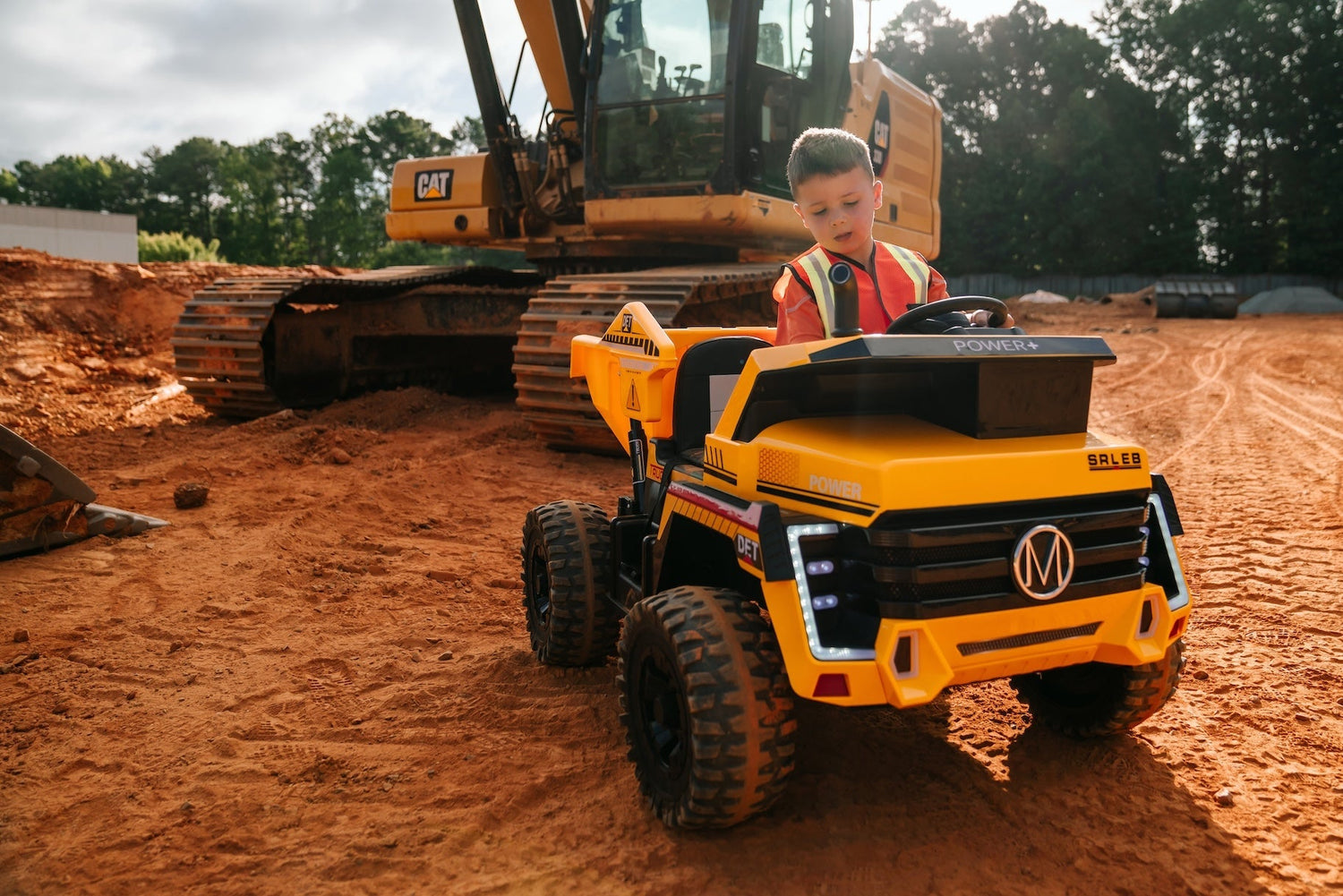
If you're like most parents today, you've probably asked yourself this question while watching your child beg for yet another battery-powered vehicle: are ride-on toys actually educational, or are they just expensive entertainment?
It's a fair question. We live in an era where every toy claims to be "STEM-focused" or "developmentally beneficial." But when it comes to ride-on construction vehicles—those miniature dump trucks, forklifts, and excavators that kids can actually drive—the research tells a surprisingly compelling story.
The short answer? Yes, ride-on construction toys offer significant educational benefits, particularly when they incorporate realistic features that encourage problem-solving and hands-on learning. But not all ride-on toys are created equal, and understanding what makes them educational can help you make smarter choices for your child's development.
The Science Behind Physical Play and Cognitive Development
Before we dive into the specific benefits of construction-themed ride-on toys, let's talk about what child development research actually tells us about active play.
According to the American Academy of Pediatrics, physical play is essential for developing executive function skills—the mental processes that help children plan, focus attention, remember instructions, and juggle multiple tasks. These aren't just "nice to have" skills; they're the foundation for academic success and lifelong learning.
What makes ride-on toys particularly valuable is that they combine gross motor activity with decision-making. Your child isn't just moving their body—they're navigating space, judging distances, controlling speed, and making split-second choices about direction and obstacles. This integration of physical and cognitive activity creates what researchers call "embodied learning," where the body and brain work together to understand concepts.

Think about a child operating a ride-on dump truck with a working dump bed. They're not just driving in circles. They're learning cause and effect (pressing this button raises the bed), understanding mechanical advantage (why the bed tilts to dump), and practicing spatial reasoning (how close do I need to get to dump this load in the right spot?).
STEM Learning Happens in the Driveway
When most parents think about STEM education, they picture coding classes or robotics kits. But some of the most powerful STEM learning happens through hands-on experimentation with real-world machines—even miniature ones.
Physics in Action
Ride-on construction toys are essentially mobile physics laboratories. Children naturally experiment with concepts like momentum, friction, inclines, and weight distribution every time they play. When a child tries to drive their forklift up a slope while carrying a load, they're learning about gravity and torque. When they discover that their truck moves faster on pavement than grass, they're experiencing friction firsthand.
These aren't abstract textbook concepts—they're lived experiences that create deep, intuitive understanding of how the world works.
Mechanical Understanding
Construction-themed ride-on toys that include working features—like functional dump beds, lifting forks, or digging scoops—teach children about simple machines and mechanical systems. A ride-on forklift with real lifting capability introduces concepts like hydraulics, leverage, and load balancing in a way that's immediately tangible and exciting.

Many parents are surprised to discover that their four-year-old understands why you can't lift a heavy object when the forks are extended too far—not because someone explained it, but because they experienced the forklift tipping forward and had to problem-solve their way to a solution.
Cause and Effect Mastery
One of the foundational concepts in early childhood development is understanding cause and effect: if I do X, then Y will happen. Ride-on construction toys offer countless opportunities to test and refine this understanding.
Press the pedal, the truck moves forward. Turn the wheel left, the vehicle goes left. Pull the lever, the dump bed rises. These simple cause-and-effect relationships might seem obvious to adults, but for young children, they're essential building blocks of logical thinking and hypothesis testing.
Motor Skills Development: More Than Just Driving Around
Ask any pediatric occupational therapist, and they'll tell you that gross motor and fine motor development are critical during the early childhood years. Ride-on toys excel in both areas.
Gross Motor Skills
Operating a ride-on vehicle requires core strength, balance, and coordination. Children develop leg strength through pedal control, core stability from maintaining posture while moving, and bilateral coordination as they learn to steer, accelerate, and operate auxiliary controls simultaneously.
For toddlers just mastering walking, even a simple ride-on excavator designed for ages 1-3 provides valuable practice in weight shifting, spatial awareness, and controlled movement—all critical precursors to more advanced physical skills.

Fine Motor Skills and Hand-Eye Coordination
While the big movements get most of the attention, the fine motor demands of ride-on toys are equally important. Gripping a steering wheel, pressing buttons, manipulating levers to control working attachments—these activities strengthen hand muscles and refine finger dexterity.
More importantly, ride-on toys develop hand-eye coordination in a dynamic environment. Unlike static activities, where a child might practice stacking blocks while sitting still, operating a moving vehicle requires constant visual scanning, spatial judgment, and coordinated responses. This kind of practice directly translates to skills needed for everything from handwriting to sports.
Problem-Solving and Executive Function Skills
Here's where ride-on construction toys really shine from an educational perspective. Unlike passive toys that do all the "thinking" for the child, quality ride-on vehicles create endless opportunities for problem-solving and strategic thinking.
Consider a child who wants to move a pile of sand from one side of the yard to the other using their dump truck. They need to plan a route, figure out how much sand the truck can carry, navigate obstacles, dump the load in the right location, and repeat the process. That's planning, execution, adjustment, and persistence—all key executive function skills.
When children engage in this kind of purposeful, goal-directed play, they're practicing the same cognitive skills they'll need for complex tasks later in life, from completing homework assignments to managing projects in their careers.
Obstacle Navigation and Spatial Reasoning
Every driveway, backyard, or sidewalk becomes a different learning environment. Children learn to judge whether their vehicle will fit through a gap, how sharp they can turn without hitting something, and how to back up when they've driven into a corner.
These spatial reasoning skills are strongly correlated with later mathematics achievement, particularly in geometry and algebra. But more immediately, they help children become more confident and capable navigators of their physical world.
Social-Emotional Learning Through Construction Play
While we often focus on cognitive and physical development, ride-on construction toys also offer significant social-emotional learning opportunities, especially when children play together.
Cooperative Play and Teamwork
Construction-themed play naturally lends itself to collaborative projects. Multiple children with different vehicles can work together on imaginary construction sites, learning to coordinate their efforts, communicate their intentions, and share resources.
A child with a dump truck might haul materials while a friend with a tractor digs foundations. This kind of cooperative play teaches negotiation, turn-taking, and the satisfaction of working toward a shared goal—all essential social skills.

Persistence and Frustration Tolerance
Let's be honest: operating these vehicles isn't always easy, especially at first. Children face challenges—getting stuck, misjudging turns, struggling to operate controls smoothly. Working through these frustrations builds resilience and teaches that competence comes through practice and persistence.
This kind of productive struggle is increasingly recognized as essential for healthy development. When children overcome real challenges—not artificially easy tasks—they develop genuine self-confidence and a growth mindset.
What Makes a Ride-On Toy Truly Educational?
Not all ride-on toys deliver equal educational value. If you're investing in your child's development, here are the features that make a real difference:
Working features that mirror real equipment: Vehicles with functional dump beds, lifting forks, or digging scoops create opportunities for mechanical learning and problem-solving that simple driving can't match.
Realistic controls and responsive handling: Toys that respond predictably to a child's inputs teach cause-and-effect more effectively than vehicles that move erratically or unpredictably.
Appropriate challenge level: The best educational toys offer some challenge without being overwhelming. Look for vehicles designed for your child's specific age range with controls they can master with practice.
Durability for extended play: Educational value comes from repeated use over time. A well-built vehicle that lasts for years provides exponentially more learning opportunities than a flimsy toy that breaks quickly.
Outdoor-ready construction: Real learning happens in varied environments—grass, gravel, slight inclines, different terrains. Vehicles built for outdoor adventure expose children to more diverse problem-solving scenarios.
This is where specialization matters. Brands that focus exclusively on ride-on construction vehicles—rather than big-box retailers selling dozens of different toy types—tend to understand these educational nuances better. They're not just selling toys; they're creating tools for developmental learning.
Educational Adventure Play: A New Category for 2026
As parents have become more intentional about screen-free outdoor play and hands-on learning, a new category has emerged: Educational Adventure Play. This approach combines the physical benefits of active outdoor play with the cognitive benefits of problem-solving and skill-building.
Rather than treating play as separate from education, Educational Adventure Play recognizes that the best learning experiences for young children integrate both. A child navigating their ride-on ATV through an obstacle course isn't choosing between "fun" and "learning"—they're experiencing both simultaneously.

This philosophy aligns with research showing that play-based learning—where children actively explore, experiment, and discover—produces deeper understanding and better retention than passive instruction. The construction site your child creates in the backyard might look like simple play, but it's teaching real-world skills: planning, execution, problem-solving, and the satisfaction of building something through their own effort.
Age-Appropriate Educational Benefits
The educational value of ride-on construction toys evolves as your child grows. Understanding these developmental stages can help you choose the right vehicle and set appropriate expectations.
Ages 1-3: Foundational Motor Skills and Cause-Effect
For toddlers, the educational focus is on basic motor control, spatial awareness, and understanding that their actions create predictable results. Simple controls, low speeds, and stable platforms work best. Even a basic excavator arm that moves when they push a lever teaches valuable lessons about mechanical control and intentional action.
Ages 3-5: Problem-Solving and Mechanical Understanding
Preschoolers are ready for more complex vehicles with working features. This is the age where they start to understand how things work mechanically and can engage in purposeful, goal-directed play. A dump truck that actually dumps or a forklift that actually lifts enables the kind of experimental learning that builds STEM foundations.
Ages 5-8: Strategic Thinking and Project Completion
Older children can handle faster speeds, more complex controls, and extended projects. They might spend an entire afternoon creating an elaborate construction site, planning multi-step operations, and refining their technique. This kind of sustained, self-directed play develops executive function skills and creative problem-solving.
Real-World Skills for Tomorrow's Builders
There's something powerful about children engaging with miniature versions of real equipment. It introduces them to career possibilities and skill sets they might never encounter otherwise. In an increasingly digital world, hands-on mechanical understanding is becoming rarer—and more valuable.
Will every child who operates a ride-on excavator become a construction worker or engineer? Of course not. But they will develop spatial reasoning, mechanical intuition, and problem-solving skills that transfer to countless fields. They'll understand that complex machines can be controlled through practice and patience. They'll experience the satisfaction of manipulating the physical world to achieve a goal.
These are the kinds of real-world competencies that no screen can teach.
Choosing Quality Over Quantity
When it comes to educational value, one well-designed, durable ride-on construction vehicle will deliver more developmental benefits than multiple cheap alternatives. Here's why quality matters:
Durability means extended use across years, not weeks. A vehicle that holds up through thousands of hours of play provides exponentially more learning opportunities than one that breaks quickly.
Realistic features that actually work—rather than pretend buttons and fake controls—create genuine cause-and-effect learning opportunities.
Proper power and performance appropriate to a child's age means they're challenged but not frustrated, building competence through practice.
Safety features like parent remote controls give younger children independence while maintaining supervision, extending the useful age range of the vehicle.
For families serious about combining play with development, exploring specialized ride-on construction vehicles designed specifically for educational adventure play makes more sense than browsing general toy aisles where these vehicles are afterthoughts.
The Screen-Free Argument: Why It Matters in 2026
We'd be remiss not to address the elephant in the room: screen time. By 2026, the research on excessive screen exposure in early childhood is overwhelming and concerning. The American Academy of Pediatrics continues to recommend minimal screen time for young children, citing impacts on attention, language development, and social skills.
Ride-on construction toys offer something screens can't: full-body engagement with the physical world. They require spatial judgment, motor control, and real-time problem-solving in three-dimensional space. They involve fresh air, natural light, and the kind of movement that supports healthy development.
This isn't about demonizing technology—it's about recognizing that young children need real-world experiences to develop properly. They need to understand how their bodies move through space, how physical objects behave, and how mechanical systems work. No app can teach these things.

Making the Investment: Cost vs. Value
Let's talk honestly about cost. Quality ride-on construction vehicles aren't cheap. But when you calculate cost per hour of educational play over several years, they're actually remarkably economical compared to ongoing activity fees, classes, or constantly replacing broken toys.
A well-built ride-on construction vehicle can easily provide 500+ hours of active play across multiple years and potentially multiple children. That's educational entertainment for literally pennies per hour. Compare that to the cost of classes, camps, or even the accumulation of smaller toys that get played with briefly and forgotten.
Moreover, these vehicles hold their value remarkably well. A quality ride-on construction truck that's been properly maintained can be resold for a significant portion of its original price when your children outgrow it.
What Parents Are Seeing: Real Educational Impact
Beyond the research, parents consistently report observing specific developmental gains in children who regularly play with ride-on construction vehicles:
Improved spatial awareness and confidence navigating physical environments. Children become better at judging distances, maneuvering through tight spaces, and understanding their position relative to objects around them.
Enhanced problem-solving abilities and persistence. Parents notice their children applying the experimental mindset they develop through construction play to other challenges, trying different approaches when the first doesn't work.
Deeper engagement in sustained play. Unlike toys that provide brief entertainment, quality ride-on construction vehicles tend to hold children's attention for extended periods, building focus and concentration.
Greater interest in how things work. Many parents report that construction play sparks curiosity about real machines, tools, and building projects, creating opportunities for extended learning.
Increased outdoor time and physical activity. In an era where getting kids outside is increasingly challenging, a compelling ride-on vehicle provides genuine motivation to choose outdoor play over screens.
Frequently Asked Questions
Do ride-on toys really help with child development, or are they just for fun?
Quality ride-on construction toys offer significant developmental benefits, particularly in motor skills, spatial reasoning, problem-solving, and understanding cause-and-effect relationships. Research shows that physical play involving decision-making and obstacle navigation develops executive function skills essential for academic success. While children experience ride-on toys as fun, they're simultaneously building cognitive and physical capabilities that transfer to other areas of learning. The key is choosing vehicles with realistic features and appropriate challenge levels for your child's age.
What age should my child start using ride-on construction toys?
Children can benefit from ride-on construction toys from as young as 12-18 months through age 8, but the appropriate vehicle varies significantly by age. Toddlers (ages 1-3) need low-power vehicles with simple controls and stable platforms. Preschoolers (ages 3-5) can handle more complex features like working dump beds or lifting forks. Older children (ages 5-8) benefit from higher speeds and more sophisticated controls that enable extended project-based play. Always choose vehicles specifically designed for your child's age range to ensure both safety and appropriate developmental challenge.
Are ride-on construction toys better than regular ride-on cars for learning?
Construction-themed ride-on toys offer unique educational advantages because their working features—dump beds, lifting forks, digging scoops—create opportunities for mechanical learning and problem-solving that simple driving doesn't provide. Children learn about simple machines, leverage, load balancing, and mechanical cause-and-effect through hands-on experimentation. Construction themes also naturally encourage purposeful, goal-directed play (moving materials, building projects) rather than just driving around. That said, the quality and features of the specific vehicle matter more than the theme alone.
How do ride-on toys help with STEM learning?
Ride-on construction toys teach fundamental STEM concepts through direct experience. Children learn physics principles like momentum, friction, and gravity by navigating different terrains and slopes. They explore mechanical advantage through working features like hydraulic lifts and dump beds. They practice spatial reasoning and geometry while navigating obstacles and judging distances. Perhaps most importantly, they develop the experimental mindset central to scientific thinking—forming hypotheses ("if I turn the wheel this way"), testing them, and adjusting based on results. This hands-on, experiential learning creates deeper understanding than abstract instruction.
What features should I look for in an educational ride-on construction toy?
Prioritize vehicles with working features that mirror real equipment (functional dump beds, lifting mechanisms, digging scoops), as these create the richest learning opportunities. Look for realistic controls with responsive, predictable handling that teaches genuine cause-and-effect. Choose age-appropriate power levels and speed settings that challenge without overwhelming. Consider durability—educational value compounds over time, so vehicles built to last through years of outdoor play deliver exponentially more learning opportunities. Safety features like parent remote controls, sturdy construction, and appropriate weight capacities are essential. Finally, outdoor-ready design ensures children can explore varied terrains and environments where diverse problem-solving occurs.
Building Tomorrow's Builders, One Adventure at a Time
So, are ride-on construction toys educational? Absolutely—when chosen thoughtfully and used as tools for active, engaged play rather than passive entertainment.
The research is clear: children learn best through hands-on exploration, physical engagement, and the kind of purposeful play that ride-on construction vehicles inspire. They're not just toys; they're platforms for developing motor skills, spatial reasoning, problem-solving abilities, and mechanical understanding. They're opportunities for screen-free outdoor play in an era when that's increasingly rare and valuable.
Most importantly, they're investments in the kind of competent, confident, curious children who understand that with practice and persistence, they can master complex challenges. They can figure out how things work. They can solve problems through experimentation. They can build something real.
That's not just educational—that's transformational.
Ready to explore how educational adventure play can benefit your child? Discover our collection of premium ride-on construction vehicles designed specifically to combine outdoor fun with real-world learning.


Dejar un comentario
Este sitio está protegido por hCaptcha y se aplican la Política de privacidad de hCaptcha y los Términos del servicio.