
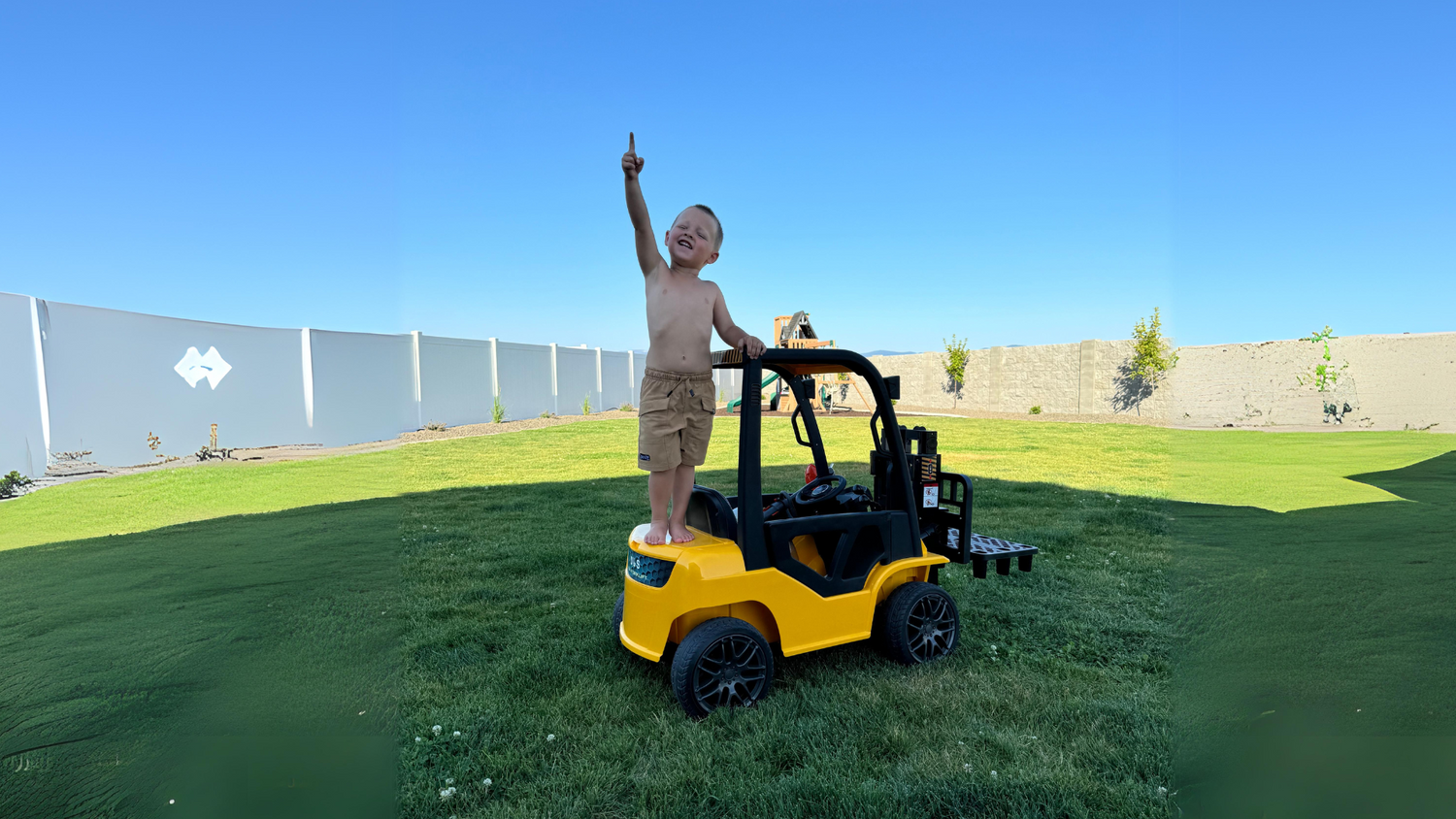
There's a moment every first-time parent reaches — standing in a store or scrolling through a screen, surrounded by options, wondering: is my toddler actually ready for a ride-on toy? And if so, which one? The world of toddler ride-on toys can feel overwhelming when you're navigating it for the first time. Between voltage ratings, weight limits, speed specs, and safety features, it's easy to feel like you need an engineering degree just to buy your one-year-old a toy.
Take a breath. This guide is written by parents who've been in your shoes — and who've spent years testing, researching, and obsessing over what makes a toddler ride-on toy genuinely great versus merely adequate. We'll walk you through everything: when your little one is developmentally ready, what features actually matter (and which ones are just marketing fluff), how to keep things safe, and why the right ride-on toy can be one of the most impactful purchases you make for your child's early development. By the end, you'll know exactly what to look for and feel confident in your choice.

When Is a Toddler Ready for a Ride-On Toy?
One of the most common questions first-time parents ask is "when can my child start using a ride-on toy?" The answer isn't a simple age — it's a combination of developmental milestones that indicate your toddler has the physical coordination and cognitive readiness to operate a small vehicle safely. While manufacturers list age ranges on their products, your child's individual development is a much better guide than a number on a box.
Physical Milestones to Watch For
The most fundamental requirement is stable, independent sitting. Your toddler should be able to sit upright without support for extended periods — not just a few seconds on the living room floor, but sustained, balanced sitting that frees their hands and arms for other tasks. This usually develops between 9 and 12 months, though some children take a bit longer, and that's perfectly normal. If your child can sit confidently in a highchair or on a low stool without leaning or tipping, they're demonstrating the core stability needed for a ride-on.
Next comes foot coordination. Even on the simplest toddler ride-on toys, children need to operate a pedal or push themselves along. Watch for your toddler's ability to push off surfaces with their feet in a controlled, intentional way — this is different from random kicking. When your child starts pushing a walker toy or scooting across the floor on their bottom using their legs in a coordinated pattern, their lower-body motor planning is developing nicely.
Steering readiness is the third piece. Can your toddler grip and turn objects with both hands working together? Do they demonstrate bilateral coordination — using both sides of their body in a coordinated way, like holding a container with one hand while dropping blocks in with the other? Steering a ride-on requires this same kind of coordinated hand movement, even when the steering on toddler models is intentionally simple and forgiving.
Cognitive Readiness: Understanding Cause and Effect
Beyond physical ability, there's a cognitive component that matters. Your toddler should demonstrate a basic understanding of cause and effect — "I push this button and something happens." This usually becomes evident around 12 months when children start intentionally pressing buttons on musical toys, flipping switches, or pulling levers to see the result. A toddler who understands cause and effect will intuitively grasp that pressing the pedal makes the vehicle move, and releasing it makes it stop. Without this understanding, a ride-on can be confusing rather than fun.
For most children, the sweet spot for their first ride-on experience falls between 12 and 18 months, though some particularly coordinated toddlers are ready as early as 10 months on foot-to-floor models. The best toddler ride-on toys for this youngest age group are specifically engineered with these developmental stages in mind — low seats, slow speeds, simple controls, and stable bases that forgive the wobbliness that comes with the territory. Our ride-on toy age guide breaks down these developmental stages in more detail if you want a deeper dive.
What to Look for in a Toddler Ride-On Toy
Not all ride-on toys are created equal, and the features that make a great ride-on for a five-year-old can actually make a poor — or even unsafe — choice for a toddler. When you're shopping for the best toddler ride-on toys in 2026, here's what genuinely matters.
Low Speed Is Non-Negotiable
This is the single most important spec for a toddler ride-on, and it's the one most first-time parents overlook. Toddlers do not have the reaction time, spatial awareness, or motor control to safely operate a fast vehicle. The best toddler ride-on toys max out between 2 and 3.5 mph — a brisk walking pace for an adult, which means you can easily keep up on foot. Anything faster than 4 mph is not appropriate for children under three, regardless of what the marketing copy claims.
Look specifically for models with adjustable speed settings that let you start at the lowest speed and gradually increase as your toddler's confidence and coordination grow. Some quality models offer two or three speed levels, allowing the toy to grow with your child rather than becoming either too boring or too dangerous as they develop.
Low Center of Gravity and Stability
Toddlers fall. That's not a design flaw — it's a developmental reality. The ride-on toy you choose should account for this by keeping the seat close to the ground and distributing weight broadly across the base. A low center of gravity means the vehicle is inherently resistant to tipping, even when your toddler shifts their weight unpredictably (which they will, frequently).
Look at the wheelbase — the wider the distance between the wheels, the more stable the platform. Four-wheel designs are generally more stable than three-wheel designs for toddlers. And pay attention to the wheel material: EVA rubber tires or solid rubber tires grip surfaces and absorb bumps far better than hard plastic wheels, which skitter and bounce on anything other than perfectly smooth pavement.
6V Battery for Toddler-Appropriate Power
When comparing 12V vs 24V toddler ride-on toys — or more accurately, when considering voltage options — the answer for toddlers is almost always: neither. A 6V battery system is the right choice for children ages one to three. Here's why.
Six-volt motors deliver gentle, manageable acceleration. They don't lurch forward when the pedal is pressed — they ease into motion in a way that gives toddlers time to react and adjust. The top speeds on 6V models stay in that critical 2-3.5 mph range. And the vehicles themselves are lighter because the battery is smaller, which further contributes to a safer, more controllable experience. A 12V or 24V ride-on might seem like a better value because it will "last longer" as your child grows, but for a toddler specifically, overpowering the vehicle creates genuine safety risks. It's worth investing in the right tool for the right stage.
How long do toddler ride-on toy batteries last? On a 6V system, you can typically expect 45 minutes to an hour of continuous riding per charge, depending on the terrain and the child's weight. That's actually ideal for toddler play sessions, which naturally run in shorter bursts. Most 6V batteries reach full charge in 8-12 hours, so an overnight charge keeps the vehicle ready for morning play.

Parent Remote Control: Your Safety Net
If there is one feature that separates a thoughtfully designed toddler ride-on from a generic toy, it's a parent remote control. This is not a luxury feature — for toddlers, it's essential safety equipment. A parent remote gives you full override capability: you can steer, stop, or redirect the vehicle from a distance, regardless of what your toddler is doing with the onboard controls.
The best toddler ride-on toys with remote control give parents true dual-channel operation. This means you're not just killing the motor — you can actively steer the vehicle away from hazards, bring it back to you, or gently stop it if your child has reached the edge of the safe play area. For first-time parents especially, the peace of mind a parent remote provides is enormous. You can let your toddler feel the thrill of independence while maintaining quiet, invisible control over the boundaries of their adventure.
Simple, Intuitive Controls
A toddler ride-on should have controls that a one- or two-year-old can figure out without frustration. That means a single pedal for go (release to stop), a straightforward steering wheel, and minimal additional buttons or switches. Some quality toddler models include one or two additional controls — like a lever for a working attachment — but these should be easy to operate and not required for basic driving.
Avoid toddler ride-ons with complex dashboards, multiple buttons, or gear-shifting mechanisms. These features are appropriate for older children (three and up) who have the cognitive bandwidth to manage multiple inputs while driving. For toddlers, simplicity equals safety and enjoyment.
Safety Essentials for Toddler Ride-Ons
Safety is the first thing on every parent's mind when considering toddler ride-on toys, and it should be. Are toddler ride-on toys safe? The honest answer: they are remarkably safe when you choose the right model and follow sensible supervision practices. Here's what every first-time parent needs to know.
Active Supervision Is Mandatory
No matter how well-designed a toddler ride-on is, it is not a babysitter. Active supervision means you are within arm's reach — or at most, a few quick steps away — and your full attention is on your child. This doesn't mean hovering anxiously; it means being present and aware. With a parent remote control in hand, you can give your toddler the feeling of independence while maintaining the ability to intervene instantly if needed.
As your child gains experience and demonstrates consistent control of the vehicle, you can gradually increase the distance between you and them. But for the first several weeks of ride-on play, close supervision is non-negotiable. Your toddler is learning a genuinely new skill, and learning involves mistakes.
Choose Your Terrain Carefully
The surface your toddler rides on matters more than most parents realize. For beginners, start on flat, smooth surfaces — a patio, a driveway, a section of short-cut lawn. Avoid gravel, steep slopes, wet grass, or surfaces near water features, roads, or drop-offs. As your toddler develops confidence and steering control, you can gradually introduce mild terrain variations like gentle inclines or slightly longer grass.
One thing experienced parents learn quickly: establish clear boundaries for the ride-on play area before your child starts driving. This might mean cones, a visible chalk line, or simply a verbal and visual understanding of "you can drive anywhere between the porch and the fence." Toddlers respond well to consistent, visible boundaries — and a parent remote control lets you enforce those boundaries gently if your adventurous explorer starts heading off course.
Speed Settings and Gradual Progression
If your toddler ride-on has multiple speed settings, always — always — start on the lowest setting. Leave it there for at least a few weeks, regardless of how quickly your child seems to be mastering the vehicle. Toddlers can look confident while still developing the reaction time and coordination needed for higher speeds. When you do increase the speed, do it one increment at a time and observe carefully for the first several sessions.
A good rule of thumb: if your toddler can consistently steer around obstacles, stop when asked, and navigate to a specific destination at the current speed, they're ready to try the next level. If they're bumping into things, struggling to steer, or showing signs of losing control, they need more time at the current speed. There's no rush — the goal is confidence, not velocity.
Benefits of Ride-On Play for Toddlers
The benefits of toddler ride-on toys extend far beyond entertainment. When child development experts and occupational therapists recommend ride-on play for young children, they're drawing on decades of research showing that self-directed, physically engaging, outdoor play is one of the most powerful developmental accelerators available to parents. Here's how ride-on toys specifically contribute to your toddler's growth.

Gross and Fine Motor Development
How do toddler ride-on toys help child development? Start with the most visible benefit: motor skills. Operating a ride-on engages virtually every major muscle group in a toddler's body. Core muscles work constantly to maintain balance and posture. Legs develop strength and coordination through pedal operation. Arms and hands build fine motor precision through steering and lever manipulation. And the entire experience develops proprioception — the body's internal sense of where it is in space — which is foundational to every physical skill your child will develop for the rest of their life.
For toddlers specifically, ride-on toys offer something that few other toys provide: simultaneous engagement of multiple motor systems. Your child isn't just sitting, just reaching, or just pushing — they're doing all of these things at once, while moving through space, while making decisions. This kind of complex, integrated motor engagement builds neural pathways far more efficiently than isolated fine-motor or gross-motor activities.
Confidence and Independence
Why kids love toddler ride-on toys often comes down to one word: autonomy. Toddlers are in the middle of an intense developmental drive toward independence — the famous "I do it myself!" stage. A ride-on toy is one of the few things in a toddler's world where they genuinely can do it themselves. They choose where to go, when to stop, which direction to turn, and how to interact with their environment. This self-directed experience builds authentic confidence — not the hollow "good job!" praise confidence, but the deep, earned understanding that "I can control something real."
Watch a toddler's face the first time they successfully drive a ride-on toy to a destination they chose. That expression of pride and accomplishment — that's the kind of confidence that transfers to every other area of their life. It makes them more willing to try new things, more resilient when they encounter challenges, and more self-assured in social situations. This is the reason developmental psychologists consistently rank ride-on play among the highest-value play experiences for young children.
Outdoor Play and Screen-Free Engagement
In 2026, the data on childhood screen time is impossible to ignore. Pediatricians, educators, and psychologists are united in their message: young children need more time outdoors and less time on screens. But telling a toddler "go play outside" doesn't work unless there's something outside that's genuinely more compelling than the screen inside. A ride-on toy is exactly that.
Parents consistently report that ride-on toys generate longer, more sustained outdoor play sessions than virtually any other toy category. A toddler who might lose interest in sandbox play after fifteen minutes will happily spend forty-five minutes to an hour driving, exploring, and operating a ride-on vehicle. That's forty-five minutes of sunshine, fresh air, physical activity, and sensory engagement that no app, show, or tablet game can replicate. The benefits of toddler ride-on toys extend beyond the play session itself — children who develop strong outdoor play habits early tend to maintain those habits as they grow.
Spatial Awareness and Early Problem-Solving
Even on the simplest toddler ride-on, your child is constantly making spatial calculations. Can I fit between those two planters? How much do I need to turn the wheel to go around the tree? Am I going to hit the fence if I keep going straight? These aren't conscious mathematical calculations, of course — they're intuitive spatial judgments that become more refined with every ride. This spatial processing ability is a foundational cognitive skill that correlates with later success in mathematics, engineering, and science.
Ride-on toys with functional features — like a working excavator arm — add another dimension of problem-solving. A toddler operating a digging arm learns about angles, reach, resistance, and the relationship between their physical actions and mechanical outcomes. This is embodied learning at its most natural: the toy teaches physics, engineering, and cause-and-effect principles through play, without workbooks, screens, or structured lessons.
Our Top Pick for Toddlers: The Little Ones First Digger
After evaluating every toddler ride-on on the market, our recommendation for children ages one to three is the Little Ones First Digger from Tough Trucks For Kids. This isn't a generic recommendation — it's the product we designed specifically because nothing else on the market met the standards we believe toddlers and their parents deserve.
Built for Toddler Bodies and Toddler Minds
The Little Ones First Digger runs on a 6V battery system, which delivers a maximum speed of 3.5 mph — fast enough to thrill a toddler, slow enough to keep parents breathing normally. The 66-pound weight capacity accommodates even larger toddlers with room to grow, and the low-profile design keeps the seat close to the ground for maximum stability and easy on-off access.
What sets this ride-on apart from the sea of generic toddler vehicles is the working excavator arm. This isn't a decorative piece of plastic — it's a functional digging mechanism that your toddler can actually operate. The controls are designed specifically for small hands and developing motor skills: intuitive, forgiving, and deeply satisfying to use. When your eighteen-month-old moves the lever and watches the arm scoop, they're not just playing — they're learning cause-and-effect, developing fine motor coordination, and beginning to understand how machines translate human input into mechanical output.
The toddler-friendly control scheme means your little one can focus on the joy of driving and digging rather than struggling with a confusing dashboard. Simple pedal operation — press to go, release to stop — is intuitive even for children who have never used a ride-on before. And the parent remote control gives you full override capability from a comfortable distance, so you can step in quietly whenever needed without disrupting your child's sense of independence.

Quality That Parents Notice Immediately
First-time parents often don't know what separates a $150 big-box-store ride-on from a quality-built machine until they've lived with both. The difference is immediate and unmistakable. The Little Ones First Digger uses materials and construction standards that simply don't exist at the low end of the market. Solid construction, reliable electronics, smooth motor operation, and the kind of build quality that survives being left in the rain, rammed into fences, and driven across gravel — because that's exactly what toddlers will do with it.
The Little Ones First Digger carries a 4.9-star rating across 86 reviews, and parent feedback consistently highlights the same themes: the quality exceeded their expectations, their toddler was obsessed from the first ride, and the working excavator arm generated far more sustained play than they anticipated. Multiple parents have noted that it's the one toy their toddler asks for by name every single morning.
Pricing and Availability
The Little Ones First Digger is currently priced at $449 (reduced from the regular price of $649) — a significant savings on a premium toddler ride-on. For parents searching for the best toddler ride-on toys under $500, this puts a genuinely exceptional product within reach.
The Little Ones First Digger is currently available for pre-order, with units shipping on February 9, 2026. Pre-ordering guarantees your spot in the first shipment, and every order is backed by Tough Trucks' 90-day bumper-to-bumper warranty, American-based customer support available Monday through Friday (9am-4pm), and lightning-fast shipping from our LA warehouse — most orders arrive within 2-5 business days once shipments begin. Each unit arrives 80% pre-assembled, so you're looking at roughly 30-45 minutes of assembly before your toddler can start exploring.
Growing Up: When to Upgrade to a 24V Ride-On
One of the smartest things about choosing the right ride-on for each stage is that your child builds skills progressively. The Little Ones First Digger gives your toddler a solid foundation in vehicle operation, spatial awareness, and the confidence that comes from mastering a real machine. But children grow — and when they do, they're ready for more power, more features, and more sophisticated play scenarios.
The Transition Window: Ages Three to Four
Most children are ready to step up to a 24V ride-on somewhere between their third and fourth birthday. The signs of readiness are similar to what you watched for with their first ride-on, just at a higher level: consistent steering control, reliable stopping on command, demonstrated understanding of boundaries and safety rules, and — honestly — growing boredom with the capabilities of their 6V vehicle. When your child starts asking for "faster" or "bigger," they're telling you they're ready for the next level.
The 12V vs 24V toddler ride-on toys question becomes relevant here. While some parents consider 12V as an intermediate step, our recommendation is to move directly from 6V to 24V when the time comes. Twelve-volt systems occupy an awkward middle ground — not powerful enough for the kind of terrain-handling and functional features that keep older children engaged, but more powerful than a toddler needs. A quality 24V ride-on will carry your child from age three all the way through age seven or eight, making it the better long-term investment. For more detailed guidance on choosing the right ride-on for children in this age range, our guide to the best ride-on toys for 3-year-olds covers the topic extensively.
What They'll Grow Into
The Tough Trucks 24V lineup is designed as the natural next chapter after the Little Ones First Digger. The Big Kahuna Dump Truck ($799 on sale) is a powerhouse with dual 550W motors, a working electric dump bed, and a 100-pound capacity — it's the truck that nearly 1,800 families have rated 4.9 stars. The Forklift 9000 ($649 on sale) brings real lifting power — 22 pounds of lift capacity — that turns backyard play into genuine problem-solving missions. The Big Digger Tractor ($759 on sale) features both a working front scooper and a rear digger on an all-metal frame. And the Mongoose ATV Quad ($499 on sale) delivers all-terrain adventure with four-wheel shock absorbers and a touch-screen control center.
Every 24V model in the Tough Trucks lineup includes a parent remote control — because even at ages five, six, and seven, there are moments when parents need that safety net. They all ship from our LA warehouse within 2-5 business days and arrive 80% pre-assembled. And they're all backed by the same 90-day bumper-to-bumper warranty and American-based customer support that covers the Little Ones First Digger. You can browse the full lineup at our Shop All page.
Toddler Ride-On Toys vs Power Wheels: What's Actually Different?
"Power Wheels" is one of those brand names that's become a generic term — like "Band-Aid" or "Kleenex." When parents search for toddler ride-on toys vs Power Wheels, they're usually asking: what's the difference between the ride-on toys I see at specialty retailers and the ones I see on the shelf at Walmart or Target?
The differences are meaningful, and they matter most at the toddler stage where safety margins are tightest.
Build Quality and Materials
Mass-market ride-on toys are designed to hit a price point. That means thin plastic bodies, small motors that struggle on anything other than smooth pavement, hard plastic wheels that skitter and bounce, and battery systems that deliver inconsistent power as the charge depletes. These compromises are noticeable at any age, but they're most problematic for toddlers. A wobbly, underpowered ride-on that lurches forward unpredictably and struggles to maintain traction is a frustrating and potentially unsafe experience for a one- or two-year-old.
The most durable toddler ride-on toys — the ones you'll find from specialty brands like Tough Trucks — use solid construction, EVA rubber tires, reliable motor systems, and battery technology that delivers consistent power from full charge to empty. The result is a smoother, more predictable, more controllable ride that's fundamentally better suited to a toddler's developing skills. When parents say a quality ride-on "just feels different" from a big-box alternative, they're responding to these material and engineering differences.
Functional Features vs Decorative Accessories
Another key distinction: many mass-market ride-ons include "features" that are purely decorative — stickers that look like control panels, plastic scoops that don't actually scoop, fixed beds that don't actually dump. These decorative touches might look good in photos, but children figure out the deception quickly, and the result is diminished play value and shorter engagement. When your toddler pushes a lever and nothing happens, they lose interest. When they push a lever and a real excavator arm moves, they're captivated for months.
This is where the gap between a quality toddler ride-on like the Little Ones First Digger and a generic alternative becomes most apparent. A working excavator arm transforms every play session into an open-ended problem-solving adventure. What can I dig? What can I scoop? Where should I put it? These questions drive hours of self-directed play that generates real developmental benefits — not the twenty minutes of novelty that a decorative ride-on provides before it becomes part of the garage's permanent background.
Parent Remote Control Quality
Not all parent remote controls are created equal. Some budget ride-ons include a remote that technically works but offers limited range, unreliable connectivity, or only basic stop-start functionality without steering control. For toddlers, the remote control isn't a convenience feature — it's critical safety equipment. Make sure any toddler ride-on you're considering includes a remote with full directional control, reliable range, and responsive operation. The difference between a quality remote and a cheap one could be the difference between smoothly redirecting your toddler away from the driveway and watching helplessly as your hand commands go ignored.
Frequently Asked Questions About Toddler Ride-On Toys
What age can a toddler start using a ride-on toy?
Most children can begin using a toddler-specific ride-on toy between 12 and 18 months, provided they can sit independently with good stability, demonstrate basic cause-and-effect understanding, and show emerging foot coordination. Models designed specifically for toddlers (like 6V ride-ons with low speed caps and simple controls) accommodate this developmental stage, while faster or more complex ride-ons should wait until age three or older. Always check the manufacturer's age recommendations and assess your individual child's readiness based on their physical and cognitive development, not just their age.
Are toddler ride-on toys safe?
Yes — toddler ride-on toys are safe when you choose age-appropriate models and follow basic supervision practices. Look for key safety features: low maximum speed (3.5 mph or less), low center of gravity, stable wheelbase, parent remote control with full directional override, and simple controls. Always supervise toddler ride-on play actively, start on flat and smooth surfaces, use the lowest speed setting initially, and set clear boundaries for the play area. Avoid ride-ons that exceed toddler-appropriate specifications, regardless of marketing claims.
How long do toddler ride-on toy batteries last per charge?
On a 6V toddler ride-on, expect approximately 45 minutes to one hour of continuous riding per charge. Actual run time varies based on the terrain (flat pavement yields longer rides than grass or hills), the child's weight, and whether the vehicle is running additional features like lights or sound. Most 6V batteries charge fully in 8-12 hours — an overnight charge keeps the vehicle ready for the next day. To maximize battery life over time, avoid letting the battery drain completely before recharging, and store the vehicle with a partial charge if it won't be used for extended periods.
What's the difference between 6V, 12V, and 24V ride-on toys?
The voltage rating determines the ride-on's power, speed, and capability. A 6V ride-on is designed for toddlers ages one to three — it delivers gentle acceleration, a low top speed (around 3.5 mph), and a lightweight, manageable vehicle. A 12V ride-on offers moderate speed and power, suitable for some children ages three to five. A 24V ride-on delivers the highest performance — faster speeds (4-5 mph), dual-motor power for tackling varied terrain, and enough electrical capacity to operate functional features like electric dump beds and lifting mechanisms. For toddlers, 6V is the right choice. For children three and older, 24V provides the best combination of performance, longevity, and play value.
What should I look for in a toddler ride-on toy buying guide?
When using a toddler ride-on toy buying guide to make your decision, focus on these fundamentals: age-appropriate speed (3.5 mph or less for toddlers), a 6V battery system, parent remote control with full directional override, a low center of gravity for stability, simple and intuitive controls, quality construction materials (EVA tires, solid body panels), and functional features that drive sustained engagement (like a working excavator arm, not decorative stickers). Weight capacity should exceed your child's current weight by at least 15-20 pounds for growth room. And check the warranty — a brand that backs its product with a 90-day or longer bumper-to-bumper warranty is standing behind its quality claims.
Ready to Start Your Toddler's Ride-On Adventure?
Choosing your child's first ride-on toy is one of those parenting decisions that feels bigger than it is — because you want to get it right. You want something safe, something that genuinely benefits your child's development, something built well enough to survive toddlerhood, and something that creates those pure, joyful moments of outdoor play that you'll remember for years.
The Little Ones First Digger was built for exactly this moment. It's the ride-on we wish existed when our own kids were toddlers — safe, engaging, developmentally valuable, and built to a standard that respects both the child who rides it and the parent who chose it. At $449 during the current sale (regular $649), with pre-order units shipping February 9, 2026, now is the time to secure one before this production run sells out.
And when your little builder is ready for the next level, the full Tough Trucks 24V lineup will be waiting — ready to take their skills, confidence, and adventures to places neither of you have imagined yet.

Leave a comment
This site is protected by hCaptcha and the hCaptcha Privacy Policy and Terms of Service apply.