
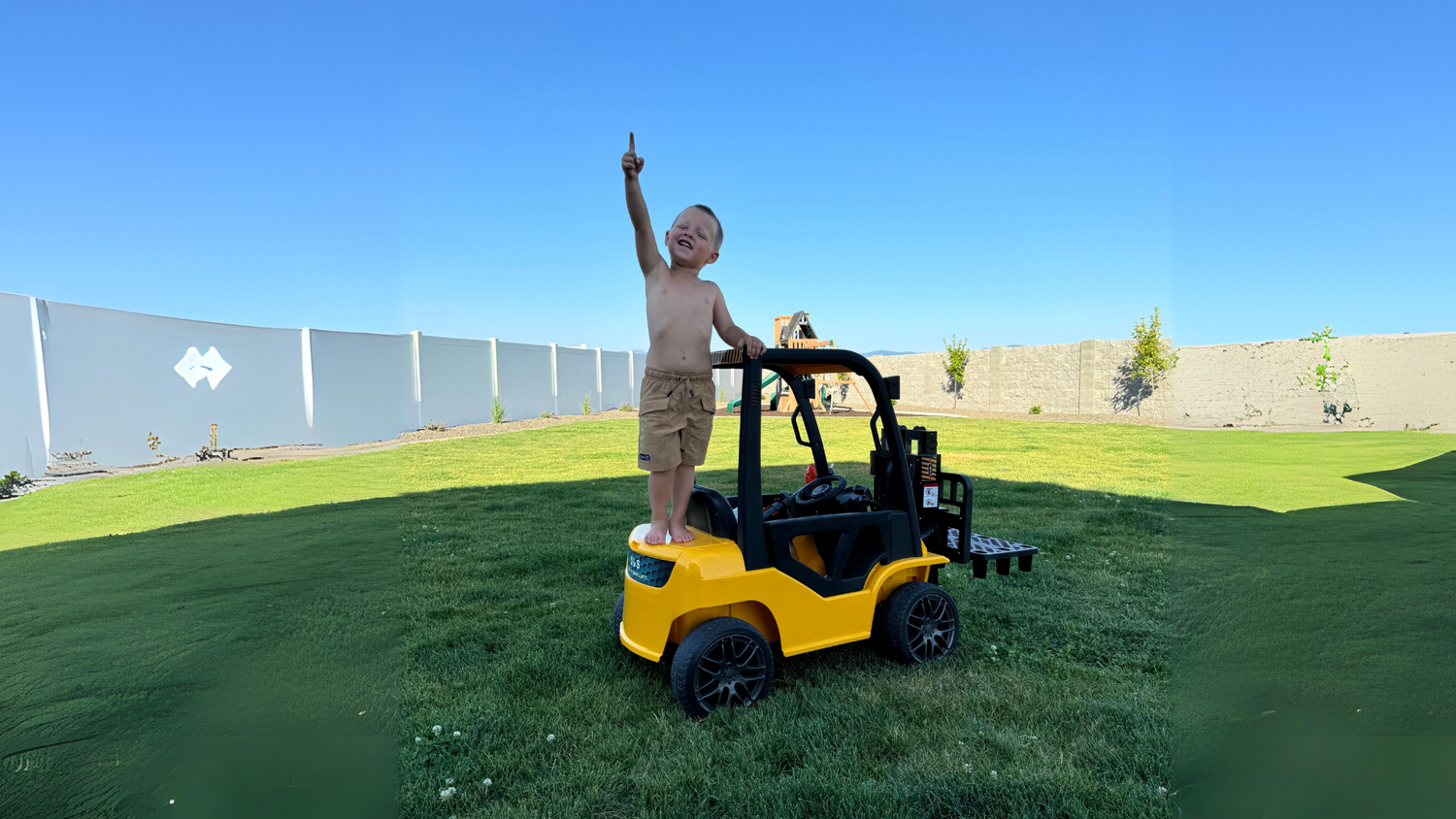
Walk into any big-box retailer and you'll find dozens of ride-on toys for kids. Power wheels shaped like sports cars, miniature Jeeps, even miniature tractors. But there's one category that stands apart from the rest, both in functionality and in the developmental benefits it offers: the kids forklift ride on.
Unlike ride-ons that simply drive forward and backward, a ride on forklift for kids introduces a completely different dimension of play. It's not just about movement—it's about manipulation, precision, and purpose. When a child climbs into a forklift, they're not just cruising around the driveway. They're learning to lift, lower, position, and transport objects with genuine working machinery scaled to their size.
As we move through 2026, parents are increasingly seeking toys that do more than entertain. They want investments that teach, challenge, and prepare their children for real-world problem-solving. A toy forklift that kids can ride checks every box, combining the thrill of independent driving with hands-on lessons in physics, spatial reasoning, and logistics that you simply can't get from a standard ride-on car.
If you're considering adding a forklift to your child's outdoor play collection, there's more to know than you might think. Not all ride-on forklifts are created equal, and understanding what sets premium options apart can make the difference between a toy that gets used once and an educational adventure that lasts for years.
The Real Lifting Power: Why Functionality Matters

The defining feature of any kids forklift ride on is right there in the name: the lift. But here's where many budget options fall short. Some models feature forks that barely move, or lifting mechanisms so weak they can't handle anything heavier than a plastic ball. These toys miss the entire point of forklift play.
A quality ride on forklift for kids should offer genuine lifting capability. The Forklift 9000, for example, can lift up to 22 pounds—enough to move cardboard boxes, plastic crates, small logs, bags of mulch, or even buckets of water. This isn't a gimmick. It's the core of what makes forklift play so developmentally rich.
When children have access to real lifting power, their play transforms. Instead of pretending to move things, they're actually solving logistical challenges. They'll create construction zones in the backyard, set up delivery routes, build obstacle courses that require precision maneuvering, and invent games that require careful balance and weight distribution. Every one of these activities teaches practical physics concepts that they'll encounter again in middle school science classes: leverage, load capacity, center of gravity, and mechanical advantage.
Parents often report that their kids spend hours creating elaborate scenarios around their forklift. One family shared that their six-year-old designed an entire "warehouse" system in their garage, complete with labeled zones and a clipboard for tracking "shipments." Another described how siblings worked together to move river rocks for a garden project, negotiating who would drive and who would load. This isn't just play—it's early project management, teamwork, and practical problem-solving disguised as outdoor fun.
What to Look for in Lifting Mechanisms
Not all forklift lifting systems are engineered equally. When evaluating any toy forklift that kids can ride, examine the control system. Is it intuitive enough for a child to operate independently? Does it move smoothly, or does it jerk and stall? Can the forks be positioned at varying heights, or are they limited to just up and down?
Quality models feature hydraulic-style systems with precise control levers that give children immediate feedback. They learn cause and effect: pull the lever, the forks rise. Push forward, they lower. This direct manipulation builds hand-eye coordination and fine motor skills in ways that touch-screen toys simply cannot replicate.
Equally important is the stability of the lifting mechanism under load. A forklift that wobbles or tips when lifting even moderate weight is not just frustrating—it's potentially unsafe. Look for models with wide, stable bases and reinforced fork construction that can handle regular use without bending or breaking.
How Forklift Play Develops Spatial Reasoning and Logistics Skills
Ask any warehouse manager or construction foreman what skills matter most in their work, and you'll hear the same themes: spatial awareness, planning ahead, understanding load limits, and maneuvering in tight spaces. These aren't skills you're born with—they're learned through experience. And for young children, a kids forklift ride on provides the perfect low-stakes environment to start building these capabilities.
Consider what happens when a child tries to pick up a box with their forklift. First, they must approach at the correct angle—too far to one side and the forks won't slide underneath. They need to judge distance accurately, stopping close enough to engage the load but not so close that they knock it over. Then they must lift smoothly, watching to ensure the weight stays balanced on the forks. Finally, they navigate to their destination, constantly monitoring the elevated load and adjusting their speed and turning radius accordingly.
Every single step in this process exercises spatial reasoning. Children learn to think in three dimensions: height, width, and depth. They develop an intuitive understanding of how objects move through space and how their own movements affect the objects they're carrying. Research in childhood development consistently shows that hands-on manipulation of physical objects is one of the most effective ways to build these critical cognitive skills.
Logistics and Sequential Thinking
Beyond spatial skills, forklift play naturally encourages logistics thinking. When children set up scenarios where they need to move multiple items from one location to another, they're engaging in the same type of planning that professional operations managers use daily. Which items should be moved first? How can they minimize trips? Where should items be staged for easy access?
Parents can enhance this learning by introducing simple challenges. "Can you move all these boxes from the patio to the sandbox in less than five trips?" or "Let's pretend we're setting up for a party—what needs to go where?" These prompts transform free play into structured problem-solving exercises that feel like games but build genuine analytical skills.
Children also learn about consequences and planning ahead. If they load the forks incorrectly and an item falls off halfway to the destination, they experience immediate feedback. Next time, they'll secure the load more carefully or drive more cautiously. This trial-and-error learning is invaluable and far more memorable than any classroom lesson could be.
Safety Considerations for Kids Forklift Ride-Ons
With real lifting power comes real responsibility—both for manufacturers and for parents. Safety should be your number one consideration when choosing a ride on forklift for kids, and there are several key features that separate well-designed models from potentially hazardous ones.
Stability and Center of Gravity
Real industrial forklifts are designed with counterweights in the rear to offset the weight of lifted loads in the front. Quality kids forklifts incorporate similar engineering principles. Look for models with a low center of gravity and a wide wheelbase that prevent tipping, even when lifting maximum weight.
The Forklift 9000 features a stable base design specifically engineered to handle its 22-pound lifting capacity without risk of tipping. The cabin protection bars also serve a dual purpose: they protect the child in case of minor collisions and provide structural reinforcement that enhances overall stability.
Speed Control and Parent Remote
While speed might seem like a secondary concern, it becomes critically important when a child is operating a vehicle with a raised load. A sudden stop or sharp turn at high speed can cause lifted items to fall—potentially onto the child or others nearby.
The best kids forklift ride on toys include adjustable speed settings and parent remote controls. This allows you to limit speed based on your child's experience level and the complexity of their current play scenario. New operators might start at slower speeds while they master the lifting controls, then gradually increase as their skills improve. The parent remote also provides an immediate safety override if a situation becomes unsafe.
Age-Appropriate Design
Pay close attention to manufacturer age recommendations. A toy forklift that kids can ride should match your child's physical size, coordination level, and cognitive development. Most quality forklift ride-ons are designed for ages 3-8, but individual children vary widely in their readiness.
Can your child reach the controls comfortably while seated? Can they understand and follow instructions about safe operation? Do they have the impulse control to stop when asked? These questions matter more than chronological age.
Operational Boundaries and Supervision
Even the safest kids forklift ride on requires appropriate supervision and clear operational boundaries. Establish rules from day one: no riding on slopes while carrying a load, no lifting anything heavier than the manufacturer's specified limit, no passengers on the forks, and operation only in designated areas away from traffic, pools, or other hazards.
Many families find it helpful to create a simple "forklift license" system where children must demonstrate understanding of safety rules and basic operational competence before being allowed to drive independently. This adds a fun element while reinforcing that operating machinery—even toy machinery—is a privilege that comes with responsibilities.
What Separates Premium Forklifts From Budget Options
Not all kids forklift ride on toys are created equal. The market ranges from $150 discount models to $650+ premium options, and the price difference reflects more than just brand names. Understanding these distinctions helps you make an informed investment rather than an impulse purchase that disappoints.
Motor Power and Battery Life
Budget forklifts often feature underpowered single motors and basic 6V or 12V battery systems. These might work fine on flat pavement with no load, but introduce any incline or weight and they struggle. Children quickly become frustrated when their forklift can barely move while carrying anything.
Premium models like the Forklift 9000 feature dual 555W motors powered by robust 24V battery systems. This provides the torque needed to lift maximum weight, navigate varied terrain including grass and gravel, and operate for extended play sessions without performance degradation. The difference in play value is substantial—budget models might see 30 minutes of use before children get bored, while powerful models support hours of engaged, challenging play.
Build Quality and Materials
Construction materials directly impact both safety and longevity. Cheaper ride on forklift for kids options often use thin plastics that crack under UV exposure or heavy use. Wheels might be solid plastic that offer rough rides and wear down quickly on concrete.
Look for models with reinforced plastic construction, metal components in stress areas like the fork lift mechanism, and EVA rubber tires that provide smooth rides and durability across multiple surfaces. These materials cost more upfront but prevent the frustration of broken toys and the expense of premature replacement.
Feature Integration
Premium toy forklift that kids can ride options often include thoughtful features that extend play value: realistic sound effects, working LED lights for evening play, horn buttons, and even Bluetooth connectivity for music. While these might seem like extras, they significantly enhance imaginative play. Lights and sounds make scenarios feel more authentic, encouraging deeper engagement and more creative storytelling.
The Forklift 9000: Engineering Meets Educational Play
When Tough Trucks For Kids designed the Forklift 9000, the goal was creating a kids forklift ride on that didn't compromise on any front: safety, functionality, durability, or play value. The result is a ride-on that consistently earns 4.9-star ratings from over 1,200 families who've made it part of their children's outdoor play experience.
At the heart of the Forklift 9000 is genuine lifting capability—up to 22 pounds of real-world payload. This isn't theoretical. Children use their Forklift 9000 to move firewood, transport garden supplies, help with yard projects, and create elaborate construction zones that would be impossible with lesser models. The hydraulic-style lift control is responsive and intuitive enough for children as young as three to master, yet precise enough to satisfy older kids working on complex scenarios.
The dual 555W motors provide serious power. This forklift navigates grass, gravel, gentle slopes, and varied terrain with confidence. At speeds up to 4.25 mph, it's quick enough to be exciting but controlled enough for safe operation with loads. The 24V battery system delivers extended play sessions—typically 60-90 minutes of continuous operation, depending on terrain and load weight.
Safety Through Design
The stable base design of the Forklift 9000 prevents tipping even when lifting maximum weight. The cabin protection bars provide structural reinforcement while keeping the child safely enclosed during operation. EVA rubber tires deliver smooth rides and reliable traction across surfaces from concrete to lawn without the harsh bumps of solid plastic wheels.
The included parent remote control gives you override capability from up to 50 feet away. This isn't just for beginners—even experienced young operators benefit from having a safety backup when attempting challenging maneuvers or working in areas with obstacles.
Built for Years of Use
With an 80-pound weight capacity and age range of 3-8 years, the Forklift 9000 grows with your child. A three-year-old might start with simple lifting and driving, gradually progressing to more complex scenarios as coordination and planning skills develop. By age seven or eight, many children use their forklift for legitimate work around the property—moving mulch, transporting tools, or helping with outdoor projects.
This longevity is reinforced by Tough Trucks For Kids' 90-day bumper-to-bumper warranty and American-based customer support. When you're investing in a premium ride on forklift for kids, knowing you have backup from a veteran-owned business that specializes exclusively in ride-on construction vehicles provides peace of mind that big-box retailers simply can't match.
Setting Up Your Kids Forklift for Success
Purchasing a quality toy forklift that kids can ride is just the first step. How you introduce it and support play makes the difference between a toy that gets used occasionally and one that becomes a central element of outdoor learning and adventure.
Create a Purpose-Driven Play Space
Children engage more deeply when their play has purpose. Rather than just letting them drive around aimlessly, set up environments that invite forklift use. Designate an area as a "loading dock" with boxes or crates to transport. Create a "construction zone" with materials that need moving. Build a "warehouse" with marked storage zones.
These setups don't need to be elaborate. A few cardboard boxes, some plastic bins, and some chalk to mark zones on the driveway can transform a basic riding toy into a complex problem-solving environment. Change the setup periodically to maintain interest and introduce new challenges.
Introduce Graduated Challenges
Start simple and build complexity as skills develop. A new operator might begin by just practicing driving without any load. Then introduce lifting stationary objects. Progress to transporting lightweight items short distances. Eventually work up to time challenges, obstacle courses, or multi-step scenarios that require planning and precision.
This graduated approach builds confidence and prevents frustration. It also allows you to teach safety concepts progressively rather than overwhelming a child with too many rules at once.
Encourage Collaborative Play
While a kids forklift ride on is typically a single-rider toy, the play it enables often works best as a team activity. One child operates the forklift while another loads items onto the forks or directs where materials should be delivered. Siblings learn to communicate, negotiate roles, and work toward shared goals.
Parents can participate too. "Can you help me move these flower pots to the garden?" or "I need someone to transport these supplies to the other side of the yard" turns chores into collaborative adventures. This type of play builds genuine skills while strengthening family bonds through shared projects.
Maintenance and Care for Long-Term Performance
A premium ride on forklift for kids represents a significant investment, and proper maintenance ensures years of reliable service. Fortunately, these vehicles are relatively simple to care for with just a few regular practices.
Battery Care
The 24V battery system in quality forklifts like the Forklift 9000 requires basic attention. Charge fully before first use, and recharge after each play session or when you notice reduced performance. Avoid letting the battery fully discharge repeatedly, as this shortens its lifespan. During winter months or extended periods of non-use, charge the battery at least once per month to maintain health.
Cleaning and Inspection
After outdoor play, wipe down the forklift to remove dirt, grass, and debris. Pay special attention to the fork mechanism—buildup here can cause sticking or reduced lift performance. Check wheels for damage or excessive wear. Inspect the lifting mechanism monthly to ensure all moving parts operate smoothly.
While these vehicles are built for outdoor use, storing them under cover when not in use—in a garage, shed, or under a tarp—protects against weather damage and extends the life of plastics and electronics.
Teaching Maintenance Responsibility
Part of the educational value of a toy forklift that kids can ride comes from teaching children to care for their equipment. Involve them in simple maintenance: wiping down the vehicle, plugging in the charger, checking tire pressure if applicable. These small tasks reinforce that machinery requires care and teaches responsibility.
Beyond Entertainment: Real Educational Value
In 2026, parents are increasingly selective about screen time and passive entertainment. The toys that earn their place in backyards are those that actively develop skills and knowledge. A kids forklift ride on excels precisely because it's not just entertaining—it's fundamentally educational.
The physics concepts children internalize through forklift play create foundations for later STEM learning. Understanding how leverage works, experiencing cause and effect in real-time, developing spatial reasoning—these aren't abstract lessons. They're embodied knowledge that makes formal education more accessible when children encounter these topics in school.
The planning and logistics skills translate directly to executive function development. Children learn to think ahead, break complex tasks into steps, and adapt when plans don't work as expected. These are the skills that predict academic success far more reliably than memorization or test-taking ability.
Perhaps most importantly, forklift play builds confidence and self-efficacy. When a four-year-old successfully transports a load from point A to point B, navigating obstacles and managing the controls independently, they're learning "I can do hard things." This internal message shapes how children approach challenges throughout life.
Making the Investment Decision
At $649 for the Forklift 9000 (regular price $1,249), a premium ride on forklift for kids is not an impulse purchase. It's an investment that deserves thoughtful consideration. Here's how to think about value beyond the price tag.
Compare the cost to other common children's activities. A year of organized sports typically runs $200-500 per season, plus equipment and travel costs. A few visits to theme parks easily exceed $600. Private lessons for music, art, or athletics can cost hundreds per month. None of these are bad investments, but all require ongoing scheduling, participation, and expense.
A quality toy forklift that kids can ride is a one-time purchase that delivers years of value. It's available whenever your child wants to play—no scheduled times, no driving to facilities, no ongoing fees. It works for rainy day make-up play when outdoor sports are canceled. It accommodates multiple children in the family across different ages.
Consider also the opportunity cost of cheaper alternatives. A $150 budget forklift that breaks after six months or fails to engage your child hasn't saved you money—it's wasted $150. A $650 forklift that sees regular use for four or five years and can be passed to younger siblings or sold secondhand is the economically sound choice.
Frequently Asked Questions
What age is appropriate for a kids forklift ride on?
Most quality ride-on forklifts, including the Forklift 9000, are designed for ages 3-8. However, individual readiness varies based on physical size, coordination, and maturity. Your child should be able to reach the controls comfortably while seated, understand and follow basic safety instructions, and have the attention span for supervised learning. Some advanced three-year-olds are ready, while some five-year-olds may need more time. Always supervise young operators and use the parent remote control until you're confident in their independent operation skills.
How much weight can a kids forklift actually lift?
Lifting capacity varies dramatically by model. Budget options might lift 5-10 pounds or less, limiting play to very lightweight objects. Premium models like the Forklift 9000 can lift up to 22 pounds, which is substantial enough to move cardboard boxes, plastic storage bins, bags of mulch, firewood, or even buckets of water. This real lifting capability is what transforms a forklift from a simple ride-on into an educational tool that teaches physics and logistics. Always check manufacturer specifications and never exceed stated weight limits, as overloading can damage the lifting mechanism or create tipping hazards.
Is a ride on forklift for kids safe?
When properly designed and appropriately supervised, kids forklift ride-ons are very safe. Look for models with stable, wide bases that prevent tipping even when lifting maximum weight. Parent remote controls provide emergency override capability. Cabin protection bars shield the child during operation. Speed controls should allow you to limit maximum velocity based on operator experience. That said, safety also depends on proper use: establish clear operational rules, supervise young or new operators, create appropriate play boundaries away from traffic or water hazards, and ensure children understand they should never exceed weight limits or carry passengers on the forks.
How long does the battery last on a kids forklift?
Battery life depends on the voltage system and usage conditions. Quality 24V systems like the one in the Forklift 9000 typically provide 60-90 minutes of continuous operation on a full charge. Actual runtime varies based on terrain (grass drains batteries faster than pavement), weight being carried, operator weight, and temperature (batteries perform less efficiently in cold weather). Heavy use with maximum loads on sloped terrain will drain batteries faster than light cruising on flat ground. Most families find this provides adequate play time, and many establish a routine of charging after each use to ensure the forklift is always ready for the next adventure.
What's the difference between a $200 forklift and a $650 forklift?
The price difference reflects fundamental differences in engineering, materials, and performance. Budget forklifts typically feature weak single motors (often just 35W), basic 6V batteries, thin plastics that crack easily, minimal lifting capacity, and no premium features. They might work on flat pavement with no load but struggle on grass, inclines, or when actually lifting anything substantial. Premium models feature powerful dual motors (500W+), robust 24V battery systems, reinforced construction with metal components in stress areas, genuine lifting capability (20+ pounds), EVA rubber tires, parent remotes, and longer warranties with real customer support. The result is a ride-on that delivers years of engaged play versus weeks of disappointing performance. For most families, the premium investment pays off in durability, play value, and educational benefit.
Ready to Build Tomorrow's Builders?
Choosing a kids forklift ride on for your child means choosing education disguised as adventure. It means investing in hands-on learning that teaches physics, develops spatial reasoning, builds planning skills, and creates confidence. It means watching your child transform from a passenger in their play to an operator solving real problems and accomplishing genuine tasks.
The Forklift 9000 represents the pinnacle of what a ride on forklift for kids can be: powerful enough to lift 22 pounds, stable enough to operate safely, durable enough to last for years, and engaging enough to become a beloved part of your family's outdoor play routine. With 4.9 stars from over 1,200 families, it's proven its value in backyards across America.
This isn't just another toy. It's a tool for building tomorrow's builders—one lift, one transport, one solved problem at a time. When you're ready to add genuine forklift functionality to your child's outdoor adventures, the Forklift 9000 is ready to deliver exactly what you're looking for: quality, safety, educational value, and years of screen-free outdoor play that teaches skills that matter.
Explore the Forklift 9000 and discover why families choose Tough Trucks For Kids for premium ride-on construction vehicles that go beyond traditional toys. See the Forklift 9000 in action and join the community of parents building tomorrow's builders today.

Leave a comment
This site is protected by hCaptcha and the hCaptcha Privacy Policy and Terms of Service apply.