
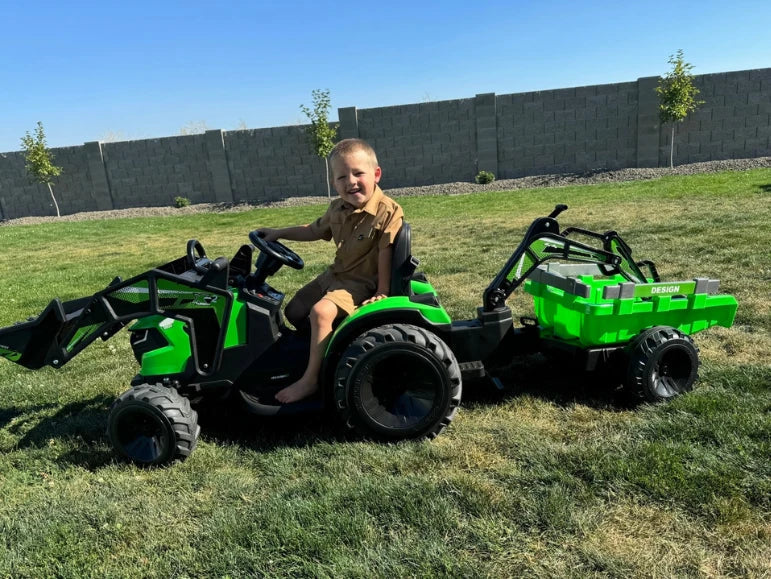
There's something magical about watching a child climb into their first ride-on tractor, gripping the wheel with both hands, their face lighting up as they realize they're in control of something real. For parents who value hands-on learning and outdoor play, a kids ride on tractor isn't just another toy cluttering the garage—it's an investment in your child's development, imagination, and connection to the world around them.
In 2026, the market for ride on tractor toys has evolved far beyond the simple plastic push models many of us remember from our own childhoods. Today's best tractor ride on toys come equipped with working features that teach real-world mechanics, powerful battery systems that handle actual terrain, and build quality that stands up to years of outdoor adventure. But with options ranging from basic battery-powered models to sophisticated construction vehicles with multiple working functions, how do you choose the right one?
This guide will walk you through everything you need to know about kids tractor ride-ons in 2026—from understanding the different types available to evaluating which working features actually matter for your child's play and learning. We'll explore battery power considerations, terrain capability, safety features, and how to assess quality construction that justifies the investment. Whether you're considering your first ride-on purchase or upgrading from a smaller model, you'll finish this guide equipped to make a confident decision.
Understanding the Different Types of Kids Ride-On Tractors
Not all ride on tractors for kids are created equal. The market breaks down into several distinct categories, each designed for different age ranges, skill levels, and play patterns. Understanding these categories is the first step toward finding the right match for your child.
Battery-Powered vs. Manual Push Tractors
The fundamental divide in the kids tractor market is between battery-powered electric models and manual push or pedal-powered versions. Manual tractors serve toddlers well for developing leg strength and coordination, but they're limited in where they can go and what they can do. Battery-powered ride-on tractors open up an entirely different world of play, allowing children to navigate varied terrain, operate working attachments, and experience the satisfaction of controlling a vehicle that responds like the real thing.
For children ages three and up, battery-powered models offer significantly more developmental value. They teach cause-and-effect relationships through controls that actually function, build spatial awareness as kids navigate around obstacles, and create opportunities for imaginative play that evolves over years rather than months.
6V vs. 12V vs. 24V Systems: What the Voltage Really Means
When shopping for electric ride-on tractors, you'll encounter voltage specifications that might seem like technical jargon but actually tell you a lot about what the vehicle can do. A 6-volt system is appropriate for toddlers and very young children, typically powering smaller vehicles at speeds around 2-3 mph on flat surfaces. These work well for first experiences but are quickly outgrown.
Twelve-volt systems represent the middle ground, offering moderate power and speed (usually 3-4 mph) with decent battery life. They're common in big-box retailer models and serve adequately for casual play on relatively flat terrain.
Twenty-four-volt systems are where serious capability begins. With dual 12V batteries working together, these systems deliver enough torque to handle actual inclines, power through grass and dirt, and operate working features without draining quickly. A quality 24V kids ride on tractor can tackle the terrain of a real backyard or farm property, not just cruise on pavement. The Tough Trucks Big Digger Tractor uses a 24V dual battery system that powers both its mobility and its working front scooper and rear digger—giving kids enough runtime for extended outdoor play sessions without constantly heading back to recharge.
Construction-Style vs. Farm-Style Tractor Ride-Ons
Within the tractor category, there's an important distinction between farm-style tractors (modeled after agricultural equipment) and construction-style tractors (designed to look like excavators, backhoes, and work vehicles). Both fall under the "tractor ride on toy" umbrella, but they offer different play experiences.
Farm-style tractors often emphasize pulling and hauling, sometimes including detachable trailers or wagons. They're ideal for children who love the idea of farming, harvesting, or transporting materials around the yard. Construction-style tractors focus on digging, scooping, and manipulating materials—teaching different mechanical concepts and appealing to kids fascinated by how things are built rather than grown.
The best construction-style options combine the visual appeal of real construction equipment with genuinely functional working parts. This isn't about mere decoration; it's about giving children tools that actually work, building their understanding of levers, hydraulics, and cause-and-effect relationships that will serve them well in future STEM learning.
Working Features That Actually Matter
Marketing materials for ride-on tractors often tout impressive-sounding features, but not all additions are created equal. Some genuinely enhance play value and learning; others are cosmetic touches that add to the price without adding to the experience. Here's how to distinguish between meaningful features and marketing fluff.
The Scooper: Front Loading Functionality
A working front scooper transforms a kids tractor from a simple vehicle into a tool your child can actually use to accomplish tasks. The key word here is "working"—many models include scoops that are essentially decorative, unable to lift more than a few ounces or so loosely attached they're useless for actual play.
Look for front scoopers with robust attachment points and enough mechanical advantage to lift real loads. Your child should be able to scoop up sand, dirt, small rocks, or snow and transport it somewhere else. This seemingly simple feature teaches physics concepts like leverage and weight distribution while enabling creative play scenarios that evolve as your child grows. A three-year-old might simply enjoy filling and dumping; a six-year-old might construct elaborate earthworks or clear pathways through snow.
The front scooper on the Big Digger Tractor is engineered to handle actual materials, with controls integrated into the vehicle's operation so kids can raise and lower the bucket while driving—just like operating real construction equipment. This level of functionality isn't common in the category, where many manufacturers opt for manual-only operation or mechanisms so flimsy they break within weeks of outdoor use.
The Digger Arm: Rear Excavator Capability
While front scoopers are relatively common in the tractor ride on toy market, rear digger arms are far less frequent and typically reserved for higher-end models. A functional digger arm adds a completely different dimension to play, allowing children to excavate and manipulate materials with precision that a front bucket can't match.
The mechanical complexity of a working digger arm is considerably higher than a simple scoop. It requires multiple pivot points, control mechanisms that a child can operate while seated, and structural integrity to handle the forces involved in actual digging. When implemented well, a digger arm becomes the favorite feature for many children—there's something deeply satisfying about the control it offers.
For children growing up on property with room to explore, a ride-on tractor with both a front scooper and rear digger essentially becomes a functional tool. Kids can help with real yard work (supervised, of course), create imaginative construction sites, or simply spend hours in the kind of focused, physical, problem-solving play that builds both bodies and minds.
Beyond the Basics: Lights, Sounds, and Multimedia Features
LED working lights, realistic engine sounds, Bluetooth connectivity, MP3 players—modern ride-on tractors often include features that would have seemed like science fiction a generation ago. The question is whether these additions enhance or distract from core play value.
Working lights have genuine utility if your child will be playing during dawn or dusk hours, and they add to the realistic feel that enhances imaginative play. Realistic engine sounds fall into the same category—they're not essential, but they contribute to the immersive quality that makes battery-powered ride-ons so appealing compared to manual alternatives.
Multimedia features are more controversial. Some parents appreciate the ability to play music during outdoor play; others view screens and audio inputs as antithetical to the screen-free outdoor experience they're trying to encourage. There's no right answer here—it depends on your family's approach to technology and play. What's worth noting is that these features shouldn't be the primary selling point. If a kids ride on tractor's marketing emphasizes Bluetooth connectivity over working mechanical features, that's often a red flag that the manufacturer is prioritizing flash over function.
Battery Power and Runtime Considerations
The battery system in a ride-on tractor determines not just how long your child can play before needing a recharge, but also what the vehicle can actually do during that play session. Understanding battery specifications helps you set realistic expectations and avoid common frustrations.
Realistic Runtime Expectations
Manufacturer specifications often cite battery runtime under ideal conditions: flat terrain, minimal working feature use, moderate temperatures, and a lightweight rider. Real-world runtime is typically shorter, sometimes significantly so. A 24V system might claim 90 minutes of runtime but deliver 45-60 minutes when your child is actually using the scooper, tackling inclines, or riding in cold weather (which reduces battery efficiency).
This isn't necessarily a problem if you understand it going in. Sixty minutes of active outdoor play is substantial for most children, especially when it's focused and physically engaging. The key is choosing a system robust enough that you're not constantly interrupted by dead batteries just as play is getting good.
Dual battery systems offer an advantage beyond raw runtime: they distribute power draw more evenly, which can actually extend battery lifespan over the vehicle's life. They also provide more consistent performance as the charge depletes—a single 12V battery might show noticeable performance degradation as it drains, while a dual 12V (24V) system maintains more consistent torque and speed until closer to full depletion.
Charging Time and Battery Longevity
Plan on 8-12 hours for a full charge on most ride-on tractor battery systems. This means if your child drains the battery during afternoon play, you'll need to plug it in overnight for the next day's adventures. Some families solve this by purchasing a second battery pack for continuous play on heavy-use days, though quality replacement batteries can cost $50-100 depending on the system.
Battery longevity depends heavily on usage patterns and maintenance. Lead-acid batteries (still common in ride-on toys despite being older technology) typically last 1-3 years with regular use. Lithium-ion batteries, increasingly available in premium models, can last 3-5 years or more and hold charges better during storage periods. They also recharge faster, though they add to the upfront cost.
Whatever battery type your kids tractor uses, a few practices extend lifespan significantly: charge fully before first use, avoid storing in extreme temperatures, recharge promptly after use rather than leaving it depleted, and maintain regular use patterns if possible (batteries that sit unused for months often deteriorate faster than those used consistently).
Power Distribution: Motors and Torque
The voltage tells part of the power story, but motor specifications complete it. Look for dual motor systems in any serious ride on tractor for kids—these distribute power to multiple wheels, improving traction and terrain capability while reducing strain on individual motors.
Motor power is typically listed in watts. Budget models might use single 35W motors or dual 25W motors—fine for flat surfaces but struggling on any incline or rough terrain. Quality 24V systems typically feature dual motors rated at 200W or higher, with premium models reaching 550W or beyond. The Big Digger Tractor doesn't publish exact wattage specifications, but its ability to handle significant inclines while operating working features indicates robust motor power matched appropriately to its battery system.
Terrain Capability: Beyond the Driveway
One of the most common disappointments parents express about budget ride-on toys is discovering that they're essentially limited to flat, hard surfaces. If you have space for your child to actually explore—a real backyard, property with varied terrain, or room to create "work sites"—terrain capability becomes a crucial consideration.
Wheel and Tire Design
The wheels on a tractor ride on toy make an enormous difference in what surfaces it can handle. Hard plastic wheels are cheap to manufacture and fine for smooth pavement, but they offer almost no traction on grass, dirt, or gravel. They're also loud and provide a harsh ride quality that becomes tiring quickly.
EVA foam tires represent a significant upgrade. These rubber-like polymer tires provide substantially better traction across varied surfaces while running quietly and offering shock absorption that plastic can't match. They're maintenance-free (no inflation needed) and highly durable against punctures and wear. Most quality ride-on tractors now use EVA tires as standard equipment.
Pneumatic (air-filled) tires offer the ultimate in ride quality and traction but require maintenance and are vulnerable to punctures—less than ideal for toys that will be operating around rocks, sticks, and other hazards. For most families, EVA tires hit the sweet spot of performance and practicality.
Ground Clearance and Wheelbase
Ground clearance determines whether your child's ride-on tractor can navigate over obstacles or gets high-centered on the first stick it encounters. Look for at least 2-3 inches of clearance for mixed terrain use. The wheelbase (distance between front and rear wheels) affects stability—longer wheelbases are more stable but less maneuverable in tight spaces.
Construction-style tractors often have lower profiles than farm-style models for stability during digging operations, but the best designs still provide enough clearance for real outdoor use. The Big Digger's wheelbase is engineered specifically to balance the stability needed for operating both front and rear working features with the agility to navigate around obstacles and turn in reasonable spaces.
Weight Capacity and Distribution
Published weight capacities for kids ride on tractors typically range from 60 to 100+ pounds. This determines not just which children can safely ride, but also how the vehicle handles when loaded. A tractor rated for 70 pounds will struggle and drain batteries quickly with a 65-pound child aboard; one rated for 100+ pounds will handle that same child with power to spare.
Weight distribution matters as much as total capacity. Rear-heavy designs (common in excavator-style tractors) can lose front-wheel traction when digging, while front-heavy designs might lift rear wheels when scooping heavy loads. The best engineering balances these forces through thoughtful weight distribution and appropriate motor power allocation.
Quality Construction: What Separates Premium from Budget Models
The price range for kids tractors spans from under $200 for basic models to well over $1,000 for premium options. While budget constraints are real for every family, understanding what you're actually paying for helps put these prices in perspective.
Frame Materials: Plastic vs. Metal Construction
The structural frame is the literal foundation everything else builds on. All-plastic frames are lightweight and inexpensive to manufacture, but they're vulnerable to cracking under stress, especially at connection points and when exposed to UV radiation over time. A plastic-framed tractor might serve well for occasional indoor use or casual outdoor play on perfect weather days, but it's likely to show serious wear within 1-2 years of regular outdoor use.
All-metal frames offer superior durability but add significant weight, which affects battery runtime and can make the vehicle harder for young children to control. The best approach, used in quality models, is strategic material selection: metal frames in high-stress areas like the chassis and working feature mounting points, with durable plastics used for body panels and non-structural components where weight savings matter.
The Big Digger Tractor features an all-metal frame construction specifically because the forces involved in operating both a front scooper and rear digger require structural integrity that plastic simply can't provide long-term. This isn't just about durability—it's about safety. Working features that create dynamic loads need solid mounting points that won't fail.
Assembly and Build Quality
Almost all ride-on toys require some assembly, but the degree varies dramatically. Budget models often arrive mostly disassembled, requiring 2+ hours of work with confusing instructions and parts that don't quite fit right. Premium models ship substantially pre-assembled, with major components already connected and tested at the factory.
The Big Digger, like other Tough Trucks models, ships approximately 80% pre-assembled. Most parents complete final assembly in 30-45 minutes, tightening bolts on the wheels, connecting the battery, and attaching body panels. This isn't just about convenience—it's about quality control. Complex assemblies completed at the factory by trained workers are far more likely to be done correctly than those tackled by parents late at night with an Allen wrench and optimistic attitude.
Warranty and Support: The Real Quality Indicator
Warranty terms reveal what manufacturers actually believe about their products' longevity. Thirty-day or 90-day warranties are common on budget models—manufacturers know these products won't last much longer than that under real-world use. Six-month to one-year warranties indicate more confidence, while extended warranties suggest genuine durability.
Tough Trucks offers a 90-day bumper-to-bumper warranty backed by American-based customer support available during business hours. More importantly, the company specializes exclusively in ride-on construction vehicles rather than being a generalist retailer. This specialization means their support team actually understands the products deeply and can troubleshoot issues effectively rather than reading from generic scripts.
When problems arise—and with complex battery-powered toys, they eventually will—having access to knowledgeable support and available replacement parts makes the difference between a toy that serves for years and one that becomes garage clutter after the first minor issue.
The John Deere Question: Brand Name vs. Quality Engineering
No discussion of kids ride on tractors would be complete without addressing the 800-pound gorilla in the room: John Deere licensed products. The iconic green and yellow branding carries serious appeal, especially for families with agricultural connections or fond memories of genuine John Deere equipment.
Here's what you need to understand: most ride-on toys bearing the John Deere name are manufactured by third-party companies who pay licensing fees for the right to use the branding. You're not getting a miniature version of actual John Deere engineering—you're getting a standard ride-on toy with premium branding attached, and you're paying for that privilege.
This doesn't mean John Deere branded ride-ons are bad products, but it does mean you should evaluate them on their actual specifications rather than the name on the hood. Compare battery systems, motor power, working features, construction quality, and warranty terms against comparable non-branded options. Frequently, you'll find better specifications and features in non-branded models at lower price points, with the primary difference being the logo.
For families where the John Deere brand holds specific meaning or connects to genuine family farming heritage, the premium might be worth it for the emotional value. But if you're simply looking for the highest quality kids tractor your budget can buy, focusing on engineering specifications rather than brand names typically delivers better results.
Age Ranges and Growing With Your Child
One significant advantage of investing in a quality ride on tractor for kids is the extended age range these vehicles typically serve. Budget models often have narrow age windows—appropriate for ages 3-5, after which they're outgrown. Premium models with higher weight capacities, adjustable features, and sophisticated working functions can serve children from age 3 through 8 or even beyond.
This extended usability isn't just about physical size, though weight capacity matters. It's about the depth of play possibilities. A three-year-old might simply enjoy driving around the yard, experimenting with controls and experiencing the independence of operating their own vehicle. That same child at age six might use the same tractor to create elaborate construction sites, complete actual yard work projects, or engage in complex imaginative scenarios with friends.
The Big Digger Tractor's age range of 3-8 years reflects this growth potential. The 70-pound weight capacity accommodates most children through second or third grade, while the dual working features (front scooper and rear digger) provide enough complexity to remain engaging as children's capabilities develop. The 4.75 mph top speed is fast enough to feel exciting but controlled enough for safe operation by relatively young children.
When evaluating whether a ride-on tractor will grow with your child, consider not just the weight capacity but also the sophistication of the working features and the quality of construction. Cheap models break before they're outgrown; quality models often serve multiple children across several years.
Safety Features That Matter
All ride-on toys carry inherent risks—these are motorized vehicles operated by children who are still developing judgment and physical coordination. The question isn't whether they're perfectly safe (nothing is), but whether they include appropriate safety features and whether parents can supervise effectively.
Speed Control and Parental Override
Many quality kids tractors include parental remote controls that allow adults to override the child's inputs if necessary. This feature is particularly valuable during the learning phase or when younger children are operating more powerful vehicles. The remote typically allows parents to stop the vehicle, control direction, or limit maximum speed until the child demonstrates readiness for full control.
Even without remote control, look for models with adjustable speed settings. The ability to start a new rider at lower speeds and gradually increase as their skills develop makes the learning curve less intimidating and reduces accidents.
Stability and Rollover Protection
Low centers of gravity and wide wheelbases reduce rollover risk, especially important for tractors with working features that might encourage enthusiastic operation. Construction-style tractors often have inherently lower profiles than tall farm-style models, contributing to stability during digging and scooping operations.
Some models include roll bars or cabin structures that provide additional protection. While these won't prevent all injuries in serious accidents, they do offer meaningful protection in the most common tip-over scenarios.
Gradual Acceleration and Braking
Instant full-power acceleration is thrilling but dangerous, especially for young children who may not anticipate the vehicle's movement. Quality models implement gradual acceleration curves that prevent sudden jerking starts. Similarly, effective braking systems—ideally automatic brakes when the foot is removed from the accelerator—prevent runaway scenarios.
Making the Investment: Cost vs. Value
When you're looking at price tags from $199 to $1,299, the question of whether a premium kids ride on tractor represents good value becomes very real. The answer depends heavily on your circumstances, expectations, and how you evaluate long-term costs.
A $200 budget tractor might seem like a bargain until it breaks after six months, teaching your child nothing except that their toys are disposable. The replacement cost plus the original purchase means you've spent $400 for a year of mediocre play value. A $799 premium tractor (the current sale price on the Big Digger) that serves multiple years across multiple children and potentially has resale value afterward tells a different cost story when you calculate cost per year of use.
Beyond pure financial calculation, there's value in quality that's harder to quantify. Children who receive toys that work properly and stand up to enthusiastic use learn different lessons than those whose toys constantly break or disappoint. They learn that well-made things are worth caring for, that quality matters, and that tools properly maintained can serve for years. These aren't trivial lessons.
For families with multiple children, the cost-per-child calculation changes dramatically. A ride-on tractor durable enough to serve three children across six or eight years represents entirely different value than one that barely survives a single child's interest span.
The Big Digger Tractor: Why It's Worth the Wait
The Tough Trucks Big Digger Tractor represents the premium end of the kids tractor market, currently priced at $759 on sale from its $1,249 regular price. At the time of this writing, it's sold out—a common occurrence with popular models, especially during peak buying seasons. But for families serious about investing in a ride-on tractor that will deliver years of value, it's worth understanding what sets this model apart and why joining the waitlist merits consideration.
The Big Digger's defining characteristic is its dual working features: a functional front scooper and rear digger arm, both operated via controls integrated into the vehicle. This isn't decorative equipment—these are genuine working tools that allow children to manipulate materials, create projects, and engage in the kind of focused problem-solving play that builds both physical and cognitive skills.
The 24V dual battery system powers both the working features and vehicle mobility through varied terrain without the constant battery anxiety that plagues lower-powered models. The all-metal frame construction provides the structural integrity necessary for working features that create dynamic loads during operation. EVA wheels handle grass, dirt, gravel, and gentle inclines that would stop cheaper models in their tracks.
At 4.75 mph top speed, the Big Digger is among the faster ride-on tractors available—fast enough to feel genuinely exciting but still within safe parameters for supervised outdoor play. The 70-pound weight capacity accommodates most children through age 8, making this a true multi-year investment rather than a toy quickly outgrown.
Perhaps most tellingly, the Big Digger maintains a 4.9-star rating across 528 reviews—a remarkable consistency that suggests most buyers are genuinely satisfied with their purchase rather than experiencing buyer's remorse after the initial excitement fades. This kind of sustained positive feedback is unusual in the ride-on toy category, where many products accumulate complaints about durability issues or features that don't work as advertised.
The current sold-out status actually speaks to the product's appeal. Tough Trucks isn't a mass-market manufacturer pumping out unlimited inventory—they're a specialized company focused exclusively on quality ride-on construction vehicles. Limited production runs and high demand create periodic availability constraints, but for families willing to wait, the alternative of settling for a lesser product rarely proves satisfying in the long run.
Alternative Options While You Wait
If the Big Digger's waitlist timeline doesn't work for your situation, or if your budget points toward different options, Tough Trucks offers several alternatives within the construction vehicle category, each with its own strengths.
The Big Kahuna Dump Truck ($799 on sale) features a working electric dump bed, 24V battery system, and dual 550W motors that make it one of the most powerful ride-ons available. For children fascinated by hauling and dumping rather than digging, it offers similar quality construction and working feature satisfaction. The dump bed's electric operation (rather than manual) adds a layer of complexity and realism that enhances play value considerably. With a 4.9-star rating across 1,781 reviews, it's the most-reviewed product in the Tough Trucks lineup and clearly resonates with families seeking premium ride-on construction vehicles.
The Forklift 9000 ($649 on sale) offers something entirely different: real lifting power of up to 22 pounds. For children who love the precision and challenge of stacking and moving objects, the forklift's working mechanism provides uniquely engaging play. The stable base and cabin protection make it particularly safe for enthusiastic operation, while the 24V dual 555W motor system ensures enough power for both lifting and mobility. It's rated for ages 3-8 with an 80-pound capacity, similar growth potential to the Big Digger but with a different functional focus.
For families with younger children not yet ready for full-size tractors, the Little Ones First Digger ($449 on sale) serves ages 1-3 with a 6V system, working excavator arm, and toddler-friendly controls. While it's a different category than the 24V tractors discussed primarily in this guide, it represents the same quality-focused philosophy applied to the youngest age range. Currently on pre-order with shipping scheduled for February 9, 2026, it offers an entry point for families with multiple children who want to start the youngest on their ride-on journey while older siblings operate more advanced models.
You can explore the complete lineup at the Tough Trucks shop page, where you'll find detailed specifications, customer reviews, and current availability for all models.
Maintenance and Care for Long-Term Value
Even the highest-quality kids ride on tractor requires basic maintenance to deliver its full lifespan potential. Fortunately, the maintenance requirements are straightforward and manageable for most families.
Battery care is the single most important maintenance factor. Charge fully before first use, recharge promptly after each play session rather than leaving batteries depleted, and store in temperature-controlled environments when possible. Extreme cold and extreme heat both degrade battery performance and lifespan. If you won't be using the tractor for extended periods (winter months in cold climates, for example), charge the battery fully before storage and top off the charge every 4-6 weeks to prevent deep discharge that permanently damages battery capacity.
Clean the vehicle after muddy or dusty play sessions. While quality ride-on tractors are built for outdoor use and can handle getting dirty, allowing mud to dry and harden in mechanical components or electrical connections creates unnecessary wear. A simple rinse with a garden hose (avoiding direct spray into electrical components) and wipe-down with a cloth handles most cleaning needs.
Check bolts and connections periodically, especially during the first few weeks of use as everything settles into place. Vibration and enthusiastic operation can loosen fasteners over time. A quick monthly inspection and tightening of any loose bolts takes minutes and prevents small issues from becoming bigger problems.
Store under cover when possible. Quality ride-on tractors can handle weather exposure, but UV radiation from constant sun exposure degrades plastics and fades colors over time, while rain exposure creates opportunities for electrical issues. A garage, shed, or even a waterproof cover when not in use extends the vehicle's cosmetic and functional lifespan considerably.
Frequently Asked Questions
What age is best for a kids ride-on tractor?
Most battery-powered ride-on tractors are designed for children ages 3-8, though specific age ranges vary by model. The key factors are whether your child can reach and operate the controls comfortably, follow basic safety instructions, and has the coordination to steer effectively. Three-year-olds are typically ready for 24V ride-on tractors with parental supervision and potentially using remote control override during the learning phase. For children under age 3, look for 6V models specifically designed for toddlers with lower speeds and simplified controls. The upper age limit is usually determined by weight capacity rather than developmental readiness—most kids can operate these vehicles effectively until they physically outgrow them around age 8.
How long do ride-on tractor batteries last per charge?
Realistic runtime for quality 24V ride-on tractors ranges from 45-90 minutes per charge, depending on several factors. Riding on flat, smooth terrain with minimal working feature use and a lightweight rider yields the longest runtime. Hills, rough terrain, heavy riders, frequent use of working features like scoopers or diggers, and cold weather all reduce runtime. Budget models with less robust battery systems may deliver only 30-45 minutes under real-world conditions. For most children, 60 minutes of active outdoor play represents a substantial session, so prioritize consistent performance over maximum runtime claims made under ideal laboratory conditions.
Can ride-on tractors handle grass and hills?
Terrain capability varies dramatically across different models. Budget ride-on tractors with single motors, hard plastic wheels, and 6V or 12V systems are essentially limited to flat, hard surfaces. They'll struggle or fail entirely on grass, and even gentle inclines drain batteries quickly or stop them completely. Quality 24V systems with dual motors, EVA tires, and appropriate weight distribution can handle grass, packed dirt, gentle gravel, and moderate inclines (typically up to 15-20 degrees). The Big Digger Tractor's 24V dual battery system and EVA wheels give it genuine mixed-terrain capability, though extremely steep hills, thick mud, or very loose sand will still challenge any ride-on toy. If you have significant property with varied terrain, investing in a truly capable system rather than fighting the limitations of a budget model makes the difference between outdoor adventure and frustrating disappointment.
Are expensive ride-on tractors worth it compared to cheaper models?
The value equation depends on your usage expectations and how long you want the toy to last. Cheap ride-on tractors ($200-400) typically feature plastic frames, 6V or single 12V batteries, minimal or non-functional working features, and build quality that fails within 6-18 months of regular outdoor use. Premium models ($700-1,200) offer metal frame construction, powerful 24V dual battery systems, genuinely functional working features, better terrain capability, and build quality that can serve multiple children across 4-6+ years. For casual use on perfect terrain with low expectations, budget models can suffice. For families wanting screen-free outdoor play equipment that genuinely engages children, stands up to enthusiastic use, and serves across multiple years, premium models deliver far better cost-per-year-of-use value. The difference isn't just durability—it's the depth of play experience. Working features that actually work teach different lessons and enable different play patterns than decorative approximations.
What's better: a farm tractor or construction tractor for kids?
The choice between farm-style and construction-style tractors comes down to your child's interests and your property. Farm tractors often emphasize pulling trailers and hauling materials—great for children who love the idea of farming, delivering goods, or transporting items around the yard. They typically have higher ride positions and sometimes include detachable wagons for expanded play. Construction tractors focus on digging, scooping, and manipulating materials through working front buckets and rear digger arms. They teach different mechanical concepts and appeal to children fascinated by how things are built. If your child lights up at real construction sites and loves heavy machinery, a construction tractor with working features delivers more aligned play value. If you have acreage where hauling and transport make sense, a farm tractor might fit better. The quality of construction and working features matters more than the style category—a premium construction tractor offers more play value than a budget farm tractor with decorative-only features.
Building Tomorrow's Builders: The Bigger Picture
Choosing the right kids ride on tractor is ultimately about more than comparing specifications and reading reviews—though both are important. It's about understanding what kind of play experiences you want to enable for your child and what lessons you want those experiences to teach.
In 2026, children have unprecedented access to screens, virtual experiences, and passive entertainment. A quality ride-on tractor represents something different: physical engagement with the real world, problem-solving that involves actual materials and mechanical feedback, and the kind of outdoor play that builds both bodies and spatial intelligence. When your child figures out how to maneuver their tractor around a tight corner, uses the digger to create a trench for imaginary construction projects, or simply spends an afternoon absorbed in focused physical play instead of staring at a tablet, you're not just getting your money's worth from a toy—you're investing in development that compounds across years.
The Big Digger Tractor may be temporarily sold out, but products of this quality tend to be worth waiting for. Whether you choose to join the waitlist, explore alternative models in the Tough Trucks lineup, or use this guide to evaluate other manufacturers' offerings, the key is understanding what actually matters: working features that genuinely work, battery systems powerful enough for real terrain, construction quality that endures, and designs that grow with your child rather than being quickly outgrown.
For families ready to invest in screen-free outdoor play equipment that teaches while it entertains, that builds skills while it builds memories, a premium kids tractor ride on represents value that transcends the price tag. These aren't toys that get abandoned after the novelty wears off—they're tools that become part of childhood, fostering the kind of play experiences that shape how children understand their world and their ability to affect it.
Ready to explore your options? Visit the Tough Trucks complete collection to see detailed specifications, read reviews from real parents, and find the ride-on tractor that matches your family's needs and your child's adventure-ready imagination.


Leave a comment
This site is protected by hCaptcha and the hCaptcha Privacy Policy and Terms of Service apply.